How Much Water Should You Store for an Emergency?
The usual answer is one gallon of water per person per day. That is the right place to begin, but it is not the whole answer.
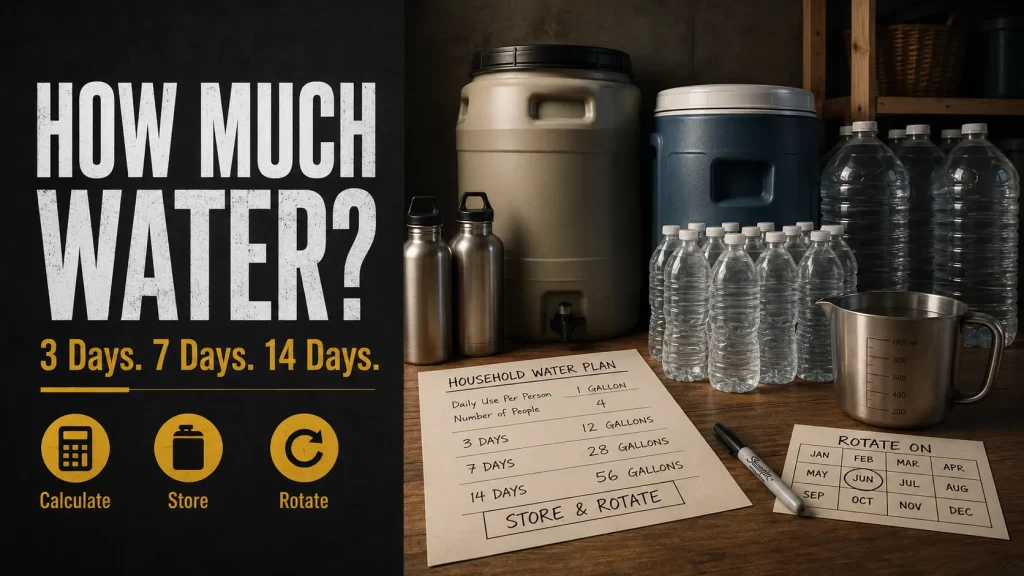
A household of four needs at least 12 gallons for three days. Stretch that same plan to a week and the number becomes 28 gallons. Two weeks means 56 gallons, which is suddenly a serious amount of water to store, move, protect, and actually use.
A few cases of bottled water can look substantial on a shelf, yet disappear quickly once the tap stops and the same supply must cover drinking, simple meals, brushing teeth, medication, and a little sanitation.
The CDC recommends at least one gallon per person per day for three days and suggests building toward a two-week supply when possible. It advises storing more for hot weather, illness, pregnancy, and pets. I treat that gallon as a planning baseline, not a promise that every household will be comfortable on exactly that amount.
Start With the Basic Water Formula
Use this calculation first:
**Number of people × number of days × one gallon = minimum stored water**
That gives you a clean starting number.
| Household size | 3-day minimum | 7-day supply | 14-day supply |
|---|---|---|---|
| 1 person | 3 gallons | 7 gallons | 14 gallons |
| 2 people | 6 gallons | 14 gallons | 28 gallons |
| 3 people | 9 gallons | 21 gallons | 42 gallons |
| 4 people | 12 gallons | 28 gallons | 56 gallons |
| 5 people | 15 gallons | 35 gallons | 70 gallons |
| 6 people | 18 gallons | 42 gallons | 84 gallons |
I prefer calculating the number before buying containers. Otherwise, it is easy to buy a few convenient jugs, feel finished, and discover later that the household has less than two days of usable water.
For a four-person household, a three-day minimum is manageable. A two-week supply weighs hundreds of pounds and takes real space. It may need to be divided between smaller containers, several storage locations, and commercially bottled water rather than placed in one enormous container that nobody can move.
A good household water storage plan has to match the home, not an idealized storage room that does not exist.
The One-Gallon Rule Is a Minimum
One gallon per person per day is intended to support drinking and basic household uses during a short emergency. Normal household water use is far higher. Showers, laundry, dishwashing, and ordinary toilet flushing can consume more water than most people realize.
Emergency storage assumes you will sharply reduce those activities.
That means the plan only works if the household understands the difference between potable water and utility water. Drinking, food preparation, brushing teeth, and taking medication require your safest water. Toilet flushing and some cleaning tasks may be handled with non-potable water when local guidance says it is safe to do so.
Do not casually move water from one category to another. Floodwater, pool water, or water with fuel, chemical, or sewage contamination is not made safe simply by boiling it. The EPA notes that boiling and disinfection kill many disease-causing microorganisms, but they do not remove heavy metals, salts, or most chemicals.
Stored drinking water protects you from having to make those decisions while tired and under pressure.
Add Water for the People Who Need More
The simple formula changes when the household includes anyone whose needs are higher than average.
Plan extra water for:
- Pregnant or nursing household members
- Babies and young children
- Anyone who is sick, feverish, vomiting, or experiencing diarrhea
- People taking medications that increase fluid needs
- Older adults who may not recognize thirst quickly
- Anyone working outside or doing heavy physical work
- Hot or unusually dry weather
- Pets and service animals
Pet water should be calculated separately. A small cat and a large dog do not have the same needs, and dry food can increase water use. Your veterinarian is the best source for an animal with medical concerns, but every pet plan should include drinking water, a bowl, and enough extra for spills.
I also add a modest margin for ordinary mistakes. A cap gets dropped. A bottle leaks. Someone pours too much into a pot. The dog knocks over a bowl. A plan that only works when every ounce is handled perfectly is a brittle plan.
Ten to twenty percent above the calculated baseline is a reasonable household buffer when storage space allows it. That is not an official universal requirement. It is practical room for the small losses that happen in real homes.
Three Days, One Week, or Two Weeks?
Three days is the minimum starting point. It is far better than having nothing, and it covers many brief outages, water-main failures, and boil-water situations.
A seven-day supply is a stronger household target. It gives local repairs, road access, and distribution systems more time to recover. It also reduces the pressure to leave home or compete for bottled water immediately.
Two weeks is the more durable goal recommended by the CDC when possible. Many households cannot store that amount all at once, especially in apartments or homes without basements. That is not a reason to do nothing.
Build it in layers:
- Reach three days.
- Expand to seven days.
- Add water until you reach 14 days or the safest practical limit for your home.
- Keep a treatment method as backup, not as a substitute for stored water.
A filter does not create water. It only treats water that is available and within the filter’s capabilities. Chemical contamination may also remain after ordinary filtering or disinfection. Stored water buys time while you learn what happened to the local supply and wait for reliable instructions.
For a deeper backup plan, review the differences among water purification methods before an emergency forces you to choose one quickly.
Storage Space Changes the Plan
Water weighs about 8.3 pounds per gallon. Fifty-six gallons—the two-week baseline for four people—weighs roughly 465 pounds before counting the containers.
Do not place that load on a weak shelf. Do not stack containers in a way that can fall, split, or block an exit. Spread the weight, keep the water away from gasoline and pesticides, and protect it from direct sunlight and extreme heat.
Smaller containers are easier to carry and ration. Larger containers use space efficiently but may become nearly useless if the pump, spigot, or lid fails. I like a mixed approach: some sealed bottled water, several manageable food-grade containers, and no single point of failure.
The CDC says commercially bottled water is the safest and most reliable emergency option. For water you fill yourself, use food-grade containers with tight lids, label the date, and replace the water every six months. Never reuse a container that previously held toxic chemicals.
Use the household water storage checklist to inspect dates, lids, leaks, locations, and rotation without trying to remember every detail.
A Four-Person Household Example
Consider two adults and two children preparing for a seven-day interruption.
The baseline calculation is:
**4 people × 7 days × 1 gallon = 28 gallons**
They also have a medium-sized dog. They add seven gallons for the dog and five gallons as a spill, heat, and cooking margin. Their working target becomes 40 gallons.
They do not store all 40 gallons in one barrel. They keep commercially bottled water in two locations, use several food-grade containers that one adult can move, and keep the oldest dated containers where they will be rotated first.
During the interruption, they reserve their safest water for drinking, simple food preparation, medication, and teeth brushing. They use paper plates for a few meals, postpone laundry, and collect suitable non-potable water for limited cleaning or toilet use where appropriate.
The important part is that the household calculated its needs before the emergency and decided how the water would be used. That removes a lot of guesswork.
Signals Most People Ignore
A water emergency does not always begin with a completely dry faucet. Often there are warnings:
- Utility crews working repeatedly on nearby mains
- A sudden pressure drop
- Discolored water or an unusual odor
- A boil-water notice in a neighboring area
- Severe weather expected to cause flooding or power loss
- A well system dependent on electric power
- Local reports of contamination, broken mains, or treatment-plant problems
- Stores selling out of bottled water before conditions become severe
A pressure change or odd color does not tell you exactly what is wrong. It tells you to stop assuming normal conditions. Check official local notices, preserve the clean water you already have, and avoid consuming questionable water until you know the cause.
When a storm or planned utility shutdown is approaching, fill clean containers early. Do not wait until the water has stopped or an advisory has already been issued.
Test the Number Before You Trust It
Write down your calculated target, then compare it with what is actually stored.
Count gallons, not containers. A shelf with 24 small bottles may hold less than four gallons. That can look like a lot of water and still be less than one day for a family of four.
Then run a simple one-day test. Without creating hardship, track how much drinking and cooking water the household uses when everyone knows the supply is limited. Include pets. You will see where water disappears and whether your assumptions were too tight.
This is also a useful companion to a broader 72-hour emergency supplies checklist, because water affects food preparation, medication, hygiene, and nearly every other part of a short-term household plan.
The first target does not need to be impressive. It needs to be counted, safe, and available.
Key Takeaways
- Store at least one gallon per person per day as the starting emergency baseline.
- Begin with three days, work toward seven days, and try to reach two weeks when space and budget allow.
- Add water for heat, illness, pregnancy, young children, pets, and physical work.
- Separate drinking water from water intended only for sanitation or utility use.
- Store water in more than one manageable container and avoid one point of failure.
- Use food-grade containers, label dates, and rotate home-filled water every six months.
- Keep purification tools as backups; they do not replace a known supply of safe stored water.
Step-by-Step Actions
- Count every person and pet included in the household water plan.
- Choose an initial duration of three, seven, or 14 days.
- Multiply the number of people by the number of days and one gallon.
- Calculate pet water separately.
- Add extra water for heat, illness, pregnancy, nursing, medication needs, and likely spills.
- Count the gallons currently stored rather than counting bottles or containers.
- Inspect container type, lids, dates, weight, and storage location.
- Divide the supply so one leak or damaged area cannot ruin all of it.
- Label home-filled containers and set a six-month rotation date.
- Run a one-day household water-use test and adjust the target.
Checklist
- [ ] Household members counted
- [ ] Pets and service animals included
- [ ] Three-day minimum calculated
- [ ] Seven-day target calculated
- [ ] Two-week target considered
- [ ] Extra medical and climate needs included
- [ ] Current stored gallons counted
- [ ] Food-grade containers confirmed
- [ ] Commercially bottled water dates checked
- [ ] Home-filled containers dated
- [ ] Six-month rotation scheduled
- [ ] Water stored away from sunlight and chemicals
- [ ] Container weight safely supported
- [ ] Supply divided between manageable containers
- [ ] Drinking water protected from sanitation use
- [ ] Backup treatment method understood