Household Water Storage Checklist: What to Store Before the Tap Stops
Water problems get serious faster than most household problems.
Power can go out and people still improvise for a while. Internet can fail and life becomes annoying. Water disruptions are different. The moment tap access becomes uncertain, the margin shrinks fast.
That is why a household water storage checklist matters. It keeps the subject practical. Not dramatic. Just practical enough that your home is not depending entirely on a system that may not cooperate when you need it most.
Household Water Storage Basics
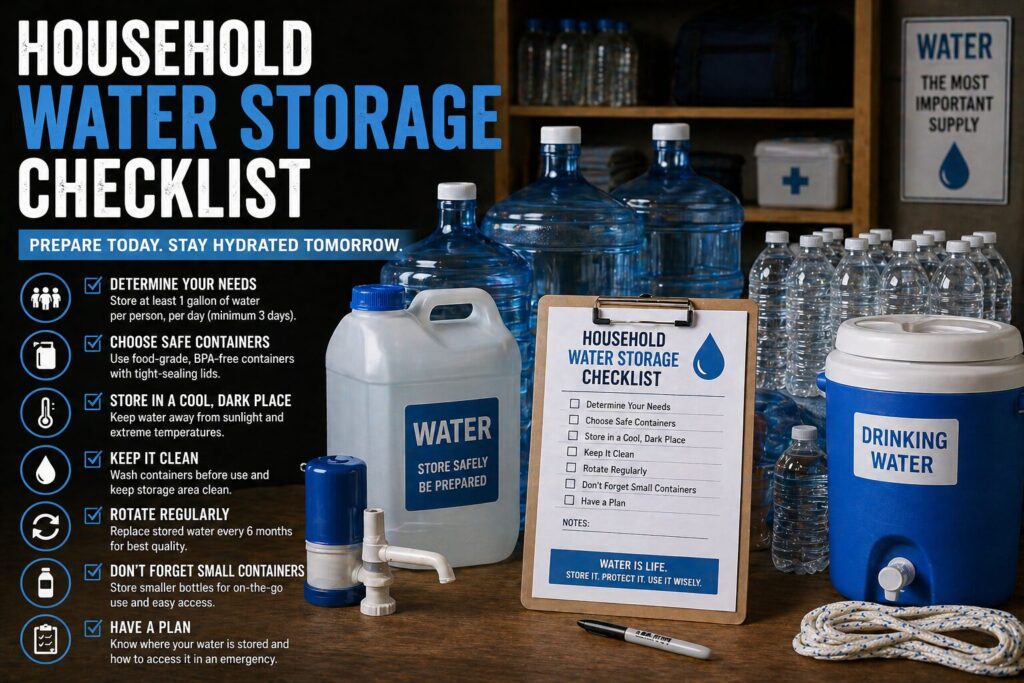
- Store drinking water before you need it, not during the outage.
- Use clean, sealable containers that are actually manageable to lift and move.
- Spread water across more than one container instead of relying on one giant point of failure.
- Keep some water in easy-access daily-use sizes, not only large storage sizes.
- Store water where temperature swings, contamination, and accidental damage are less likely.
- Label stored water so rotation and purpose stay clear.
The goal is not to build a bunker. The goal is to avoid becoming immediately fragile when the tap becomes uncertain.
Checklist: What to Store
- Dedicated drinking water containers
- Smaller grab-and-pour containers for daily use during an outage
- Extra water for pets
- Extra water for basic hygiene where practical
- Backup containers in case one fails or becomes contaminated
- One written note of how much water the household is actually trying to keep on hand
That last one helps more than people think. A household that says “we store water” often has not really decided what that means in measurable terms.
Container Rules That Matter
- Choose containers meant for water storage or food-safe reuse where appropriate.
- Avoid relying on damaged, cracked, or questionable containers.
- Keep lids secure and matched to the right container.
- Do not make every container so large that only one strong person in the household can move it.
- Think about where the water has to travel if the power is out, especially in apartments or multi-story homes.
Storage is not just volume. It is usability under less-than-ideal conditions.
During an Outage or Water Alert
- Fill additional safe containers early if service is still running.
- Separate water meant for drinking from water meant for other household tasks if supplies are tight.
- Use the oldest stored water first if rotation has been maintained properly.
- Keep containers clean while dispensing instead of dipping random cups and hands into them.
- Pay attention to official boil-water or contamination notices before assuming tap restoration means safe use.
Water problems are often not just quantity problems. They become quality problems too.
Quick Household Water Storage Checklist
- Stored drinking water already in place
- Containers in practical sizes
- Pet water considered
- Basic hygiene water considered
- Containers labeled
- Storage area protected from contamination and damage
- Rotation habit in place
- Backup plan for purification or additional water from options like rainwater collection if disruption lasts longer
A good water storage setup does not have to look impressive. It just has to work before, during, and after the kind of interruption that makes everyone else suddenly wish they had thought about it sooner.