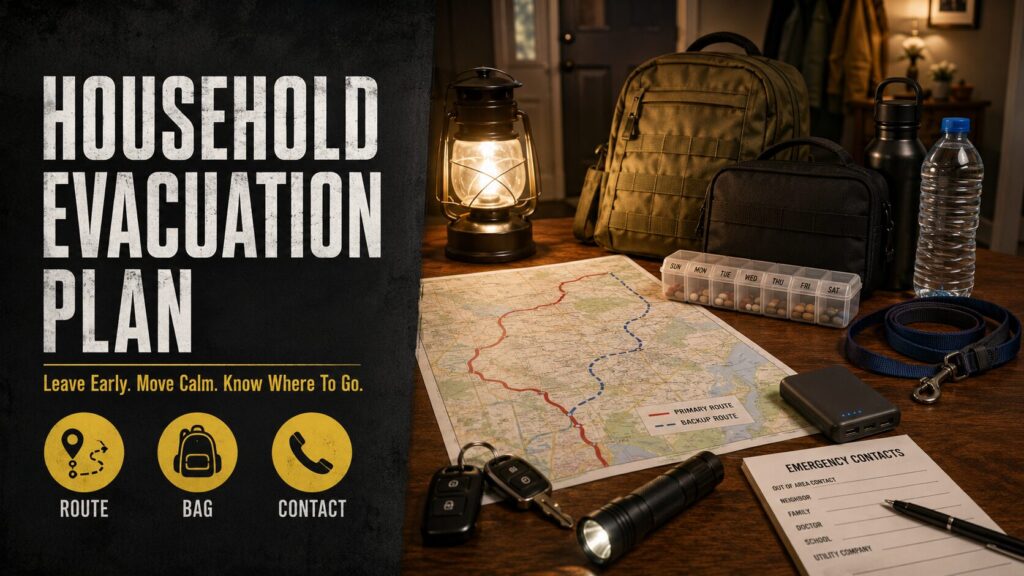
Most people picture evacuation as a dramatic thing. Sirens, smoke in the distance, somebody throwing bags into a vehicle, everybody moving fast. That can happen, sure. But the household evacuations that go well usually look less exciting than that. They look like a family that already knows where the car keys are, who grabs the medication, which neighbor may need a knock on the door, and which road they will try first if the main road is jammed.
That is the part I care about. Not the fantasy version. The workable version.
I have noticed that families often prepare for emergencies in pieces. They buy a flashlight. They keep water in the house. Maybe there is a bag in a closet with batteries and a first aid kit. That is not bad. It is just incomplete. Evacuation is a system problem. The house, people, vehicle, roads, phones, pets, money, weather, and warning all have to line up well enough.
A good evacuation plan does not make you fearless. It just gives you fewer decisions to make when your thinking is already getting crowded.
Leave Earlier Than Pride Wants You To
The hardest part of evacuation is usually not packing. It is deciding.
People wait because they do not want to overreact. They want one more update. They want to see whether the storm turns, whether the fire line slows, whether the water stops rising, whether officials change the wording. I understand that. Nobody wants to leave home for no reason.
But the cost of leaving early is usually inconvenience. The cost of leaving late can be bad timing, fuel shortages, closed roads, tired kids, stressed pets, and a line of cars full of other people who waited for the same final proof.
That is why I like decision points written down before anything happens. Not vague ones like “we leave if it gets bad.”
- If local officials issue an evacuation order for our zone, we leave.
- If water reaches the bottom step, we leave.
- If smoke is visible from the neighborhood and the wind is moving toward us, we leave.
- If one adult feels the window to leave safely is shrinking, we leave instead of debating for another hour.
That last one matters. A household needs a rule that protects the person who notices trouble first. In many families, one person sees the pattern before the rest of the room is ready to admit it. Do not punish that person for being early.
A written family emergency plan helps here because it turns the argument into a checklist. Not perfectly. Families still act like families. But a plan gives you something outside the emotion of the moment.
Routes Are Not Just Roads
A route is not only a line on a map. It is a fuel situation, a bridge, a low spot that floods, a traffic light that may not work, a school pickup, a pet-friendly destination, and a backup road that half the town may also try.
I like households to choose at least three destination layers.
The first is close: a friend, relative, hotel area, or public shelter option outside the immediate danger zone. The second is farther out, beyond the obvious traffic pattern. The third is a longer-distance option for wider trouble.
Now, that does not mean you need a military-style route book. Keep it simple. Print or write down the primary road, the alternate road, and the road you would avoid unless you have no other choice. Mark fuel stops that are usually reliable. Mark low crossings, bridges, and choke points. Pay attention to the local places that become problems first.
Phones are useful until they are not. Batteries die. Cell networks get overloaded. Apps send everyone onto the same “fastest” route, which stops being fast once everyone follows it. A paper map in the vehicle still earns its place.
This is also where the vehicle matters. You need enough fuel, decent tires, cash, chargers, and the boring things people ignore until the dashboard light comes on. A simple car emergency kit checklist is not glamorous, but it can keep a small delay from becoming the whole problem.
The Bag Is Not the Plan
I like go bags. I keep them practical. But a bag is not an evacuation plan, and people confuse the two.
A bag helps you move. The plan tells you when, where, and how to move.
For a household, I would rather see modest bags that people can actually lift than giant adventure sacks full of gear nobody has touched in two years. Each adult should have personal basics. Kids should have comfort items and simple clothing. Pets need food, leash, carrier, bowls, medication if needed, and proof of vaccines if you may end up at a hotel or shelter.
Put documents where you can grab them quickly. Copies of IDs, insurance information, medication lists, emergency contacts, and a little cash belong together. Not scattered in five drawers. The same goes for chargers and power banks. I have seen people own three power banks and still leave with none because they were all sitting in different rooms, half charged.
Supplies should cover the first rough stretch, not every possible future. Water, snacks, medications, light, hygiene, warm layers, and basic first aid. The 72-hour emergency supplies checklist is a useful baseline, but do not treat it like a shopping shrine. Adjust it to your real household. A baby, an elderly parent, insulin, mobility limits, pets, and winter weather all change the list.
One more thing: keep shoes where people can find them. It sounds too small to mention until you are trying to get everyone out at 2 a.m. and somebody is barefoot.
Communication Gets Weird Fast
Household evacuation planning is partly about communication, and communication fails in ordinary ways first.
Somebody misses a call. A text sits unsent. One person assumes another person has the child, the dog, the medication, or the folder. A relative three towns away hears a rumor and starts calling everybody. The group chat becomes noise.
Write down who contacts whom. Pick an out-of-area contact if possible, because local lines may be busier than distant ones. Decide what message means “we are leaving,” what message means “we arrived,” and what message means “go to the backup destination.” Keep it plain.
A printed family emergency communication plan template helps because it makes the plan visible to someone who is tired, worried, or dealing with kids in the back seat. I like visible plans. They reduce the number of things living only in one person’s head.
Do not rely on memory for phone numbers either. Most of us stopped memorizing them years ago. Put numbers on paper. Put a copy in each vehicle. Put one in the main bag.
Signals Most People Ignore
Evacuations rarely begin at the front door. They begin with weak signals.
The weather report changes tone. Local officials start using firmer wording. Schools cancel before businesses do. Gas stations get busier than normal. Shelves thin out in the same few categories. Neighbors who usually stay calm start loading cars. Traffic patterns shift. A road you use every week suddenly has standing water. The sky looks wrong. The wind changes.
None of those signals means panic. Panic is usually what happens when people ignore signals until the choices get narrow.
I pay attention to friction. If normal tasks suddenly take longer, that matters. If fuel lines are forming, if evacuation routes already show slow traffic, if a family member is sick, if nightfall is coming, if the weather is worsening, the safe window may be smaller than it looks.
Households should talk about signals before they matter. Ask, “What would make us leave earlier than our neighbors?” That is a good question. It does not need a dramatic answer. Sometimes the answer is, “Grandma moves slowly, and we do not want to load the car in heavy rain.” That is enough.
Practice the Annoying Parts
You do not need to rehearse an evacuation like a movie scene. But you should test the parts that usually snag.
Can everyone find the bags? Does the pet carrier still fit the pet? Are the printed numbers current? Does the power bank hold a charge? Does the vehicle have enough fuel most of the time? Do the kids know which adult to listen to if things get tense? Does anyone need help carrying items down stairs?
Try a ten-minute load test some weekend. Put the bags near the door, gather the documents, get the pet gear, and see what feels clumsy. You will learn something. People always do.
Maybe the bag is too heavy. Maybe the flashlight has old batteries. Maybe the folder is missing the insurance card. Maybe the route assumes a bridge that floods. Good. Better to find that out while nothing is happening.
Evacuation planning is not about living afraid. It is about removing small uncertainties before they stack up.
Key Takeaways
- A household evacuation plan works best when the decision to leave is written down before stress hits.
- Routes should include backup destinations, fuel awareness, paper maps, and known local choke points.
- Go bags support the plan, but they do not replace the plan.
- Communication should be written, simple, and shared across the household.
- Early warning signals matter because they show when the safe window may be shrinking.
- Practicing the awkward parts reveals weak spots while there is still time to fix them.
Step-by-Step Actions
- Choose your household evacuation triggers and write them in plain language.
- Pick three destination layers: close, farther out, and long-distance.
- Map one primary route and at least two backup routes.
- Prepare modest go bags that each person can actually carry.
- Gather essential documents, medication lists, cash, and contact numbers in one place.
- Build a simple communication plan with an out-of-area contact when possible.
- Keep the vehicle at a practical fuel level and maintain a basic car kit.
- Include pets, kids, elderly relatives, and medical needs in the plan.
- Review weak signals that would make your household leave early.
- Do a short load test and fix the clumsy parts you discover.
Checklist
- Written evacuation triggers
- Primary and backup destinations
- Primary and backup routes
- Paper map in the vehicle
- Vehicle fuel habit established
- Go bags ready and liftable
- Water, snacks, lights, chargers, and hygiene supplies
- Medications and medical notes gathered
- ID, insurance, and key documents copied
- Pet food, carrier, leash, and records ready
- Emergency contacts printed
- Out-of-area contact chosen
- Family communication plan shared
- Shoes, keys, wallets, and glasses easy to find
- Seasonal clothing considered
- Ten-minute household load test completed