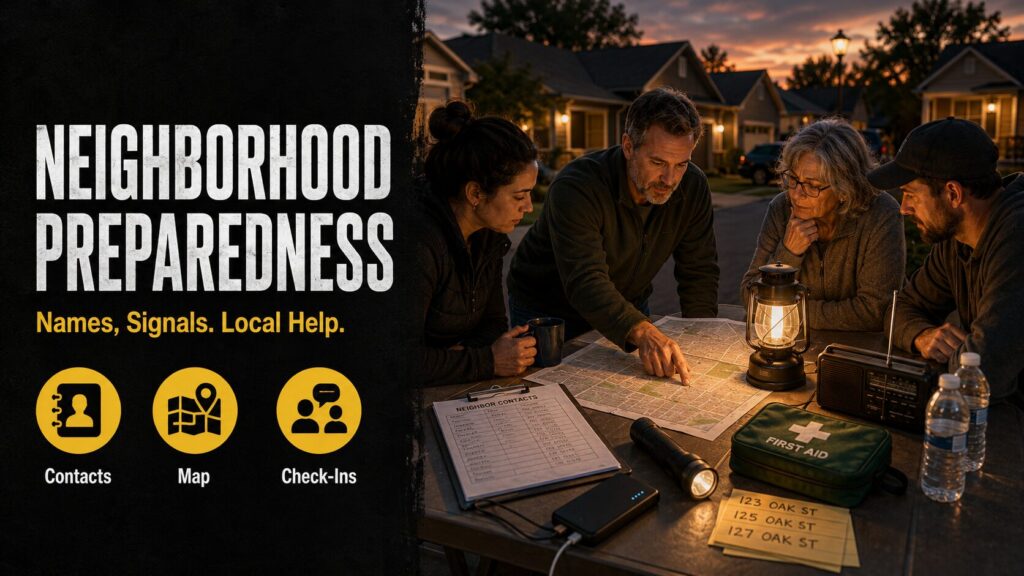
A prepared neighborhood does not have to look dramatic. Most of the useful work is almost boring.
People know who lives nearby. They know which house has an elderly couple, which family has a newborn, who owns a chainsaw, who has medical training, who works nights, who may not hear a warning, and who is likely to be out of town half the week. They know the street names without looking at a phone. They know which intersection floods first. They know who will answer the door and who probably will not.
That sounds simple. It is simple. It is also the part many people skip.
Most household preparedness happens behind closed doors. Food, water, flashlights, radios, documents, batteries. Good. I like that. But emergencies do not always respect property lines. A long power outage, a storm, a water problem, a wildfire evacuation, a road closure, even a missing child in the neighborhood — these are local problems before they become official problems. The first useful information often comes from someone close enough to look out a window.
That is why neighborhood preparedness matters. Not because you need to turn your street into a formal organization. You just need a little trust, a little contact, and a few habits that make confusion smaller.
Start With Names, Not Gear
The first neighborhood preparedness tool is not a radio. It is knowing names.
That may sound too soft for a survival topic, but I do not think it is soft at all. If you do not know the person two houses down, you are less likely to knock when smoke is moving behind the tree line. You are less likely to ask whether they have seen the missing dog, heard the transformer blow, or noticed water rising in the ditch. You are more likely to sit alone with partial information.
A useful neighborhood does not require everyone to be best friends. That is unrealistic. Some people are private. Some are busy. Some are just not going to participate much. Fine. The goal is not friendship. The goal is enough familiarity that people can act quickly without feeling strange about it.
A simple contact sheet can help. Names, phone numbers, house numbers, pets, medical concerns people are comfortable sharing, and a note about who may need extra help. Keep it voluntary. Nobody should feel interrogated. A neighborhood contact sheet is not a government form. It is a practical tool for ordinary people trying to keep the first hour from becoming messy.
Your own family emergency plan still comes first. A neighborhood plan should support the household plan, not replace it. If your own family does not know where to meet or who picks up the kids, adding neighbors to the picture will not fix that.
The Street Has Its Own Weak Points
Every neighborhood has patterns. The trick is noticing them before the day you need them.
Maybe one road in washes out in heavy rain. Maybe the dead-end street fills with cars when the main road closes. Maybe the storm drain near the corner backs up. Maybe cell service gets poor on one side of the hill. Maybe the most direct route to the hospital crosses railroad tracks or a bridge that becomes a choke point.
People who live there usually know these things in pieces. One neighbor knows about the drainage problem. Another knows the back road. Someone else remembers the last ice storm. The useful work is putting those pieces together.
I like a plain street map for this. Not fancy. Mark the homes of people who volunteered contact information. Mark shutoff locations if they are known and safe to mark. Mark places where water gathers, trees drop limbs, traffic jams, or emergency vehicles may have trouble turning around. Mark who has a generator, not so everyone can borrow power, but so people understand where noise, fuel, cords, and carbon monoxide risks may appear during an outage.
This is where city infrastructure dependencies become local and visible. It is one thing to know that water, power, fuel, roads, and communications are connected. It is another thing to know how those dependencies show up on your actual street.
And now, maybe abruptly, I will say the part people do not love: the weakest point is often coordination. Not supplies. Coordination.
One person assumes someone else checked on the older man at the end of the road. One family thinks the road is open because it was open an hour ago. Someone posts a rumor in a group text and everyone starts reacting to it. Little confusion spreads fast when nobody knows who knows what.
Keep Communication Small and Clear
A neighborhood communication plan should be boring enough that people will actually use it.
One group text can work for small streets, but it needs rules. Emergency information only during a real event. No arguments. No politics. No selling things. No thirty-message side debates while someone is trying to find out whether the main road is passable. A group text can become useless if it turns into noise.
For larger neighborhoods, break it into smaller clusters. Five to ten homes is often easier than trying to keep thirty homes aligned. Each cluster has one or two people who can share confirmed information with the next cluster. Not commanders. Just contact points.
The most useful messages are short:
- Power is out on Maple Street from house 12 to house 28.
- Oak Road is flooded near the culvert.
- Smith family has left for the community shelter.
- Ambulance access is clear from the east entrance.
- Please check on house 17 if you are nearby.
That kind of information helps. Long emotional messages usually do not.
A printed family emergency communication plan template can also be adapted for a small neighborhood contact sheet. The same idea applies: names, roles, backup contacts, and plain messages that do not require everyone to think creatively under stress.
You also need a non-phone option. It could be as simple as a front-window sign, a porch light pattern, a door hanger, or a prearranged meeting spot after a storm passes. Radios may help in some neighborhoods, but do not build a plan around gear nobody practices with. A plan that depends on a device sitting in a drawer is mostly wishful thinking.
Know Who May Need Help Early
This is where neighborhood preparedness becomes very real.
Some people need more time. Elderly residents. People with mobility problems. Families with young children. People who rely on powered medical equipment. People who do not drive. People with pets they cannot load quickly. People who may not speak the same first language as everyone else. The list is not complicated, but it is easy to miss if nobody asks.
The respectful way to handle this is simple: ask people what they want neighbors to know during an emergency. Let them choose. Some may share details. Some may only say, “If the power is out more than a few hours, please knock.” That is enough.
I would rather know one practical thing than collect a bunch of private information nobody needs.
A neighborhood can also make small agreements ahead of time. Who can help move a trash can out of a flooded gutter? Who can give a ride if evacuation is ordered? Who can check on the house with two dogs if the owner is at work? Who has a battery radio and is willing to share official updates at the corner after a storm?
This does not have to become a formal volunteer program. In fact, if you make it too formal, people may avoid it. Keep it human.
Shared Supplies Should Be Modest
I am cautious about shared neighborhood supplies. They sound good, but they can create arguments if expectations are not clear.
A better approach is household-first, then neighborhood support. Each home keeps its own basics. Water, food, lights, first aid, medication, sanitation supplies, chargers, and warm clothing. The 72-hour emergency supplies checklist is a good baseline because it keeps the focus on the first stretch of disruption, not fantasy scenarios.
After that, neighbors can identify useful shared resources without pretending everything belongs to everyone. Tools, tarps, extension cords, ladders, saws, battery chargers, radios, sandbags, snow shovels, wagons, coolers. Make a list of who is willing to help with what. Do not assume.
Fuel and generators deserve special caution. Generator use can create carbon monoxide danger, fire risk, noise problems, and conflict over cords. If your neighborhood talks about generators, talk about safety first. Outside only. Away from windows. No backfeeding into a house without proper equipment. No indoor grills. No running engines in garages.
That advice feels repetitive until someone gets it wrong.
The Best Drill Is a Conversation
You do not need a dramatic neighborhood exercise. Start smaller.
Have one short meeting or driveway conversation. Ask three questions:
What usually fails first around here?
Who may need a check-in?
How would we share confirmed information?
That alone is useful. It reveals more than people expect.
Then do one simple practice. Update the contact sheet. Walk the street and identify the weak points. Test the group text with a non-emergency message. Pick the meeting spot. Ask who has a battery radio. Decide which homes will check on which homes after a major storm if it is safe to go outside.
Preparedness often grows better through ordinary repetition than big plans. A street that talks twice a year will usually do better than a street with a perfect document nobody remembers.
And if participation is low, do not quit. Start with two or three households. That is still something. A small reliable circle beats a large imaginary one.
Signals Most People Ignore
Neighborhood problems usually show themselves early.
A drain that always struggles before the road floods. A neighbor who stops answering calls during outages. A tree that drops limbs every storm. A gas station line forming before the warning gets serious. A family loading the car quietly. The usual shortcut suddenly full of traffic. Utility trucks staged nearby. A local official changing from casual language to firmer wording.
Those signals do not mean panic. They mean pay attention.
The mistake is waiting until every signal is obvious. By then, everyone else is seeing it too. The value of neighborhood awareness is that it gives you local information earlier than public updates sometimes can. Not better than official information. Earlier and closer.
A good neighborhood does not replace emergency services. It fills the gap before they arrive, and sometimes it simply gives them a clearer path when they do.
Key Takeaways
- Neighborhood preparedness starts with names, contact, and trust, not gear.
- A useful street map can show weak points, contact points, and local hazards.
- Communication should be short, confirmed, and kept free of noise during real events.
- People who need extra time or help should be identified respectfully before trouble starts.
- Shared resources work best when expectations are modest and voluntary.
- Small conversations and simple practice beat large plans that nobody uses.
Step-by-Step Actions
- List the households nearest to you and learn basic names where possible.
- Create a voluntary contact sheet for neighbors who want to participate.
- Mark local weak points such as flood spots, road choke points, and utility concerns
- Choose one simple communication method for urgent neighborhood updates.
- Identify residents who may want a check-in during outages, storms, or evacuations.
- Keep household supplies as the foundation before relying on shared help.
- Make a voluntary list of useful skills, tools, and equipment.
- Set one non-phone signal or meeting spot for situations where phones are unreliable.
- Hold a short seasonal conversation before storm, wildfire, winter, or hurricane risk periods.
- Review what worked after any real event and adjust while people still remember.
Checklist
- Nearby names and house numbers known
- Voluntary neighborhood contact sheet started
- Out-of-area or backup contact option discussed
- Local flood spots and road problems identified
- Communication method chosen
- Group-message rules agreed on
- Non-phone signal or meeting spot chosen
- Check-in list for vulnerable neighbors created
- Pet and mobility needs considered
- Useful tools and skills listed voluntarily
- Generator safety reminders shared where relevant
- Official information sources identified
- Seasonal risk conversation scheduled
- After-action notes captured after real disruptions
- Household plans kept as the foundation