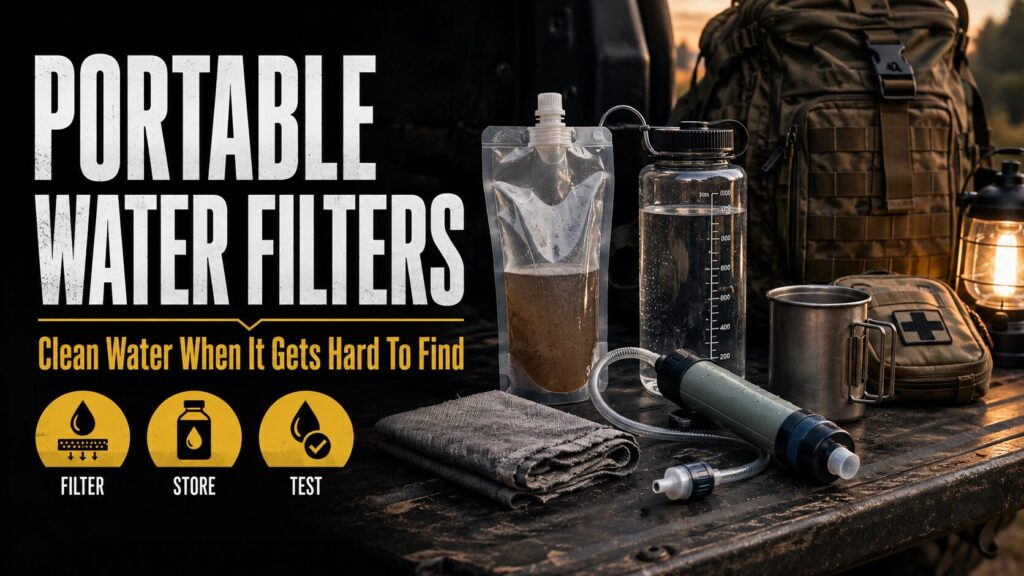
A portable water filter is one of those pieces of gear people like to buy and then forget about. It goes in a drawer, a backpack, maybe the glove box, and everybody feels a little better because they “have a filter.” I understand the appeal. Water is heavy, dirty water is dangerous, and a small filter feels like a shortcut through both problems.
But a filter is not magic. It is a tool with limits.
I’ve seen people treat water gear like a lucky charm. They buy the smallest straw-style filter they can find, never test it, never read the instructions, and assume it will solve every water problem from a muddy stream to a flooded basement. That is not how this works. A good filter can make a rough situation much safer. The wrong filter, or the right filter used badly, can give you false confidence at the exact moment you need clear judgment.
What a Portable Filter Is Really For
A portable water filter is mainly for making biological contamination less of a threat. In plain language, it is there to help remove things like sediment, bacteria, protozoa, and other small organisms depending on the filter design. Some filters also improve taste. Some include carbon that may reduce certain chemicals or odors. Some purifier-style units go farther.
The key word is depending.
Not every filter handles the same risks. A backpacking filter that works well for clear mountain water may not be the right tool for floodwater near a road, industrial runoff, or a questionable puddle behind a building. That does not make the filter bad. It just means you have to match the tool to the water source.
The first rule is simple: start with the cleanest water you can reasonably find. Clear moving water is usually better than stagnant water. Water collected before a storm is better than water collected after debris and fuel and sewage have moved through the neighborhood. Stored water you already rotated is better than water you are trying to rescue from a ditch.
That is why I like to think of filtration as one layer in a bigger water plan, not the whole plan. If you have not already read through basic water treatment thinking, the article on water purification methods is a good companion to this one.
The Main Types You’ll Actually See
Most people looking at portable water filters run into the same few styles.
Straw filters are the smallest and simplest. You drink through them directly from a bottle, bag, or water source. They are light, cheap, and easy to carry. The downside is that they are not great for filling pots, sharing water with a family, or storing clean water for later. They are personal-use tools.
Squeeze filters use a soft bag or bottle. You fill the dirty-water container, attach the filter, and squeeze clean water into another bottle or pot. I like this style for small kits because it gives you more control than a straw. You can filter water for cooking, washing a cut, or filling another person’s bottle.
Pump filters are more deliberate. They take more effort, but many are built well and can pull water from shallow sources more easily than a squeeze setup. The downside is weight, moving parts, and slower use when you are tired or cold.
Gravity filters are excellent when you are staying in one place for a while. Hang a dirty-water bag, let gravity do the work, and collect cleaner water below. They are not always the best for fast movement, but for a family, a campsite, or a house without working taps, they can be very practical.
Bottle filters are convenient because the filter is built into the bottle. They are good for travel bags and car kits. Just remember that the bottle capacity limits how much clean water you can produce at once.
There is no single best answer. A solo hiker and a family riding out a three-day outage at home do not need the same setup.
Why Flow Rate Matters More Than People Think
A filter can look great on paper and still be miserable to use if it barely moves water.
Flow rate matters because emergencies are tiring. Your hands may be cold. People may be thirsty. Kids do not wait politely while you squeeze a stubborn bag for twenty minutes. If a filter is slow when it is new, it will feel even slower after it starts to clog.
This is one reason I test filters before I need them. Not a big dramatic test. Just fill the dirty-water side with tap water and see how it handles. Learn how much pressure it takes. Learn how to backflush it if the design allows that. Learn whether the bags are annoying, whether the cap leaks, whether the threads fit your bottles.
That little bit of practice reveals things the product photo never shows.
I once watched someone struggle with a brand-new squeeze filter because the bag was too stiff, the opening was awkward, and he had never tried to fill it from shallow water. None of that was a disaster in the yard. In bad weather, after dark, it would have felt very different.
Signals Most People Ignore
Water trouble usually announces itself before it becomes obvious. The trouble is, people miss the early signs because the tap still works.
Pay attention when your area has repeated boil-water notices, construction near main lines, flooding in low neighborhoods, chemical spills on local roads, or a long power outage that affects pumping stations. Watch how stores look before a storm. If bottled water disappears quickly every time the forecast gets ugly, that tells you something about your community’s backup capacity.
At home, watch your own habits. If you have no stored water, no way to treat water, and no filter you have actually tested, you are depending on a very thin chain. The chain may hold most days. That is not the point. The point is what happens on the day it does not.
A portable filter gives you options, but it should sit beside stored water, not replace it. I would rather have a modest filter and a sane water storage habit than an expensive filter and empty shelves. If you need to tighten that part up, start with household water storage before you buy more gear.
What I Look For in a Filter
For a basic emergency kit, I want a filter that is simple, durable, and easy to clean in the field. Fancy is not the same as useful.
I look for these things:
- A clear statement of what the filter is designed to reduce
- A realistic flow rate
- A way to clean or backflush the filter
- Replacement parts or bags that are easy to get
- A design that works with common bottles or containers
- Instructions that are short enough to follow under stress
I also think about who will use it. A strong adult can squeeze a stiff pouch longer than a child or an older person. A pump may be fine for one person and annoying for another. A gravity setup may be perfect for a family but too bulky for a small go-bag.
For a household, I like redundancy. A gravity filter for the group, a squeeze filter for movement, and some stored water give you more room to adapt. That does not have to be expensive all at once. Build it in layers.
What Filters Do Not Solve
Filters do not make every water source safe. Chemical contamination is the big blind spot people overlook. Water near fuel, pesticides, heavy runoff, industrial sites, flood debris, or sewage backup needs more caution than a simple filter can provide.
Boiling is still useful for many biological threats, but boiling does not remove chemical contamination either. In some cases, boiling can make certain chemical problems worse by reducing water volume while leaving the contaminant behind. That is why source selection matters so much.
Also, filters can freeze. If a wet filter freezes, the internal fibers or element can be damaged, and you may not see the damage from the outside. In cold weather, keep the filter close to your body or in an insulated area once it has been used.
And filters clog. Silty water, algae, mud, and leaf debris shorten filter life quickly. Pre-filtering through cloth, letting sediment settle, or scooping from clearer water can help. It is not glamorous. It is just the kind of boring step that keeps gear working.
A Practical Setup That Makes Sense
For most people, I would start with three layers.
First, store water at home. That is the easiest water you will ever “filter,” because you do not have to find it during the problem. Even a few days of water changes your options.
Second, keep one portable filter in each serious emergency bag. A squeeze-style filter or bottle filter is usually more useful than a straw alone because it lets you make water for later.
Third, keep a larger home or camp option if you are preparing for family use. A gravity filter can quietly produce water while you handle other problems, and that matters when the whole household is tired.
A portable filter also belongs in a broader gear plan. It pairs naturally with containers, backup purification tablets, a metal pot, and a basic kit. If you are building from scratch, the article on essential survival gear can help you think through the wider setup without turning your closet into a gear museum.
Key Takeaways
A portable water filter is a valuable tool, but it is not a promise that every water source is safe.
The cleanest available source is still the best starting point.
Straw filters, squeeze filters, pump filters, bottle filters, and gravity filters all serve different needs.
Flow rate, cleaning method, and ease of use matter more than people expect.
Chemical contamination, freezing, clogging, and poor source selection are real limitations.
Step-by-Step Actions
- Check the filter you already own and read what it is actually designed to reduce.
- Test it with clean tap water so you understand flow rate, fit, and cleaning.
- Add a pre-filter cloth, clean container, and backup purification option to the same kit.
- Store water at home so filtration is a backup layer, not your only plan.
- Choose a second filter style if your household needs both personal carry and group water production.
Checklist
- Portable filter tested before an emergency
- Clean-water and dirty-water containers kept separate
- Backup purification method stored with the filter
- Filter protected from freezing after use
- Instructions kept with the filter
- Stored household water already in place
- Water source chosen carefully before filtering