Most people think they have an emergency contact system because every important number is saved in a phone. That works right up until the phone is dead, locked, missing, broken, or sitting in a pocket with no signal. Then the whole plan shrinks down to memory, luck, and whether somebody else knows what to do.
A real contact system is not complicated. It is a small set of written information, backup habits, and decision rules that help your household find each other when normal channels get weak. The goal is not to build a command center in your kitchen. The goal is to keep one bad afternoon from becoming a family-wide guessing game.
I have noticed that families often prepare food, water, flashlights, and batteries before they prepare information. That is backwards. During many household emergencies, the first problem is not hunger or darkness. It is uncertainty. Where is everyone? Who has the kids? Which road is open? Who already knows what happened?
If you already have a family emergency plan, this contact system is one of the pieces that makes that plan usable. If you do not have one yet, start here and build outward.
Why Phone Contacts Are Not Enough
Phones are convenient, but they create a bad habit: they let people stop remembering essential information. Many adults do not know a spouse’s number by memory. Many children do not know a parent’s work number. Some households do not know the school office number, the doctor’s office number, or the out-of-area relative everyone should call after a local disruption.
That weakness shows up fast. Cell towers can overload. Internet calling can disappear when the modem loses power. A cracked screen can make a phone useless even when the battery is full. A child may be separated from a parent without access to the family contact list. A driver may have a working car but no way to look up the number they need.
Your emergency contact system should assume three things:
- At least one phone may be unavailable.
- At least one person may be away from home.
- Messages may need to move through another person.
Once you accept those three facts, the solution becomes simple: write down the right information, put copies in the right places, and decide ahead of time who calls whom.
The Contact Sheet Is the Foundation
The heart of the system is a printed contact sheet. It should be boring, clear, and easy to read under stress. Do not make it clever. Do not hide it in an app. Make a paper version and put copies where people can reach them.
Your contact sheet should include:
- Each household member’s full name and phone number
- Work numbers, school numbers, and caregiver numbers
- One out-of-area contact who can relay messages
- Local emergency contacts such as a neighbor, nearby family member, or trusted friend
- Doctor, pharmacy, insurance, and veterinarian numbers if they matter to your household
- School pickup rules or emergency pickup names
- Home address and nearby cross streets
- Two meeting locations if the house is unsafe or inaccessible
Keep it to one or two pages. A contact sheet that takes ten minutes to understand will not be used well during pressure. Use large type, plain labels, and enough spacing that someone can read it in poor lighting.
I like paper for this job because paper does not need a charged battery, a remembered unlock code, a working screen, or cell service. A laminated copy is useful, but even a folded copy in a freezer bag is better than a perfect digital list nobody can open.
Pick an Out-of-Area Relay Contact
Local emergencies often hit local phone networks at the same time. A storm, blackout, evacuation, or regional incident can make local calls difficult while calls outside the area still work. That is why many families use an out-of-area contact as a message hub.
This person should live far enough away that the same local event is unlikely to affect them. They should be reliable, calm, and willing to receive short check-ins. Their job is not to solve your emergency. Their job is to collect simple messages and repeat them to the right people.
For example:
- “Dad is safe at work and will leave at 5:30.”
- “Mom and the kids are at the school pickup point.”
- “Grandma is staying with the neighbors tonight.”
- “Everyone should meet at Location B if roads are open.”
Write this person’s number on every contact sheet. Make sure every adult and older child knows the rule: if you cannot reach each other locally, call the out-of-area contact and leave one clear message.
Tell that person ahead of time. Do not surprise them during a storm. A good relay contact should know the names of household members, the basic meeting locations, and the kind of short messages you want them to take.
Build a Simple Call Order
During stress, people waste time deciding who to call first. A call order removes that friction.
A basic household call order might look like this:
- Try the person directly.
- Send a short text.
- Call the out-of-area relay contact.
- Call the local backup contact.
- Move to the agreed meeting point if communication fails.
Text messages often get through when voice calls fail, so teach everyone to send short, specific texts. Avoid long emotional paragraphs. Use simple messages:
- “SAFE – at school – waiting by front office.”
- “SAFE – at work – leaving in 20.”
- “NEED RIDE – library entrance.”
- “GOING HOME – Main St closed.”
This is where a broader emergency communication plan becomes useful. The contact sheet tells people who to reach. The communication plan tells them what to do when normal channels fail.
Create Meeting Points That Match Real Life
Contact systems are not just about calling. They are also about knowing where to go when calling does not work.
Use at least two meeting points:
- **Location A:** near the home, such as a neighbor’s house, mailbox cluster, corner, or nearby landmark.
- **Location B:** outside the immediate neighborhood, such as a library, school, church, workplace, or relative’s house.
Write both locations on the contact sheet. Include the address, not just the name. Children should know what the place looks like and who they are allowed to go with.
Do not choose locations that depend on wishful thinking. A meeting point across a bridge, through a flood-prone road, or behind a locked building may fail when you need it. Pick places that are realistic for walking, driving, or being picked up.
I have seen people choose meeting spots because they sound good on paper. Then you ask one question — “Can your youngest child actually get there from school?” — and the plan falls apart. A good meeting place is not impressive. It is reachable.
Signals Most People Ignore
An emergency contact system should not only help after things break. It should help you notice when communication trouble is likely.
Watch for these early warning signs:
- A storm forecast that includes heavy wind, ice, flooding, or long outage potential
- Local cell service becoming slow during a crowded event, emergency scene, or evacuation
- School, workplace, or town alerts mentioning early dismissal or road closures
- A phone battery below 30 percent when you still need to travel
- A household member leaving without a charger, contact card, or clear destination
- A caregiver, school, or workplace changing pickup rules without everyone knowing
- Local roads becoming closed, flooded, or heavily congested
These signals matter because communication systems usually weaken before they disappear. The family that notices early can charge phones, confirm pickup plans, print a fresh contact sheet, and remind everyone of the out-of-area number before the situation gets messy.
Preparedness is often less dramatic than people imagine. It is noticing a weak signal early and doing the small thing before the small thing becomes expensive.
Make It Work for Children
Children need a version they can actually use. A full adult contact sheet may be too much for a young child, but a small card can work well.
For younger children, create a simple card with:
- Child’s name
- Parent or guardian names
- Primary phone number
- Backup phone number
- Out-of-area contact
- Home address
- One safe adult or pickup person
Put the card in a backpack or school folder. Review it without making it scary. The lesson is simple: “If you cannot reach us, show this to a teacher, police officer, firefighter, nurse, or trusted adult at the front office.”
Older children can learn more. They should know the out-of-area contact rule, the meeting locations, and how to send short texts. They should also know that battery conservation matters. A phone used for games during a blackout may not be available when it is time to call for help.
Put Contact Information in the Right Places
A good system is duplicated. One copy is not a system.
Put contact information in:
- Wallets
- Purses
- Backpacks
- Glove boxes
- Go-bags
- Home binder or refrigerator area
- Work bag or laptop bag
- First aid kit or household emergency binder
This also fits naturally with a 72-hour emergency supplies checklist. Food, water, light, and batteries matter, but information is also emergency gear. A printed contact sheet weighs almost nothing and can solve problems that money cannot solve during a local disruption.
Keep a Small Communication Backup Kit
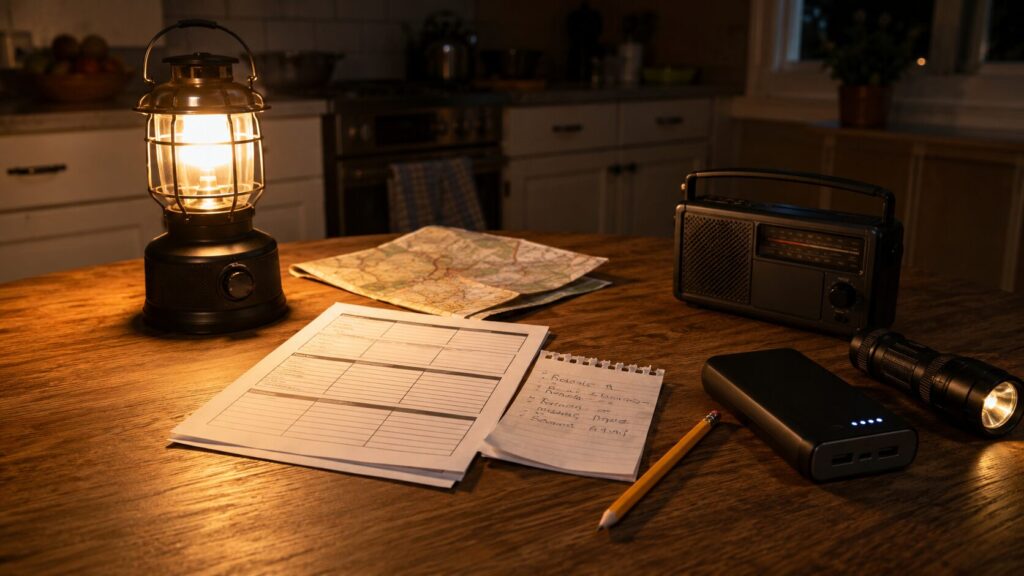
The contact sheet is paper. The communication backup kit is the hardware that helps you use the information.
A practical kit can include:
- Spare charging cable
- Wall charger
- Car charger
- Charged power bank
- Small notebook
- Pencil or waterproof pen
- Printed maps of your immediate area
- Copy of the contact sheet
- Battery radio if you already use one
Do not overcomplicate this. The most important part is that the power bank is actually charged and the printed information is actually current. A fancy emergency radio does not fix an outdated phone number.
I would rather see a family maintain one charged power bank and one accurate contact sheet than buy a closet full of gear they never check. The simple things work when they are kept ready.
Review It on a Schedule
Most contact systems fail because nobody updates them. People change jobs. Children change schools. Doctors move offices. Phone numbers change. Neighbors move away. A plan from three years ago may be worse than no plan because it creates false confidence.
Review your contact system every six months. A good rhythm is spring and fall. Check every number. Confirm the out-of-area contact is still willing. Update school pickup names. Replace damaged paper copies. Recharge power banks.
Also review it after any major life change:
- New job
- New school
- New address
- New medical need
- New caregiver
- New vehicle
- New phone number
This review does not need to take all afternoon. Fifteen focused minutes twice a year is enough for most households.
Avoid the Common Mistakes
The most common mistake is making the system too complicated. A thick binder full of tabs may feel impressive, but the person who needs it during an emergency may only need one page.
Other mistakes include:
- Keeping the only copy on a phone
- Forgetting an out-of-area relay contact
- Never teaching children what the sheet means
- Not telling the relay contact they have a role
- Failing to update school and work numbers
- Choosing meeting points nobody can realistically reach
- Writing down numbers but not creating a call order
- Forgetting to place copies outside the home
A good contact system is plain. That is the point. It should be easy to use when people are tired, scared, separated, or in the dark.
A Simple Setup You Can Finish Today
Start with one page. Write down every household member, every key number, the out-of-area contact, two meeting points, and a simple call order. Print five copies. Put them where they belong. Then send a message to your out-of-area contact explaining their role.
After that, build a more complete family emergency communication plan template if your household needs more structure. But do not wait for the perfect template to begin. A working one-page contact sheet today is better than a perfect plan you never finish.
Emergency planning is not about predicting every problem. It is about removing obvious failure points before they cost you time. When the phones go quiet, the family that already knows who to call, where to meet, and how to leave a message has a real advantage.
Your contact system should be simple enough to use, durable enough to survive a dead phone, and clear enough that every person in the household knows their next move.
Key Takeaways
- A phone contact list is not an emergency contact system.
- Every household needs a printed contact sheet in more than one place.
- An out-of-area contact can relay messages when local calls struggle.
- Two realistic meeting points matter when communication breaks down.
- Short text messages, current numbers, and repeated habits beat complicated plans.
Step-by-Step Actions
- Create one printed household contact sheet.
- Choose one out-of-area relay contact and explain their role.
- Set a simple call order for adults and older children.
- Choose one nearby meeting point and one farther backup location.
- Place copies in bags, vehicles, and the home.
- Add charging gear, a notebook, and a local map to your communication backup kit.
- Review the system every spring and fall.
Checklist
- [ ] Household numbers written down
- [ ] School, work, caregiver, and medical numbers included
- [ ] Out-of-area relay contact selected
- [ ] Local backup contact selected
- [ ] Two meeting locations listed with addresses
- [ ] Copies placed in bags and vehicles
- [ ] Power bank charged
- [ ] Children know the basic plan
- [ ] Relay contact understands their role
- [ ] Review date scheduled