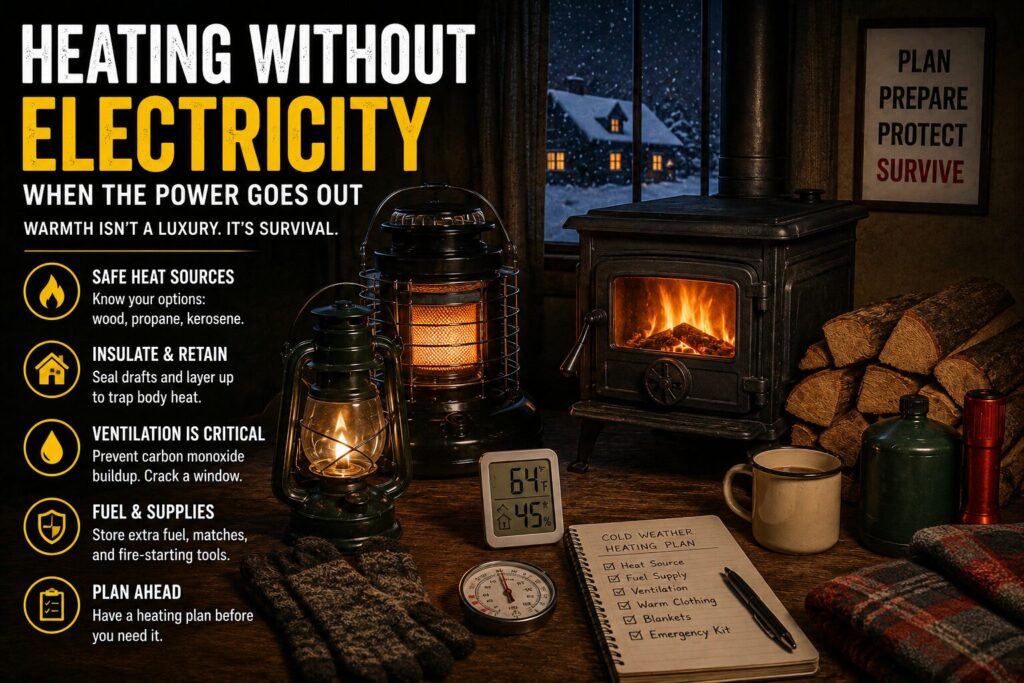
Most people do not think about heat until the house is already getting cold. That is the first mistake. The time to plan for heating without electricity is not when the furnace blower has stopped, the roads are slick, and every store nearby is out of batteries, propane, and common sense.
I have seen families handle a winter outage calmly with almost no special gear because they understood one simple idea: do not try to heat the whole house. Heat the people first, protect one room, slow the loss of warmth, and avoid anything that can poison you while you sleep.
That sounds basic, but it is where a lot of emergency heating plans fall apart. People reach for the fastest source of heat instead of the safest system. They bring outdoor cooking gear inside. They run a generator too close to a door. They burn things in a fireplace that was never inspected. They trust a space heater without thinking about cords, distance, oxygen, or carbon monoxide.
A cold house is uncomfortable. A bad heating decision can be deadly. The practical goal is to stay warm enough, not to make the house feel normal.
Why Electric Heat Fails So Quickly
Modern homes are built around systems. The furnace may burn gas or oil, but it often still needs electricity for the blower, ignition, controls, pumps, or thermostat. Heat pumps obviously need power. Electric baseboards need power. Even pellet stoves usually need electricity to feed pellets and move air.
That is why a winter outage can surprise people. They say, “I have gas heat,” and then the house still goes cold because the gas burner is only one part of the larger heating system.
The same systems thinking applies outside the house. When power is out across a region, stores run out faster, roads may be harder to travel, and repair crews may be stretched thin. That is why a home heating plan belongs beside your broader preparing for power failures plan, not as a last-minute winter thought.
When the grid is quiet, your priorities change:
Keep body heat in.
Reduce heat loss from the space.
Use safe supplemental heat only if you have it and know how to use it.
Watch for warning signs before the situation gets worse.
Start by Heating the People, Not the House
The cheapest emergency heat is insulation around the body. Layers work because they trap air. One heavy coat is not always as useful as a base layer, warm middle layer, outer layer, hat, wool socks, and gloves.
I like to think in zones. Your core matters most. Your head, neck, hands, and feet are where cold gets your attention fast. If those areas are covered, most people can tolerate a cooler room far better than they expect.
A good cold-weather indoor setup can include:
Thermal underwear or long base layers.
Wool or synthetic socks.
A warm hat.
Fingerless gloves for tasks.
Sleeping bags or heavy blankets.
A closed-cell foam pad, carpet, or folded blanket under you.
Hot drinks if you can heat water safely.
High-calorie food because the body burns energy staying warm.
I have noticed that people often sit on a couch with cold air moving underneath and wonder why they cannot get comfortable. Put insulation below you as well as above you. A sleeping bag on the floor can be colder than a sleeping bag on a foam pad because the floor pulls heat away. A blanket under your body may do more than the third blanket on top.
Choose a Warm Room
During an outage, shrink your world. Pick one room and make it the warm room. Smaller is usually better, but not if the room has unsafe ventilation, too much glass, or no practical way to monitor people.
Good choices often include a bedroom, den, or interior room with few windows. Bad choices include garages, rooms with open fuel containers, or spaces where people are tempted to run outdoor heaters or grills.
Close doors to unused rooms. Hang blankets over open doorways if needed. Cover drafty windows with curtains, blankets, towels, or plastic sheeting if you already have it. Put rolled towels at the base of doors. Do not seal a room so tightly that you create a ventilation problem if using an approved indoor heater. The goal is to slow heat loss, not create a trap.
If you live in an apartment or high-rise, your choices may be limited, but the principle is the same: gather people into the easiest area to keep warm. During a longer outage, this overlaps with the same planning covered in citywide blackout survival, because heat, light, water, elevators, and communication all start affecting one another.
Safe Heat Sources Worth Planning Around
The safest heat source is the one you have already prepared, tested, and matched to your living situation. There is no universal answer. A rural house with a maintained wood stove has different options than a city apartment with no chimney and strict building rules.
Common emergency heat options include:
A properly installed and maintained wood stove.
A fireplace that has been inspected and is used with a screen.
An indoor-rated propane heater with the correct safety features and ventilation.
A kerosene heater where legal, properly fueled, and used exactly as intended.
A generator powering a furnace system, kept outdoors and far from openings.
Stored hot water bottles if you have a safe way to heat water.
Passive solar gain during daylight.
Extra insulation and a warm room plan.
The key phrase is “used exactly as intended.” Outdoor grills stay outdoors. Charcoal stays outdoors. Camp stoves stay outdoors unless the manufacturer specifically rates a device for indoor use, and even then you still need ventilation and carbon monoxide protection. A generator never belongs in a garage, basement, shed, porch, or near open windows.
I have seen people get casual with carbon monoxide because they cannot see it or smell it. That is the danger. Every home emergency heat plan should include working carbon monoxide detectors with battery backup. Smoke alarms matter too. Keep a fire extinguisher where you can reach it, not buried behind storage boxes.
Fireplaces and Wood Stoves
A fireplace feels like the obvious answer, but it is not automatically efficient or safe. A traditional open fireplace can pull warm air from the room and send it up the chimney. It may help if you are close to it, but it can also make other parts of the house colder.
A wood stove is usually far more useful, but only if it is properly installed, inspected, and fed with dry wood. Wet wood burns poorly, creates more smoke, and increases creosote problems. Do not burn trash, treated wood, painted wood, cardboard piles, or random furniture. Emergency pressure is not a reason to turn a chimney into a hazard.
Before winter, check:
Chimney condition.
Clearance around the stove or fireplace.
A metal ash container.
Dry wood supply.
Fire tools.
Smoke and carbon monoxide alarms.
A plan for children and pets around hot surfaces.
This is where off-grid thinking matters. A wood stove is not just a heater. It is a fuel supply, storage problem, maintenance habit, ventilation issue, and fire-safety responsibility all at once.
Indoor-Rated Fuel Heaters
Indoor-rated propane or kerosene heaters can be useful, but they are not casual devices. Read the actual instructions before you need the heater. Know the fuel type, ventilation requirements, clearance distance, tip-over protection, oxygen-depletion shutoff, and lighting procedure.
Do not store large fuel containers in living areas. Do not refill heaters while hot. Do not place heaters near bedding, curtains, paper, furniture, or clutter. Do not run them while everyone is asleep unless the unit is designed for that use and you are following the manufacturer’s safety rules. Even then, detectors are not optional.
The practical example is simple: if your warm room is a small bedroom full of blankets, clothing, pets, and extension cords, that may be a terrible place for a fuel-burning heater. Move the plan to a safer room or rely on body heat and insulation instead.
Use the Sun When You Can
Winter sun is weak, but it still matters. During daylight, open curtains on the sunny side of the house. Let the sun warm floors, walls, and furniture. Before the sun drops, close curtains again to hold what you gained.
If you have a safe solar setup, it may not run large heat loads, but it can keep phones charged, run small fans for certain systems, power radios, or support lighting. That is why it helps to understand solar power basics before an outage instead of buying random panels during one.
Do not expect small solar gear to heat a house. Electric heat is power-hungry. The realistic solar goal in many homes is support, not full replacement heat.
Protect Pipes Without Wasting Heat
Cold homes create plumbing problems. If the outage is short, the house may never get cold enough to freeze pipes. If the outage stretches, you need to think ahead.
Open cabinet doors under sinks on exterior walls so warmer room air can reach pipes. Know where your main water shutoff is. If pipes are at risk and you know how to drain vulnerable lines safely, that may prevent a bigger mess. In some homes, allowing a small trickle from a faucet can help, but that depends on the plumbing, temperature, water supply, and whether drains are working properly.
This is another place where systems connect. Heat loss becomes water damage. Water damage becomes sanitation trouble. Sanitation trouble becomes a shelter problem. A house can become technically standing but temporarily unlivable.
When Staying Home Stops Making Sense
There is a point where grit becomes bad judgment. If indoor temperatures keep dropping, people are getting confused or clumsy, infants or older adults are present, medical devices need power, pipes are failing, or your only heat option is unsafe, you may need to leave.
That does not always mean driving far. It may mean a relative’s house, a warming center, a hotel outside the outage area, or a community shelter. It helps to understand basic emergency shelters before you are tired, cold, and trying to decide in the dark.
I have learned to treat evacuation for cold as a timing decision, not a pride decision. Leave while roads are still passable, phones still work, and everyone can move safely. Waiting until the room is dangerously cold gives you fewer choices.
Signals Most People Ignore
Cold emergencies usually give warnings before they become serious. People miss them because they are waiting for something dramatic.
Watch for these signals:
The outage covers a wide area, not just your street.
Utility repair estimates keep moving later.
Indoor temperature drops steadily even with doors closed.
You can feel drafts near doors, windows, outlets, or attic access.
People stop drinking water because they do not want to leave the warm room.
Children or older adults become unusually quiet, confused, or sluggish.
The only available heat ideas involve outdoor devices.
Neighbors are improvising with unsafe fuel sources.
Roads are getting worse while the house is getting colder.
Carbon monoxide alarms chirp, fail, or are missing entirely.
The earlier you notice these signals, the easier the fix usually is. Add layers now. Close off the room now. Check on vulnerable people now. Decide on a safer destination now. Emergencies punish delay more than they punish discomfort.
Build the Heating Plan Before Winter
A basic no-electricity heating plan does not need to be fancy. It needs to be realistic.
Write down:
Which room becomes the warm room.
Where blankets, sleeping bags, hats, and gloves are stored.
Which heat sources are approved for indoor use.
Where fuel is stored.
How ventilation will be handled.
Where smoke and carbon monoxide detectors are located.
Who checks on children, older adults, pets, and neighbors.
At what indoor temperature or warning sign you leave.
Then test the plan gently. Pick a cold evening before winter gets serious. Turn the thermostat down for a few hours. Do not create a real emergency. Just see which room cools fastest, where drafts show up, where blankets are, and whether your family understands the plan.
That small rehearsal will reveal more than a long shopping list. You may discover the best room is not the one you expected. You may find the door sweep leaks badly. You may realize the flashlight batteries are dead or the carbon monoxide detector is too old. That is useful information before the outage.
Key Takeaways
Heating without electricity is mainly about conserving heat, protecting people, and avoiding dangerous shortcuts.
Do not try to heat the whole house. Create a warm room, layer clothing, insulate above and below the body, and slow drafts.
Only use heat sources that are rated for indoor use and that you understand before the outage starts.
Carbon monoxide protection is part of the heating plan, not an optional add-on.
Leave before the situation becomes dangerous if the home keeps cooling, vulnerable people are at risk, or safe heat is not available.
Step-by-Step Actions
- Choose one warm room with few windows and manageable drafts.
- Gather blankets, sleeping bags, hats, gloves, warm socks, and floor insulation.
- Close off unused rooms and reduce drafts around doors and windows.
- Use only safe, intended indoor heat sources.
- Keep smoke alarms and carbon monoxide detectors working.
- Open sunny curtains during daylight and close them before dark.
- Monitor indoor temperature and the condition of people in the home.
- Decide early where you will go if the house becomes too cold.
Checklist
- Warm room selected
- Extra blankets and sleeping bags stored together
- Hats, gloves, and wool or synthetic socks available
- Door drafts reduced with towels or draft blockers
- Windows covered with curtains or temporary insulation
- Safe indoor heat source identified
- Fuel stored correctly
- Smoke alarms working
- Carbon monoxide detectors working
- Fire extinguisher accessible
- Main water shutoff located
- Plan for infants, older adults, pets, and medical needs
- Backup destination identified
- Family knows when to leave