Preparedness Mistakes That Quietly Weaken a Household
Most households do not fail in an emergency because they own the wrong flashlight or forgot one specialty tool. They struggle because several ordinary weaknesses show up at the same time.
The water was stored but never rotated. The backup batteries were scattered through drawers. The emergency contacts lived only in one person’s phone. Everyone assumed somebody else had packed the medication. The plan sounded reasonable, but nobody had ever tried it on a dark evening with the power off.
Preparedness works when the household can still function after convenience disappears. That requires more than buying supplies. It requires clear decisions, usable systems, and enough practice to expose weak points before an actual disruption does it for you.
The good news is that most preparedness mistakes are easy to correct once you can see them.
Mistake 1: Buying Gear Before Defining the Problem
Gear is useful, but random gear creates the illusion of readiness.
A household may own several lanterns, a water filter, emergency food, radios, and a first-aid kit while still having no clear answer to basic questions:
- What are we preparing for first?
- How long should we be able to function without normal services?
- Who may be away from home when it starts?
- What medical, mobility, pet, heating, or transportation needs change our plan?
Start with likely disruptions rather than dramatic scenarios. Power outages, severe weather, temporary water loss, blocked roads, evacuation orders, communication failures, and short-term supply interruptions are enough to reveal most household needs.
A useful decision filter is simple:
- What stops working?
- What does that affect next?
- What must our household do without outside help?
That systems view prevents you from buying isolated items while missing the chain of consequences. A power outage is not only a lighting problem. It can affect refrigeration, heating, well pumps, garage doors, internet service, phone charging, medical devices, and the ability to cook.
Build around functions first: water, food, light, communication, sanitation, medication, temperature control, and movement. Then choose gear that supports those functions.
Mistake 2: Treating Stored Supplies as Finished Work
Supplies age. Batteries leak. Food expires. Water containers develop problems. Clothing no longer fits children. Medications change. Contact information becomes outdated.
A shelf full of neglected supplies is not a reliable system.
Use a simple rotation date. Twice a year is enough for most households. Pick two memorable dates, such as the weekends when clocks change or the first weekends of April and October. Check:
- Water condition and container integrity
- Food dates and signs of damage
- Battery charge and leakage
- Flashlight and lantern operation
- First-aid contents
- Prescription and over-the-counter medication needs
- Seasonal clothing and blankets
- Pet supplies
- Printed contact information
- Cash, fuel, and charging options
Do not inspect everything with the goal of making it perfect. Inspect it with the goal of knowing whether it will work tonight.
The household that rotates ordinary groceries through emergency storage will usually maintain a stronger food reserve than the household that buys unfamiliar food and forgets it in a basement. A practical 72-hour emergency supplies checklist can help you establish a baseline without turning the process into a shopping marathon.
Mistake 3: Keeping the Plan in One Person’s Head
Many families have one informal preparedness manager. That person knows where the shutoff valve is, which bag holds the radio, where the insurance papers are stored, and who should be called first.
That works until the knowledgeable person is away, injured, unreachable, or overwhelmed.
Every capable household member should know the essentials:
- Where emergency supplies are stored
- How to shut off utilities when appropriate
- Which exits and meeting places are used
- Who handles children, pets, medication, and transportation
- Where printed contacts and documents are kept
- Which out-of-area person receives check-ins
- What conditions trigger sheltering, leaving, or calling for help
Use direct role language. Instead of saying, “We should grab the important things,” assign the task:
“Maria gets the medication bag.”
“James checks the pets and brings the carrier.”
“I shut down the stove, take the document pouch, and meet you at the car.”
Clear roles reduce repeated effort and prevent essential tasks from being missed. A written family emergency plan gives everyone the same reference instead of relying on memory.
Mistake 4: Assuming Phones Will Solve Communication
Phones are valuable, but networks can become overloaded, power can fail, batteries can die, and family members can miss calls while moving.
A contact list is not a communication plan.
Your household needs a short call order and a fallback method. Decide:
- Who contacts whom first
- Which out-of-area contact receives updates
- Whether text messages are preferred when networks are congested
- What message format everyone uses
- Where people meet if communication fails
- When someone should stop calling and begin following the plan
Keep messages short and structured:
“I am safe. I am at the north parking lot. I have Ben. We are leaving for Aunt Carol’s at 6:15.”
That message gives condition, location, responsibility, destination, and time. It is more useful than several emotional messages that do not tell anyone what is happening.
Build an emergency communication plan that still gives people direction when the phone becomes unreliable.
Mistake 5: Planning Only for Everyone Being Home
Emergencies rarely respect household schedules.
One person may be at work. Children may be at school or an activity. Someone may be driving. An older relative may be alone. A pet may be at a boarding facility or veterinarian. The primary vehicle may be away from the house.
Plan from separation, not only from reunion.
Ask each household member three questions:
- Where are you most likely to be?
- How would you get home or reach the alternate meeting place?
- What would you need if you could not return immediately?
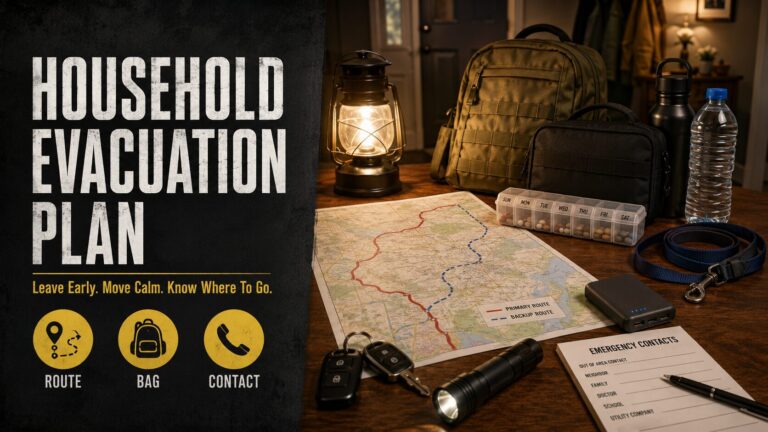
This may lead to small changes: a charger and walking shoes at work, emergency contacts in a child’s backpack, a paper map in each vehicle, medication split between appropriate locations, or a backup person authorized to pick up a child.
The goal is not to predict every movement. It is to prevent the entire plan from depending on everyone standing in the kitchen when the lights go out.
Mistake 6: Making the Plan Too Complicated to Use
A complicated plan often fails under stress because people cannot remember it.
Use layers.
The first layer should fit on one page:
- Immediate safety actions
- Meeting places
- Contact order
- Assigned roles
- Evacuation destination
- Critical medical information
- Utility and document locations
The second layer can hold details such as inventories, insurance records, extended contact lists, pet information, and neighborhood resources.
During a stressful moment, the household needs the next action, not a binder full of theory.
A good test is whether a teenager, visiting relative, or babysitter could follow the first page without a long explanation. If not, simplify it.
Mistake 7: Never Testing the Plan
An untested plan is a collection of assumptions.
A drill does not need sirens, costumes, or a full weekend. Set a 15-minute timer and run a specific test.
Try this blackout drill:
- Turn off normal room lighting.
- Have each person locate a safe light source.
- Check how phones will be charged.
- Identify what stops working in the home.
- Make one test contact using the planned message format.
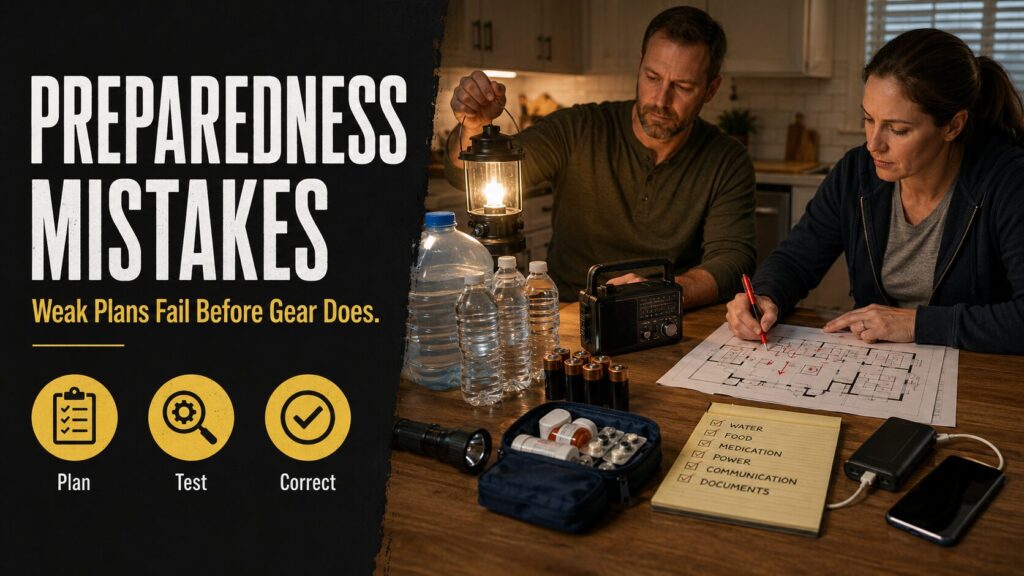
- Locate water, medication, and the document pouch.
- End by writing down three corrections.
The purpose is not performance. It is discovery.
You may learn that the lantern has no batteries, the child cannot reach the supply shelf, the garage door release is unfamiliar, or the printed phone list is two years old. Those are successful findings because you found them during a calm evening.
Mistake 8: Ignoring Small Human Problems
Preparedness discussions often focus on supplies while ignoring fatigue, fear, conflict, boredom, and unclear authority.
Those human problems can degrade good plans quickly.
Decide in advance how the household will communicate under pressure. Use short statements, one task at a time, and confirmation:
“Get the water containers and place them by the back door.”
“Water containers by the back door. Understood.”
When people disagree, use a three-question reset:
- What do we know?
- What matters in the next 30 minutes?
- Who is doing what?
This keeps the household from arguing about distant possibilities while immediate tasks remain unfinished.
Children also need simple, honest direction. “The power is out. We are safe. Your job is to bring your shoes and sit by the lantern,” is more useful than either alarming them or pretending nothing is happening.
Mistake 9: Depending on a Single Location
A basement stockpile is useful until the basement floods, the house is inaccessible, or you must leave quickly.
Avoid putting every critical resource in one place.
Keep the main household supplies together, but distribute a few essentials appropriately:
- Vehicle kits
- Work or school basics
- A small evacuation bag
- Copies of critical contacts
- More than one safe lighting location
- Backup charging in separate areas
- Water stored in more than one container
Distribution does not mean duplication of everything. It means one blocked room, dead vehicle, or missing bag should not collapse the entire plan.
Mistake 10: Waiting for a Perfect Preparedness Setup
Perfection delays useful action.
You do not need the ideal storage room, complete gear list, or final family plan to improve readiness this week. Start with the failure that would create the fastest household problem.
For many homes, the order is:
- Water
- Medication and medical needs
- Light and phone power
- Communication
- Food and basic cooking
- Temperature and sanitation
- Evacuation and transportation
Fix one weak function, record what you did, and move to the next. Preparedness becomes durable when it is treated as ordinary household maintenance rather than a special project that must be completed all at once.
Key Takeaways
- Preparedness fails more often from weak systems than from missing specialty gear.
- Supplies must be rotated, tested, and adjusted as the household changes.
- Essential knowledge and responsibilities should never belong to only one person.
- Communication plans need short messages, a call order, and a no-phone fallback.
- Plans should account for family members being separated when a disruption begins.
- Short drills expose assumptions while there is still time to correct them.
- Simple, usable preparation is stronger than a perfect plan that never gets finished.
Step-by-Step Actions
- List the three disruptions most likely to affect your household.
- Identify which basic functions each disruption could interrupt.
- Check water, food, lighting, medication, charging, and communication supplies.
- Write one page containing meeting places, contacts, roles, and immediate actions.
- Assign responsibility for children, pets, medication, documents, and transportation.
- Create a short emergency message format everyone can use.
- Place critical information and a few essentials in more than one appropriate location.
- Run a 15-minute blackout or evacuation drill.
- Record three weaknesses discovered during the drill.
- Correct those weaknesses and set the next twice-yearly review date.
Checklist
- [ ] Likely household disruptions identified
- [ ] Basic functions and dependencies reviewed
- [ ] Water and food checked and rotated
- [ ] Lights, batteries, and charging options tested
- [ ] Medication and medical needs current
- [ ] One-page household plan completed
- [ ] Roles assigned by name
- [ ] Contact order and out-of-area contact confirmed
- [ ] Meeting places understood
- [ ] Printed contacts and documents accessible
- [ ] Vehicle and evacuation basics prepared
- [ ] Short household drill completed
- [ ] Weak points recorded and corrected
- [ ] Next review date scheduled