Preparing for Power Failures Before the House Starts Feeling Smaller
Most people think they understand a power outage until one lasts longer than expected.
At first it feels manageable. The lights are out. The Wi-Fi is gone. A few things beep, then go quiet. Everyone looks at their phone like the phone might have a more useful opinion than it had ten seconds earlier. If the outage is short, that is mostly an inconvenience story.
If it keeps going, the house starts changing.
Refrigeration becomes a clock. Water becomes a question if pumps or pressure are involved. Phones lose battery. Indoor temperature starts drifting. Hallways and stairwells feel different. Routines get slower. Information gets less reliable. A normal home starts feeling smaller because more and more of what made it easy to live in depended on invisible electrical support.
That is why power-failure preparation matters. Not because every outage becomes a disaster, but because outages reveal how quickly convenience turns into dependency once the system underneath it disappears.
Power Failures Are Really Multi-System Problems
I think this is the first thing people need to understand. A blackout is not just a lighting problem.
It is a communication problem if batteries die. A food problem if refrigeration drifts too long. A water problem in the wrong building or neighborhood. A mobility problem if elevators are involved. A medical problem if equipment or refrigerated medications matter. A stress problem once people stop knowing how long the outage will last and start filling the gap with guesses.
That sounds obvious written down. It still catches people unprepared all the time.
The better question is not “how do I survive with no power.” It is “what in my actual life stops working when power fails, and what is my backup for each of those points.” That is the practical version.
Start With the First 12 Hours
A lot of preparedness advice jumps too quickly into long-term fantasy. Most households are better served by getting the first 12 hours right, then the first 24, then the first 72.
In the first part of an outage, the useful priorities are usually simple:
- light
- phone power
- food preservation discipline
- water awareness
- temperature management
- clear household communication
A working headlamp or flashlight settles a room down fast. So does a charged power bank. So does a family that already knows where the lights are, where the water is, and what to do first instead of wandering around opening the refrigerator every four minutes out of nervous habit.
Preparedness often looks dramatic in advertising and very ordinary in real life. In a power outage, ordinary wins.
A House Example That Feels Familiar
Picture a household on a humid summer evening. The power drops just before dinner. At first everyone assumes it will come back soon. The adults make half-serious jokes. A child is annoyed that the television died. Someone opens the refrigerator and stands there too long as if cold air is free. Phones come out. The utility map does not load. The cell signal starts lagging because the whole area is doing the same thing at once.
An hour later the temperature inside is starting to feel heavier. Someone remembers there is not much bottled water in the house. The rechargeable lantern is dead because nobody charged it after the last outage. A second person asks whether the freezer food is safe and nobody has a good answer. Another person keeps checking outage rumors online, which would be more useful if half of them were not obvious nonsense.
Nothing here is dramatic. That is the point. Most power failures get harder by stacking small frictions until the household mood starts dropping with the battery percentages.
The prepared house handles the same evening differently. Lights come on from one known place. Water is already stored. Phones shift to lower power use immediately. Refrigerator discipline is understood. The first conversation is not “what do we even do” but “all right, here is what we know and here is what we do next.”
That difference is preparedness in its plainest form.
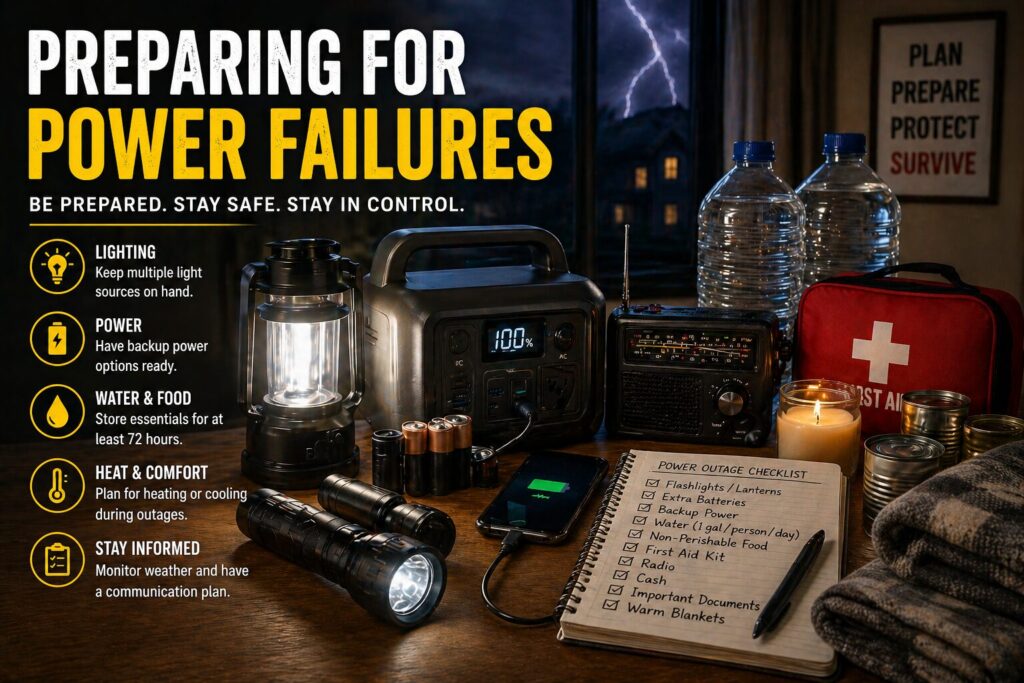
What to Keep Ready
You do not need a bunker to prepare for power failures. You need a few categories handled well.
Light first. Headlamps, flashlights, spare batteries, or charged rechargeable lights. I like headlamps more than most people do because hands-free light changes what you can actually do.
Then phone power. Battery banks, charging cables that actually fit current devices, and some discipline about not wasting charge on panic-scrolling.
Then water. Stored drinking water matters because an outage does not always stay politely inside the category of electricity. Pumps, treatment, and building systems can widen the problem.
Then food and refrigeration judgment. Not theatrical survival rations necessarily. Just enough practical food and enough understanding that the kitchen does not become its own confusion engine.
Then temperature and comfort. Blankets, layers, airflow, shade management, window judgment, whatever fits the season. Comfort is not shallow here. Physical discomfort erodes decision-making faster than people like to admit.
Communication Matters More Than People Think
I would put this higher than most people do.
A house can tolerate inconvenience better than uncertainty. If everybody knows the plan, the mood stays steadier. If nobody knows whether to conserve phone battery, whether to fill containers, whether someone is coming home late, whether medication is becoming a problem, or whether the outage is local or wider, stress multiplies.
This is one reason simple household communication plans are underrated. Even a few plain rules help:
- Charge phones early.
- Use text before repeated calls if networks are strained.
- Fill water if the outage appears likely to last.
- Do not keep opening refrigeration.
- Decide one main room if conditions worsen.
Structure beats improvisation once the outage starts stretching out.
What People Usually Get Wrong
- They prepare for darkness and not for the other systems tied to power.
- They own lights but do not keep them charged or easy to find.
- They underestimate water dependence.
- They burn phone battery too quickly.
- They treat food safety and refrigeration casually.
- They never talk through a household plan until stress is already high.
All of these are fixable. That is the encouraging part.
What Good Preparation Actually Looks Like
Good power-failure preparation is not theatrical. It is specific.
You know where the lights are. You know where the water is. You know what needs charging. You know what inside the house becomes time-sensitive. You know whether anyone has medical or mobility complications. You know what the first hour looks like if the power does not return quickly.
And maybe most important, you know what not to waste energy on.
I think that is the real advantage. Not invincibility. Just less waste. Less wasted movement, less wasted battery, less wasted heat, less wasted attention, less wasted stress.
What This Preparation Really Buys You
People often talk about resilience as if it means toughness. Sometimes it just means the house stays calmer longer.
A power failure is easier when the people inside it are not making ten decisions from scratch. A little stored water, a little light discipline, a little communication structure, and a little temperature planning go further than they look like they should.
That is one of the more useful truths in preparedness. The house does not have to become extraordinary. It just has to become less dependent on everything working perfectly all the time.
And honestly, that is enough to change the whole tone of an outage.