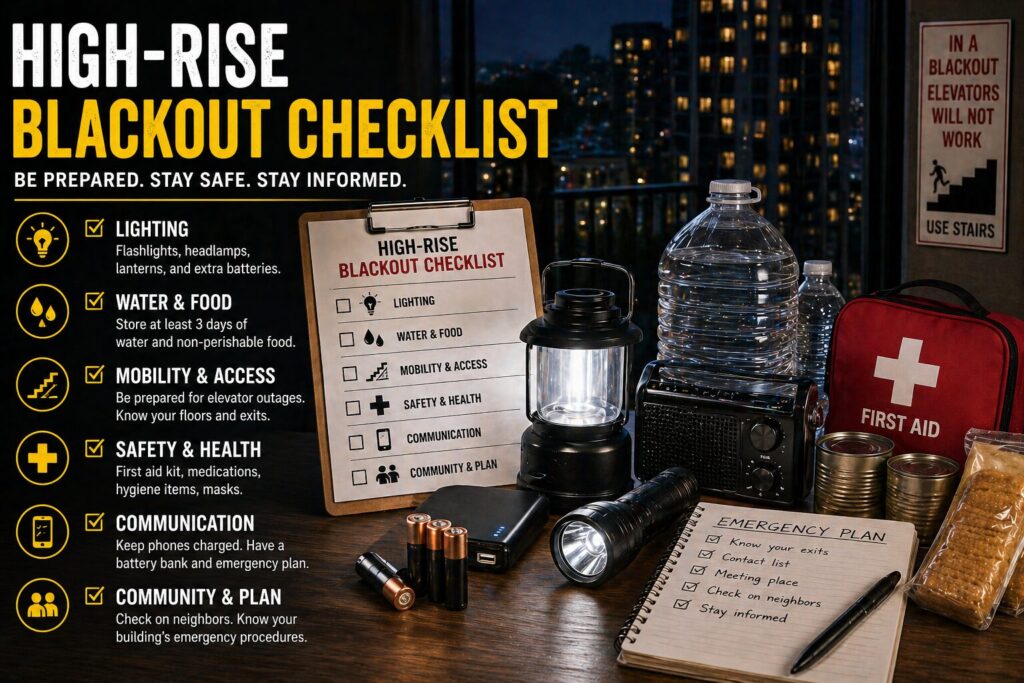
High-Rise Blackout Checklist: What to Do When Elevators Stop and Building Systems Fail
Blackouts feel different in tall buildings.
The power goes out and suddenly the problem is not just your apartment. It is the stairwell. The elevators. The hallway lighting. The entry system. Maybe the water pressure. Maybe building access. Maybe the fact that walking back up to your own floor is now a small event instead of a small task.
A high-rise blackout checklist helps because tall buildings create layers of dependency that people usually do not think about until those systems stop cooperating all at once.
Before the Blackout
- Keep a flashlight or headlamp where you can reach it in seconds.
- Store water inside the unit before there is ever a disruption.
- Keep shoes, keys, and a basic outer layer easy to grab in the dark.
- Keep a charged power bank ready.
- Know which stairwell routes are practical from your floor.
- Know whether anyone in your home depends on refrigerated medication, powered equipment, or mobility support.
- Have a small carry setup for walking up or down many flights if elevators are out for hours.
- Keep emergency contacts printed.
In a high-rise, the distance between inconvenience and real friction is shorter than people expect.
First 15 Minutes of a High-Rise Blackout
- Confirm whether the outage is only your unit, the building, or a wider area.
- Use battery light instead of relying on phone flashlights alone.
- Check on children, older adults, and anyone who may have difficulty with stairs.
- Fill safe containers with water early if pressure is still normal.
- Avoid using elevators even if one briefly appears to reset.
- Keep refrigerator and freezer doors closed.
- Conserve phone battery immediately.
- Stay specific when talking to neighbors and avoid amplifying rumors, especially when panic is starting to spread.
The first job is not solving everything. It is creating order before the building atmosphere gets sloppy.
What Gets Harder as Time Passes
- Walking many flights repeatedly
- Carrying water upstairs
- Managing hallway and stairwell visibility
- Entry and security uncertainty
- Indoor temperature drift
- Communication strain as batteries drop
- Checking on vulnerable neighbors without wasting energy
High-rise outages become coordination problems fast. The household that already expects these friction points usually handles them better.
What to Keep in Reach
- Flashlight or headlamp
- Power bank and charging cable
- Stored drinking water
- Basic first aid kit
- Light snacks
- Jacket or warmth layer
- Printed contact sheet
- Medications or medical notes
- Bag small enough to carry up and down stairs if needed
This is one reason general preparedness advice needs a building-specific layer. High-rise living changes how even simple supplies are used.
Quick High-Rise Blackout Checklist
- Light ready
- Water already stored
- Phone charging backup
- Stair plan understood
- Medical needs considered
- Printed emergency contacts
- Basic food and first aid available
- Plan for repeated stair travel if outage continues
A blackout in a tall building is not just about waiting for the lights to come back. It is about knowing which systems quietly support daily life and getting ahead of the ones that fail first.