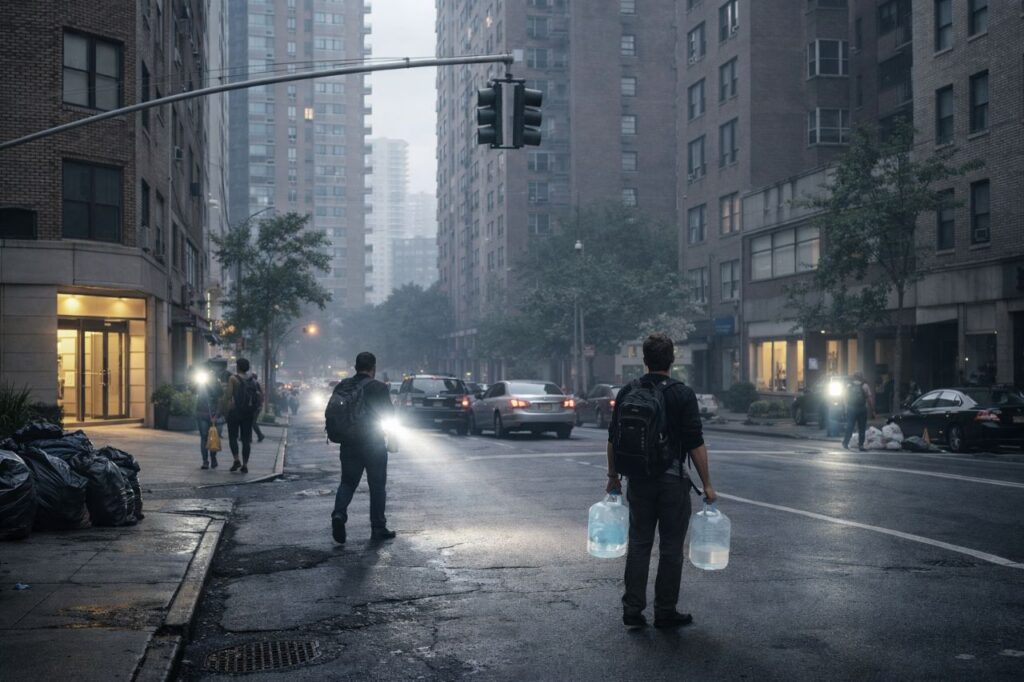
Citywide Blackout Survival When the Systems You Count On Go Quiet
A city feels permanent right up until the lights go out across enough blocks that people stop calling it a flicker and start calling family. That change happens fast. One minute it is a nuisance. The next minute traffic is wrong, elevators are stuck, stores are confused, and everybody is trying to decide whether this is a short inconvenience or the start of a rough night.
I think that is where a lot of bad decisions begin. People wait too long to mentally switch categories. They keep treating a citywide blackout like a normal outage with a slightly larger footprint. Sometimes it is that. Sometimes it is not. The problem is that the first hour usually gives you incomplete information, and cities are built on systems that look independent until they start failing together.
Electricity is the obvious one, but the real issue is systems that fail together. A blackout does not just remove lighting. It changes water pressure in some places, electronic payment systems, building access controls, phone charging, refrigeration, transit schedules, traffic flow, and the general level of public patience. You do not need every one of those systems to fail at once for a city to get strange. You just need enough of them to become unreliable at the same time.
That is why city blackout survival is less about one dramatic trick and more about early stabilization. I do not mean panic. I mean making a few solid decisions before the crowd mood changes and before the building you live in starts feeling less predictable than it did an hour earlier.
The First Problem Is Usually Confusion, Not Darkness
When people picture blackouts, they often picture darkness first. In cities, confusion usually matters just as much. Elevators stop where they stop. Some emergency lights come on, some do not. Cellular service may work for a while, then get overloaded. Card readers fail. Some businesses close instantly and others stay half-open because no one knows what management wants. That half-functioning stage can trick people into wasting time.
The useful question is not, “Is this bad yet?” The useful question is, “What normal systems am I still assuming will work in thirty minutes?” That is a sharper way to think. If the answer includes elevators, ride shares, open convenience stores, mobile payments, lobby access, or reliable transit updates, I would start reducing that dependence quickly.
A city blackout tends to punish delay in an uneven way. Not everybody gets hit at once. The person who charged devices, filled bottles, and checked building conditions early may feel almost bored for a while. The person who waited for more certainty may suddenly be competing with everybody else for the same shrinking options.
Buildings Become Their Own Small Survival Environments
This part gets underestimated. People talk about cities in the abstract, but during a blackout, your building matters more than the skyline. A high-rise, a mid-rise apartment, a walk-up, and a house inside city limits do not experience the same event in the same way.
If you are in a large apartment building, vertical living becomes part of the problem almost immediately. Elevators go down. Hallways may be dim. Electronic key systems may default one way or another. Water may still run for a while, but maybe not for long, especially in upper floors if pumping systems are affected. Trash, heat, stairwell conditions, and security posture can all shift in a few hours. Suddenly your apartment is not just a home. It is a position inside a stressed system.
That sounds dramatic, maybe, but it is true. People do better when they admit what environment they are actually in.
So one of the smartest early actions is to assess the building, not just your unit, especially if you live high enough that a high-rise blackout checklist changes what you keep ready. Are stairwells lit? Is water pressure normal? Does the main entrance still lock properly? Is the lobby becoming crowded or tense? Are elderly neighbors, children, or medically vulnerable people already struggling? Those details tell you more than doomscrolling a weak phone signal for vague outage reports.
Water, Light, and Information Need To Be Secured Early
In a city blackout, I would secure three things early if I could: usable water, dependable light, and a realistic information picture.
Water comes first because people assume it will remain normal longer than it sometimes does. Fill bottles, jugs, pitchers, whatever practical containers you have while the water is still clearly available and pressure is still normal. If you do not already store water inside the home, that gap becomes obvious fast in a blackout. Not in a frantic way. Just do it while the option exists. If the outage resolves quickly, fine. If it does not, that small move was cheap insurance.
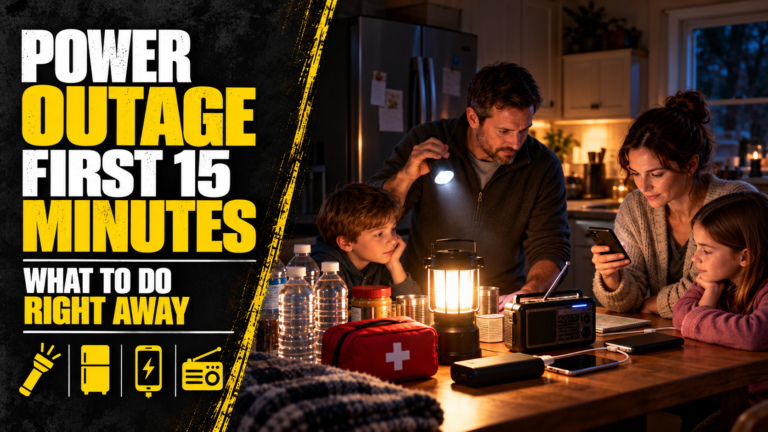
Light matters next, but useful light is different from ambient light. One lantern in the wrong room can make a place feel less dark without actually helping you do anything. Headlamps, compact flashlights, and a room-based plan are better. You want the ability to move safely, check locks, use stairs, handle food, and keep one area calm after sunset. That is different from flooding the place with brightness.
And information, honestly, has to be filtered. The same goes for backup power: a modest setup for lights, phones, and radios can change the whole tone of a long outage. A blackout creates rumor almost as fast as it creates inconvenience. The first reports are often partial, dramatic, or just wrong. I would rather have one weak but trusted update source than five frantic message threads repeating guesses. You are trying to answer practical questions: how large is the outage, what services are affected, what are local officials saying, and what conditions around you are actually changing.
Traffic and Street Conditions Change Faster Than Most People Expect
One reason city blackouts feel unstable is that streets stop behaving normally. Traffic signals fail. Intersections get sloppy. Drivers get impatient. Pedestrians take risks they normally would not take. Public transit can stall or run in a degraded way. Gas stations may be unable to pump. Parking garages can become bottlenecks. If the outage stretches into evening, the general tone outside can shift from inconvenience to agitation.
That does not mean the streets instantly become dangerous in a cinematic sense. Usually it is messier and more ordinary than that. Bad judgment, poor visibility, uncertainty, and crowd friction. That is enough.
So I tend to think movement decisions should be made early and conservatively. If you need to go somewhere, leaving before the city fully adjusts can matter. If you do not need to go anywhere, staying put may be smarter than entering a system that is losing coordination by the hour. Not always. But often.
People sometimes cling to their original plans because they do not want to overreact. I get that. But there is a difference between overreacting and recognizing that urban systems degrade in layers. Missing that difference gets people stranded in transit lines, stuck in dead traffic, or walking much farther than they expected with bad lighting and a dying phone.
Blackouts Reveal Which Supplies Are Actually Useful
Preparedness in cities has a way of exposing fake readiness. A blackout is pretty good at this. It quickly shows whether your gear is practical or just theoretically comforting.
A giant emergency kit buried in a closet is less useful than a smaller, organized setup you can reach in the dark. Fancy gadgets with dead batteries do not matter much. A single flashlight with no backup is not a plan. Food that requires a bunch of electric appliances is not really stored food in this context. And a phone at twelve percent battery is an alarm bell, not a communications strategy.
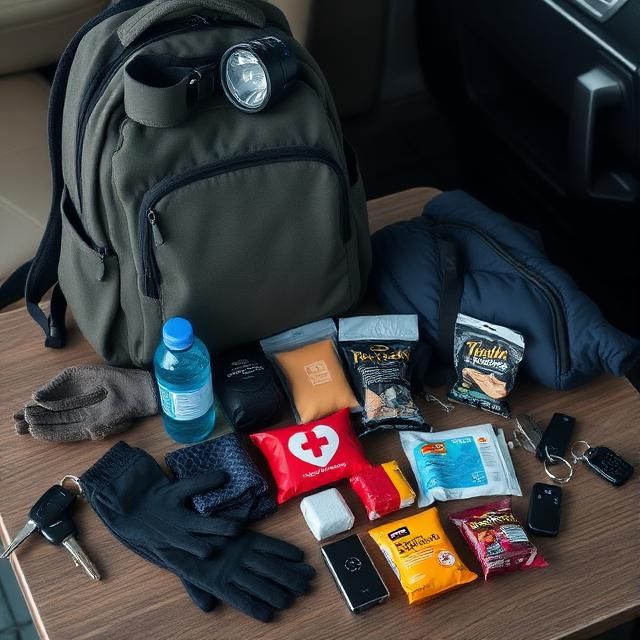
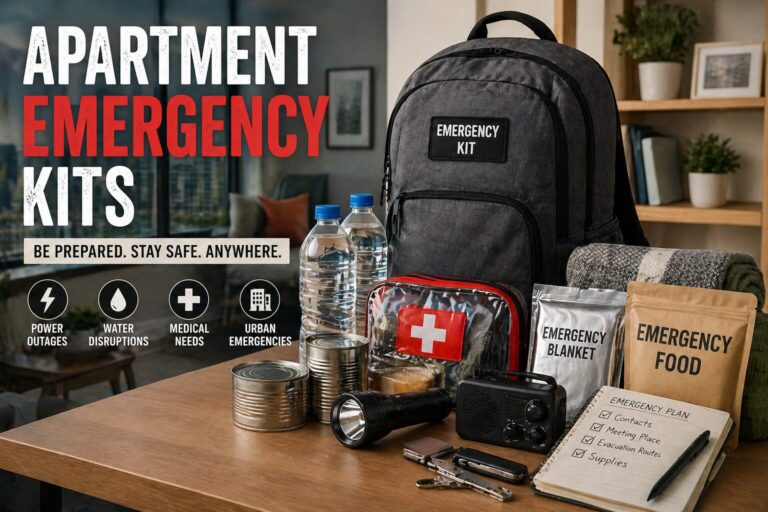
Useful blackout supplies are boring. Water. Flashlights. Spare batteries. Power banks that are actually charged. Shelf-stable food that can be eaten with little or no cooking. A lighter. A basic first aid kit. A radio if you keep one. Cash in small bills. Shoes near the bed. A way to stay warm if heating systems fail. It is not glamorous. That is part of why it works.
I would add one more thing that people do not always mention: a habit of keeping order while the event is still small. Put the flashlight back in the same place. Consolidate critical items. Keep walkways clear. Charge devices in order if you are using limited backup power. Blackouts get more annoying when your own apartment starts behaving like a junk drawer.
The Social Side Matters More Than People Like To Admit
Preparedness conversations sometimes get weirdly isolated, as if everybody is operating in a sealed box. In a city, that is rarely true. Neighbors matter. Building staff matter. The mood in the hallway matters. If an outage lasts, the social environment around you starts affecting security, information quality, and practical problem-solving.
I do not mean you need to become everyone’s crisis coordinator. Usually that goes badly. I mean simple awareness helps. Know who around you may need help. Notice who is escalating tension. Notice who actually has useful information. A calm building with a few competent people talking normally feels very different from a building where everybody is guessing and nobody is checking basics.
I have seen situations, not just with blackouts, where one calm person asking ordinary questions changes the tone fast. Is the stairwell clear? Does water still run on the tenth floor? Does anyone know whether the front entry lock is still working? Small grounded questions pull people back into reality. That matters.
Night Changes the Equation
A city blackout that begins in daylight and continues into night becomes a different event. That is usually when uncertainty starts feeling heavier. Visibility drops. Businesses that were lingering shut down. Temperature becomes more noticeable. Building noise changes. People who spent the day assuming the power would return start realizing maybe not yet.
This is where earlier decisions pay off. If you already secured water, light, communication priorities, and a basic overnight setup, the night is still inconvenient, but it is not chaotic. If you waited, the same night feels much longer.
I think that is one of the big lessons here. City blackout survival is often won early. Not fully won, maybe that is too neat, but shaped early. The first hour or two creates momentum in one direction or another.
What To Actually Do
If I were reducing this to action, I would keep it plain.
Check the scope of the outage, but do not get trapped in rumor hunting. Charge what you can immediately if backup power exists. Fill water containers while systems are still normal. Set out lighting before dark makes that annoying. Evaluate your building, not just your apartment. Decide early whether you truly need to move or whether sheltering in place is the better call. Keep critical gear together. Use power banks deliberately, not casually. And pay attention to the human environment around you because city events are never only technical failures.
There is something else, too. Blackouts have a way of making people feel helpless because so much is outside their control. The better response is to identify the layer you do control and work there. Your room. Your floor. Your supplies. Your immediate decisions. Your ability to stay calm when other people start drifting.
That is not everything. It is enough to matter.
Key Takeaways
- A citywide blackout is usually a systems problem before it becomes a dramatic survival problem.
- The first hour matters because water, movement, light, and information are easiest to stabilize early.
- Your building conditions often matter more than broad city headlines.
- Useful blackout preparedness is usually simple, organized, and boring.
- Calm observation helps more than frantic information chasing.
Step-by-Step Preparedness Actions
- Fill practical water containers as soon as the outage appears larger than a brief flicker.
- Set out flashlights, headlamps, and backup batteries before darkness makes this harder.
- Check building access, stairwell lighting, elevator status, and water pressure.
- Consolidate essential items like chargers, power banks, first aid, shoes, and cash.
- Decide early whether to stay put or move based on real conditions, not habit.
- Limit unnecessary phone and battery use until the outage scope is clearer.
Quick Preparedness Checklist
- Drinking water containers
- Flashlight or headlamp
- Spare batteries
- Charged power bank
- Shelf-stable food
- Cash in small bills
- Basic first aid kit
- Shoes and outer layer ready
- Reliable local information source
Skills Practiced in This Module
- early outage assessment
- urban shelter-in-place judgment
- resource prioritization
- building condition awareness
- calm decision making
- blackout readiness