The Quiet Appeal of Off Grid Living
Every now and then someone asks me why people are drawn to off-grid living.
Usually the question comes with a little skepticism baked in. Images of remote cabins, solar panels buried in snow, maybe someone hauling water from a stream. It can look extreme from the outside. A little dramatic even.
But most people who move in this direction aren’t really chasing isolation or some wilderness fantasy. What they’re after is something simpler. Control over the basic systems that keep life running.
Electricity. Water. Heat. Food. Waste.
Most of us grow up never thinking about where any of those actually come from. We flip switches. Turn faucets. Set thermostats. The infrastructure behind those conveniences is huge and complicated and mostly invisible.
Off-grid living pulls that curtain back a bit.
Suddenly the question isn’t “Why isn’t the power working?”
It’s more like “How much sunlight did I collect today?”
That shift in perspective changes more than people expect. Maybe not right away. But after a while.
Understanding What “Off-Grid” Really Means
There’s a common idea that off-grid living means total self-sufficiency.
That’s not really accurate. At least not for most people.
Being off the grid simply means your home isn’t connected to public utilities — no municipal electricity, no city water, no sewer connection. Everything that normally arrives through infrastructure now comes from systems you manage yourself.
Those systems usually include:
- Power generation (most often solar)
- Water collection or wells
- Waste management
- Heating and cooling
- Food storage and sometimes production
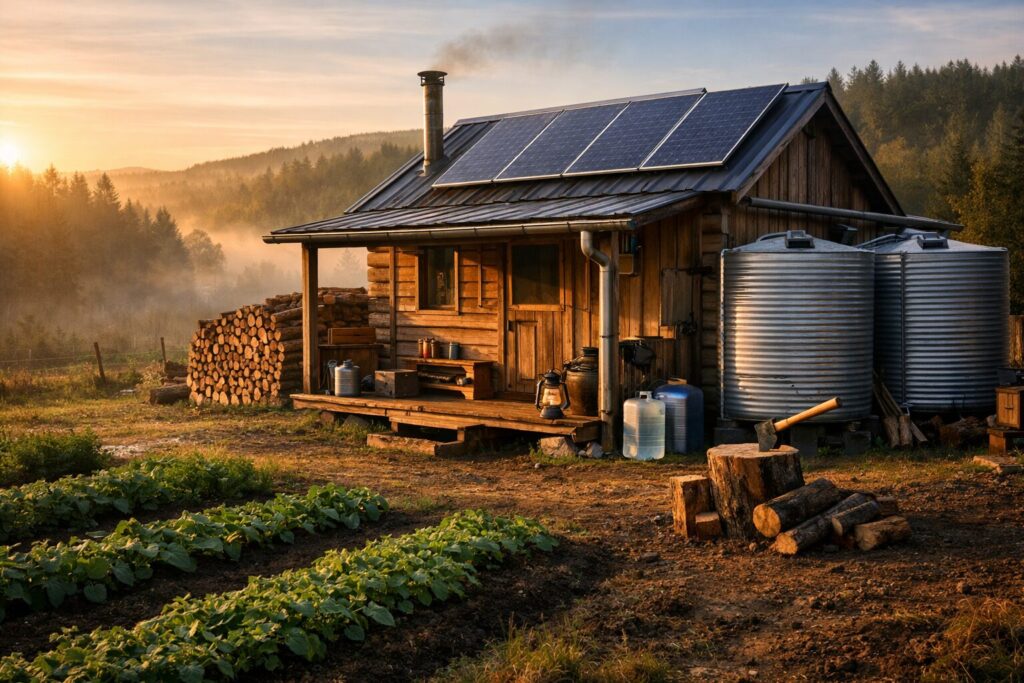
Some people build pretty elaborate setups that start to resemble small utility systems. Others keep things simple — small cabin, modest solar array, rainwater tanks, wood stove.
There isn’t one version of this life.
What matters is understanding the systems well enough that they keep working most of the time. When they don’t, you usually know why.
It takes patience at the beginning. Probably more than people expect.
Electricity: The First System Most People Build
Electricity tends to be the first real hurdle.
Modern life quietly depends on it for almost everything — lighting, refrigeration, communication, tools, water pumps. Remove it and you notice pretty quickly.
Most off-grid homes rely on solar power. It’s reliable, scalable, and once installed it produces energy every day without fuel deliveries or many moving parts.
The basic components look something like this:
- Solar panels that collect sunlight
- Charge controllers that regulate incoming energy
- Battery banks that store power for night or cloudy weather
- Inverters that convert stored energy into usable household electricity
The system itself isn’t that complicated once you see it laid out.
What surprises beginners more than the hardware is the mindset shift.
Grid power feels infinite because the supply is abstract. Off-grid electricity is tangible. You can watch the battery levels change throughout the day.
Sunny afternoon? Batteries filling up.
Several cloudy days in winter? Energy becomes something you think about a little more carefully.
Lights still work. Refrigerators still run. But you’re aware of the system behind it.
And oddly enough that awareness often feels satisfying instead of restrictive.
Water: The System That Deserves the Most Respect
Electricity gets most of the attention, but water is usually the more important system.
People can improvise around limited power for a while. Water shortages become serious quickly.
Off-grid homes typically rely on one of three sources:
- Private wells
- Rainwater catchment
- Nearby springs or surface water
Wells are common in rural areas because they provide a stable supply year-round. A pump brings groundwater into storage tanks, and the system works quietly in the background.
Rainwater systems can work well too, especially in places with steady rainfall. Roof surfaces collect water, which flows through filtration systems into storage tanks. From there it can be pumped into household plumbing.
The thing people underestimate here is storage.
Rain might fall only a few days each month, but water is needed every day. Storage tanks smooth out that difference.
A small example makes the point.
I once saw a small off-grid home that collected rainwater from a modest metal roof. Nothing elaborate. But beside the house were two tall cisterns — maybe 2,500 gallons each.
During storms they filled quickly. During dry spells the family barely thought about water because those tanks quietly bridged the gap.
That’s a pattern you start to see with off-grid systems. Capture abundance when it appears, store it, use it slowly.
Simple idea. But it takes a little while before it really sinks in.
Heating: Where Simplicity Often Wins
Heating systems off the grid often end up simpler than people expect.
Wood stoves remain one of the most dependable heating methods ever built. They require no electricity, produce steady heat, and the fuel can often be sourced locally.
There’s something satisfying about that kind of reliability.
You stack firewood months ahead of winter. When cold weather arrives the system is already sitting there waiting.
No fuel deliveries. No thermostats negotiating with a utility company.
Just fire, steel, and stored energy in the form of wood.
Some homes combine wood heat with propane heaters or efficient electric heat pumps powered by solar. Every setup ends up slightly different depending on climate and resources.
But generally the idea stays simple. Heat comes from fuel you control.
Waste and Sanitation: The System Nobody Talks About
Waste management doesn’t show up much in glossy off-grid photography, but it matters.
Homes disconnected from municipal sewer systems usually rely on septic systems or composting toilets.
Septic systems operate quietly underground. Wastewater flows into buried tanks where natural processes break down organic material before filtered water disperses into soil through drain fields.
Composting toilets take a different approach by separating waste streams and allowing decomposition to occur in controlled containers.
Both systems work well when installed correctly. They just require a little more awareness from the homeowner.
Another example of the broader pattern.
Modern infrastructure hides complexity. Off-grid living brings some of it closer to the surface. Not dramatically. Just enough that you notice it now and then.
Food: A Spectrum, Not a Requirement
Some people imagine off-grid living automatically means full homesteading — gardens, livestock, root cellars, the whole picture.
That happens sometimes. But it isn’t required.
Many off-grid households still buy groceries like anyone else. The difference is simply where the electricity and water come from.
That said, once people start managing their own systems, food production often becomes interesting.
A small garden turns into a useful supplement. Maybe a greenhouse extends the growing season. Chickens appear at some point — chickens seem to find their way into nearly every rural property eventually.
Not because it’s necessary.
Just because it sort of fits the rhythm of the place.
The Psychological Adjustment
Something unexpected tends to happen after a few months of off-grid living.
People slow down.
Not dramatically. Just enough to notice things they ignored before.
Weather patterns start to matter because sunlight affects power production. Rainfall matters because it fills water tanks. Wood piles matter because they represent stored heat.
There’s a rhythm to those systems that feels grounded, I guess.
You wake up, check the sky, glance at battery levels, maybe look at the water tanks. None of it takes long.
But it creates a quiet awareness of how the environment interacts with daily life.
It’s not romantic wilderness living. That part gets exaggerated.
It’s more like living closer to the machinery that supports your life.
Mistakes Beginners Often Make
I’ve seen a few patterns repeat when people first explore this path.
One is trying to build everything at once.
Solar system, gardens, livestock, water systems, new buildings — all started at the same time. That can become overwhelming pretty quickly.
Off-grid systems are easier to learn one at a time.
Electricity first.
Then water reliability.
Then heating efficiency.
Everything else can evolve gradually.
Another mistake is oversizing systems without understanding usage.
It’s tempting to install massive solar arrays and huge battery banks right away. But energy habits change once people begin living off-grid. Efficient appliances, LED lighting, thoughtful power use — all of that reduces the scale required.
Understanding your actual consumption matters more than guessing.
And maybe the most common mistake is expecting perfection.
Every off-grid system has occasional hiccups.
Batteries age. Pumps fail. Storms arrive at inconvenient times. Sometimes two things break at once. It happens.
But when you understand how the systems work those moments become manageable problems instead of emergencies.
Starting Smaller Than You Think
If someone asked me where to begin, I’d probably suggest starting smaller than expected.
A small cabin. A weekend property. Even a shed with a modest solar setup.
Learn how a battery bank behaves through the seasons. Watch how water storage changes with rainfall. Notice what actually uses electricity during a normal day.
That kind of experience teaches far more than theoretical planning ever could.
One summer I spent time on a property where the entire electrical system consisted of four solar panels and a small battery bank tucked into a corner of the workshop.
Nothing fancy.
But those panels powered lights, laptops, a small refrigerator, and a water pump. The owner knew exactly what the system could handle and lived comfortably within that boundary.
Watching that system run quietly day after day made something obvious.
Off-grid living isn’t really about having less.
It’s more about understanding the systems well enough that less turns out to be enough.
And once that idea clicks, the whole thing starts to make a lot more sense.