

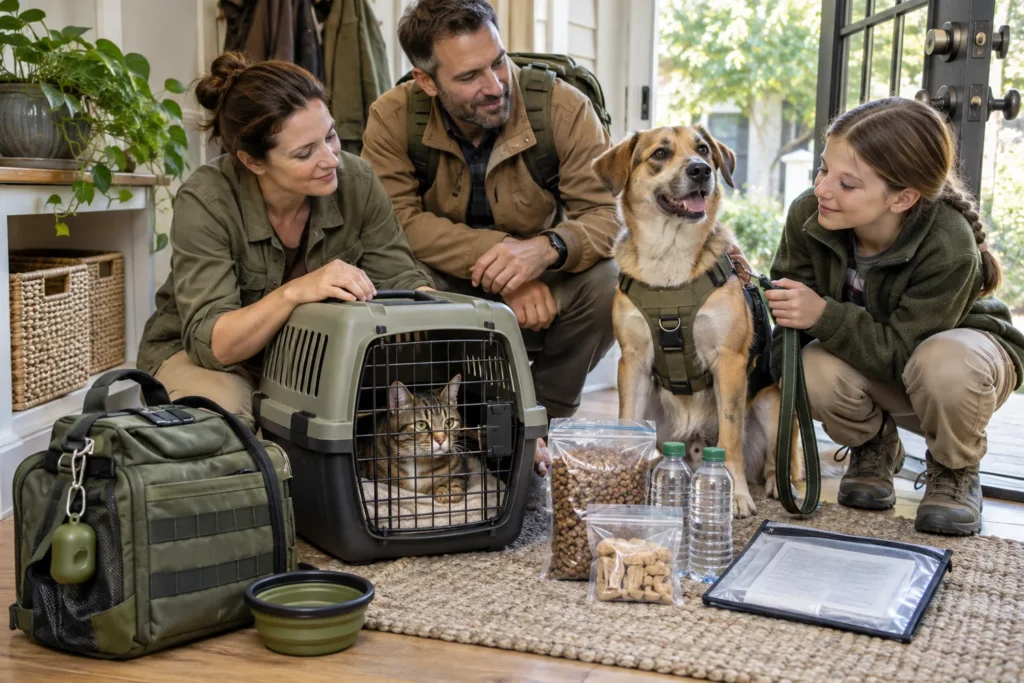
A pet emergency plan covers safe transport, supplies, destinations, and backup care. If you have pets, your evacuation plan has to work for them too. “We'll bring the animals” sounds like a plan until a cat hides, a carrier jams, or the shelter turns you away. Before trouble starts, you need to know how each animal will travel, what goes with it, where it can stay, and who steps in when you're not home.
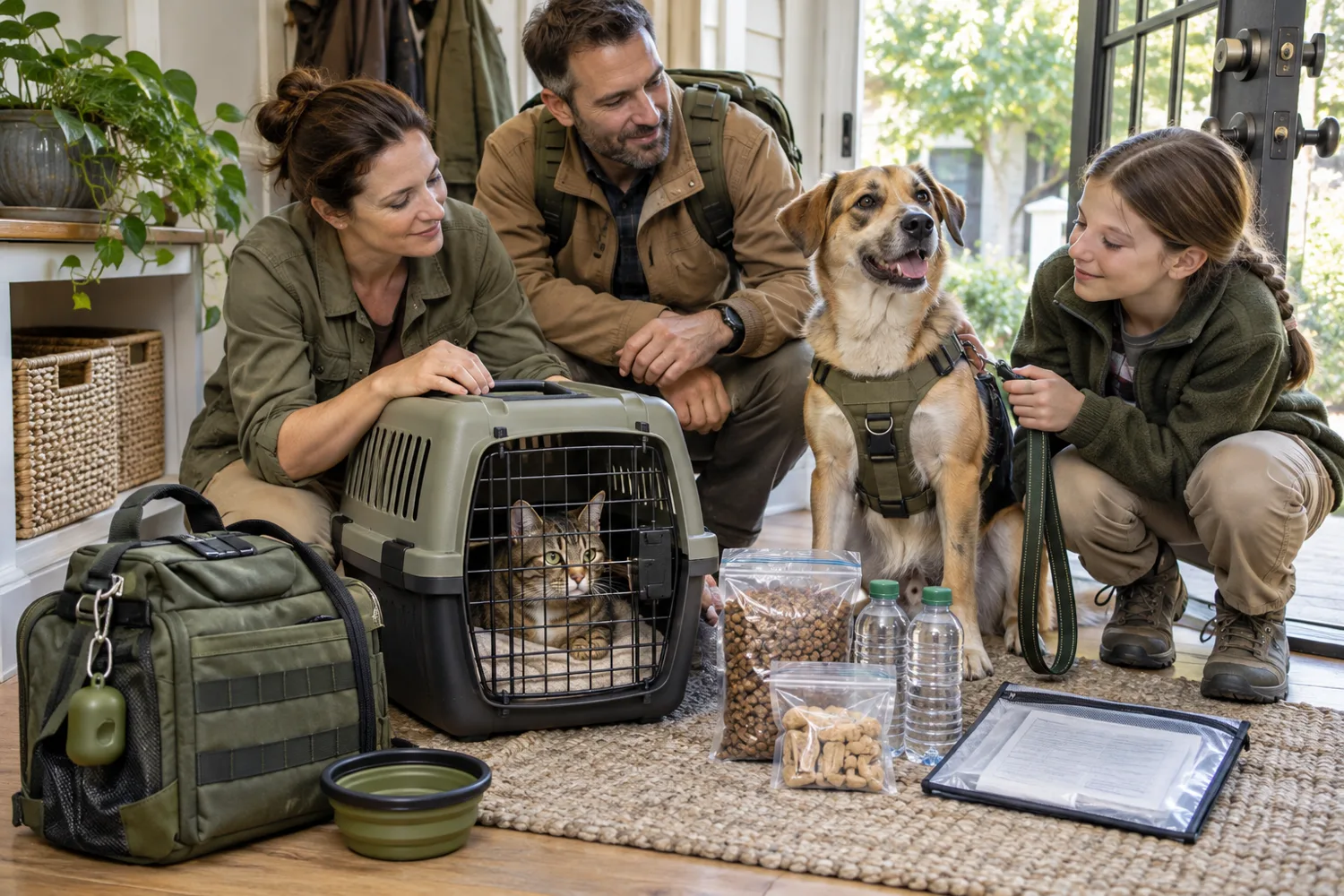
Start small: one safe carrier or restraint per pet, a kit you can grab, two realistic places to go, and one person who can help if you're away. Practice the first ten minutes. But when officials say leave now, leave. You don't finish packing or run a drill while an evacuation order is in effect.
The Problem Usually Appears at the Door
Picture a family told to leave because a wildfire is approaching. The dog is ready to jump into the car, but the cat has disappeared under a bed. The cat carrier is in the basement. One person assumes the emergency shelter will accept both animals. Another has packed food but forgotten the cat's prescription.
Each problem costs time at the worst possible moment. Each can be handled on a quiet weekend instead.
Pets react to unfamiliar noises, smoke, crowds, and disrupted routines. Even an animal that normally comes when called may hide or bolt. The CDC advises families to know where pets hide, practice catching and loading them, and keep a leash or carrier near an exit. An evacuation is not the time to discover that the carrier door is broken or the dog refuses to enter the vehicle.
Start Your Pet Emergency Plan With Safe Transport
Build your pet emergency plan animal by animal, not bag by bag. What will actually keep this animal contained from your front door to the destination? For a cat or small dog, that may be a ventilated carrier with a latch you have tested. A larger dog needs a fitted harness and leash, plus an appropriate restraint in the vehicle. Birds, rabbits, reptiles, and other small animals need secure enclosures suited to their species; temperature and ventilation can matter as much as the door latch.
For an animal with unusual handling or temperature needs, work out the transport details with your veterinarian ahead of time.
Label each carrier with the animal's name and your contact information. Keep the equipment where it can be reached quickly without blocking the household exit. A leash in a drawer across the house is not as useful as one stored with the evacuation kit.
Practice with the equipment when nothing is wrong. Leave the carrier open in a calm room, introduce it gradually, and reward voluntary entry where appropriate. A familiar blanket can help, provided it does not interfere with ventilation or safety. Do not assume one successful practice means the animal will cooperate during a frightening event. Repeat the drill and note which pet needs extra time.
With several animals, the weak point is often the person doing the loading. One adult cannot reliably catch two frightened cats, manage a large dog, and load supplies all at once. Give each person a job. Write down the animal count and check it at three points: before loading, before driving, and after arrival. Three pets at home should still mean three pets at the destination.
Build Two Kits, Not One Overstuffed Bag
A giant supply bag is no help if you need both hands to carry a nervous dog. Split your supplies. Keep a small grab-and-go kit near the exit, then store a larger reserve for sheltering at home or dealing with a longer disruption. You should be able to lift the travel kit while managing the animal.
For a practical starting point, prepare at least seven days of pet food and drinking water when storage and carrying capacity permit. The FDA recommends at least a week's supply of food and fresh water for evacuation. Arrange an appropriate medication reserve with your veterinarian. These are planning targets, not a reason to delay evacuation while searching for extra supplies. Discuss prescription refills and special diets with your veterinarian before an emergency.
Pack food in sealed, labeled containers. Include a manual can opener if needed, bowls, prescribed medication with instructions, a leash or harness, waste bags, cat litter and a small litter pan where relevant, cleanup supplies, and a familiar comfort item. Add towels or bedding appropriate to the animal. Avoid putting hazardous cleaning chemicals where animals can reach them.
Review your household emergency water storage so the pet supply is accounted for too.
Keep a waterproof document envelope or offline phone copy with vaccination records, medication details, veterinary contacts, microchip number, insurance information if applicable, and a recent photograph showing the animal clearly. Include a photo of you with the pet when possible. Update records and supplies as they change; set a recurring calendar reminder to check expiration dates, food condition, and contact numbers.
Use a loading order that fits your household: secure each animal in its carrier or appropriate restraint, load the portable kit, and confirm that every person and pet is accounted for before departure. Keep carriers stable and appropriately ventilated, and never allow a loose animal to interfere with the driver. Do not leave an animal unattended in a parked vehicle; interior temperatures can become dangerous quickly.
Choose Destinations That Actually Accept Your Pets
A public shelter may have room for you and no place for your cat. Some emergency centers arrange separate animal housing; others cannot take household pets. Service animals are treated differently. The important question is not whether a hotel or shelter was pet-friendly last month. It's whether your specific animals can stay there when you arrive.
Prepare three kinds of options before you need them:
First, identify a friend or relative outside your likely hazard area who has agreed to accept you and your animals. Confirm the number, size, and species of animals, and whether that household has pets of its own.
Second, identify several pet-friendly lodging possibilities along different evacuation directions. Record phone numbers and the actual restrictions: species, number of pets, size, fees, and whether a policy may change during a disaster. Call when an evacuation becomes likely; availability and rules can change.
Third, identify a veterinary boarding facility, animal sheltering partner, or local animal-control resource that may be able to arrange temporary care. This is a contingency, not a guaranteed bed. Ask what vaccination records and supplies they require.
Write down alternative routes to your destination areas, but treat official evacuation routes, road closures, and hazard updates as controlling when the emergency arrives. A road closure can make a good hotel useless. Use the emergency binder to organize contacts and destinations. Keep the destination list on paper as well as on your phone so a dead battery does not erase the plan. If your first destination is unavailable, call the next option from a safe location rather than driving from place to place with distressed animals.
Your Pet Emergency Plan When You Are Not Home
Now consider the day you're not home. A road closes while you're at work, and the animals are still inside. A trusted neighbor or nearby friend can help only if you've asked beforehand and authorities allow safe access. Make sure that person can get in, find the carriers, identify each pet, and locate feeding and medication instructions and the veterinarian's number.
If emergency treatment might be needed, settle any written permission and spending limits in advance.
Agree on a simple communication rule: the caretaker sends a message saying which animals were located, where they were taken, and which animals remain unaccounted for. Agree in advance on what happens if the caretaker cannot reach your home: they notify you and follow official directions rather than attempting entry. Do not send anyone into a restricted or dangerous area. Emergency responders and evacuation orders take priority over a rescue attempt.
Identification Is Your Recovery System
Collars and readable tags help someone contact you quickly. Microchips provide another identification route when a collar comes off, but a chip is not a GPS tracker. The chip number must be registered to current contact details. Check the registration, especially after a move or phone-number change.
Keep current photographs and distinguishing descriptions for each pet. If an animal becomes lost, contact local animal control, shelters, and the microchip registry, and share accurate identifying information. After a disaster, familiar scents and landmarks may have changed. Keep animals confined or leashed in unfamiliar places; a normally reliable pet may not recognize the route home.
Signals Most People Ignore
Watch what happens on an ordinary day. Does the cat disappear when a carrier comes out? Can you carry that carrier through the doorway without moving boxes? Does the dog fight the harness? Will your first-choice hotel accept all three animals, not just one? Those are not small inconveniences. They tell you exactly where the plan will jam.
Other signals deserve attention: an almost-empty prescription bottle, a microchip registered to an old phone number, a carrier with a weak latch, a destination inside the same flood or wildfire zone, and a household member who does not know where the kit is stored.
Do not wait for a formal evacuation order to begin getting animals indoors and preparing equipment when a credible warning is approaching. Follow official local instructions, and leave promptly when told to evacuate. A last-minute search for a frightened cat is not worth remaining in immediate danger.
A Ten-Minute Practice That Exposes Weaknesses
Test your pet emergency plan on an ordinary afternoon. Without creating panic, ask everyone to perform the opening steps of evacuation. Start a timer. Retrieve each carrier, leash, and kit. Bring each animal to its designated loading area and practice safe entry into the carrier or vehicle restraint; keep the exercise short and calm rather than forcing a frightened animal. Read the destination list aloud and have someone say which location they would call first. Count the animals, confirm the backup caretaker's role, and check medications and records. If a pet cannot be safely handled during the rehearsal, stop and work on gradual training or ask your veterinarian for advice.
End the rehearsal while the animals are still calm. Write down the three things that slowed you most. Maybe the cat took six minutes to find. Maybe nobody knew where the leash was. Maybe the carrier is too small. Fix those problems and try again another day. A steady routine matters more than beating the clock.
After You Leave
At your destination, keep animals secured while doors open and people unload. Before releasing a pet, inspect the room or temporary enclosure for escape routes, exposed wires, toxic materials, and other animals. Set up water and a quiet resting space first. Keep dogs leashed outside secure areas and cats confined in a safe indoor space while they adjust. Maintain food, medication, and familiar routines as much as possible, and count every animal again after unloading.
If your pet is injured, sick, overheated, or unusually distressed, contact a veterinarian promptly. Fearful or injured animals may bite even when they are normally gentle. Avoid forcing close handling when it would put you or the animal at risk.
A good pet emergency plan survives a rushed departure, a frightened animal, and a destination that falls through. Test those weak spots now. You'll have fewer decisions to make when the warning comes.
Sources and Further Reading
- CDC: Pet Safety in Emergencies
- FDA: Take Care of Your Pets Before Disaster Strikes
- AVMA: Pets and Disasters
Key Takeaways
An evacuation plan must cover containment, transport, supplies, destinations, and a backup caretaker for every animal. Practice loading pets before a disaster. A familiar carrier and a clear assignment reduce delays. Do not assume a public shelter will accept household pets. Arrange multiple realistic destinations and call ahead. Keep identification, microchip registration, records, and medication instructions current. The first rehearsal should reveal weaknesses to fix, not merely confirm that a kit exists.
Step-by-Step Actions
- Count every pet and assign one person to secure and transport each animal.
- Inspect and label each carrier, harness, leash, and vehicle restraint.
- Assemble a portable pet kit and a larger home reserve; arrange medication and special-diet needs with your veterinarian.
- Record at least two out-of-area destinations, backup routes, and emergency animal-care contacts.
- Confirm microchip registration, ID tags, photographs, vaccination records, and veterinary information.
- Agree on a backup caretaker and safe-access instructions for times when you are away.
- Run a calm ten-minute loading drill, record the delays, and fix the first three weaknesses.
Checklist
- Every pet has a suitable carrier or restraint.
- Carrier labels and identification tags show current contact information.
- Microchip registrations have been checked.
- Food, water, bowls, medication, sanitation supplies, and records are packed.
- Special medical or temperature needs have a veterinarian-reviewed plan.
- Two possible destinations and alternative routes are written down.
- A backup caretaker has agreed to help and knows the safe-access plan.
- Everyone knows who handles each pet and where the kit is stored.
- The household has practiced loading and counting the animals.
- Supplies, contact information, and destination options have a scheduled review date.