Emergency water storage succeeds only when the water remains safe, accessible, and manageable. One large inaccessible container is a fragile plan.
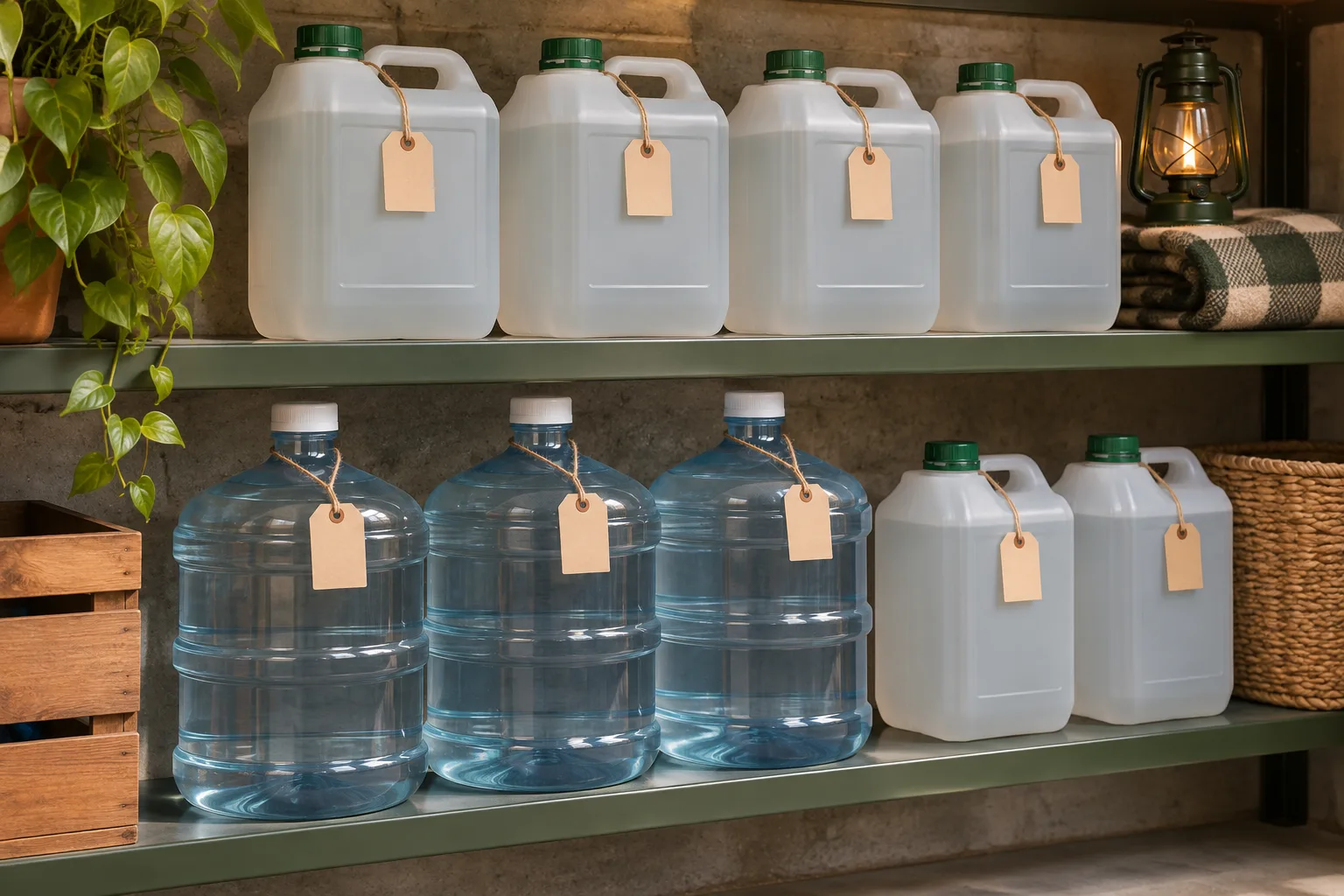
Most emergency water plans fail long before the water itself becomes a problem.
The containers are full, so the job feels finished. Then the faucet stops and the weak points show up: not enough gallons, a jug nobody can lift, a cap you cannot reach, a supply stored in one room you suddenly cannot enter, or a treatment method that does not address the kind of contamination you are dealing with.
That is the mistake: treating stored water like an object instead of a system.
A dependable water plan has to answer six questions: How much do you have? Is it stored safely? Can you reach it? Can you move and dispense it? When was it last checked? What happens when it runs out?
If you cannot answer those questions, more containers may not solve the real problem.
Emergency water storage: start With Enough Water to Matter
Ready.gov's familiar baseline is at least one gallon per person per day for several days. Treat that as a planning floor, not a guarantee that one gallon covers every person in every situation.
A family of four needs at least 12 gallons for three days at that baseline. Seven days takes 28 gallons. That is already well over 200 pounds of water before you count the containers.
The weight matters because a reserve you cannot move or use is only partly useful.
Instead of thinking only in total gallons, think in layers. Keep some water in smaller containers that people in the household can carry. Keep a larger reserve for sheltering at home. Add capacity for pets and for situations that increase water needs, such as hot weather, illness, pregnancy, or nursing. Then decide what you will do if the outage lasts longer than the stored supply.
And do not count drinking alone. Cooking and basic hygiene use water too.
Use Containers Made for the Job
Commercially bottled water is simple: keep it sealed and follow the manufacturer's storage guidance.
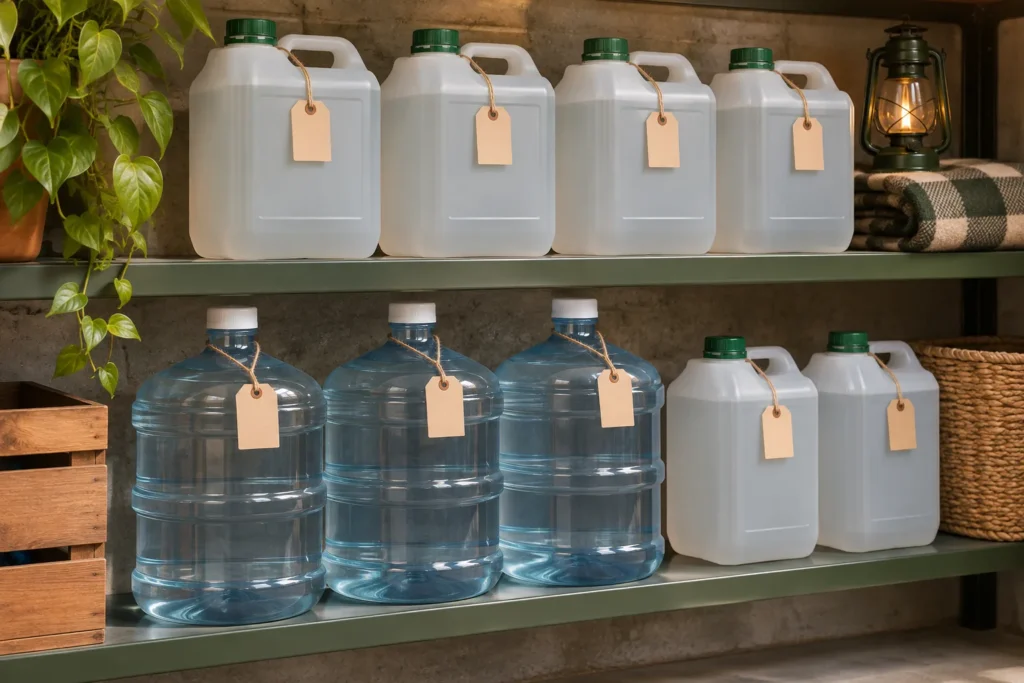
If you fill containers yourself, use food-grade water-storage containers. Do not reuse a container that held gasoline, pesticides, cleaners, or other toxic chemicals. Rinsing does not turn a chemical container into a drinking-water container.
Clean and sanitize reusable food-grade containers according to current public-health guidance before filling them. Label them as drinking water and mark the fill date.
For home-filled water, the CDC recommends replacing the stored water every six months.
That six-month mark is useful for more than rotation. It gives you a reason to put your hands on the system and find the little failures that otherwise sit unnoticed: a damaged cap, a faded label, a slow leak, a blocked shelf, or a transfer pump that no longer works.
Do Not Bet Everything on One Storage Spot
One location can become one point of failure.
A basement can flood. A garage can become extremely hot or cold. Debris can block a storage room. A large container can leak. Fire or structural damage can make part of a house inaccessible even when the water stored there is untouched.
You do not need bottles hidden in every closet. You do need enough separation that one ordinary failure does not take out the entire reserve.
A practical arrangement might put the main reserve in a cool, protected location and a smaller immediately accessible supply somewhere else. If evacuation is realistic where you live, some of that water should be in containers you can actually carry to a vehicle.
Here is the test I would use: pretend your main storage area is unavailable right now. Do you still have drinking water you can reach without entering it?
If not, fix that weakness before buying another gadget.
Protect the Supply From Obvious Storage Problems
Emergency water does not need a laboratory-perfect room. It does need protection from preventable problems.
Keep it in a cool place when practical, out of direct sunlight, and away from gasoline, pesticides, strong cleaners, and other toxic substances. Choose the best protected location your home realistically gives you rather than chasing a theoretical perfect spot.
The room name matters less than the conditions. Heat, sunlight, contamination hazards, and poor access are the things to notice.
Make Sure a Full Container Still Works for You
This is the part people skip because it seems almost too basic to test.
Test it anyway.
A five-gallon container weighs more than 40 pounds when full. Larger containers quickly become stationary objects. That is fine if the system is built around them. It is a problem if your plan quietly assumes somebody will pick one up and pour from it during an outage.
Take a full container and use it the way you expect to use it in an emergency.
Can the people in your household lift the smaller containers? Can you dispense from the larger reserve without wasting water? Do you need a spigot, pump, or transfer jug? Can you reach the cap under the shelf where the container actually lives?
Do the test while the lights are on and the floor is dry. The emergency version will not be easier.
Preparedness gear should work for the people who will really use it, not for an imaginary stronger and calmer household.
Stored Water and Water Treatment Solve Different Problems
Stored water is immediately available. Treatment is the backup when the reserve runs low or when authorities warn that the normal supply may be unsafe.
Do not treat those as the same thing.
Boiling and approved disinfection methods can address many disease-causing germs. They do not make water contaminated with fuel, toxic chemicals, or radioactive material safe to drink. If officials warn of that kind of contamination, use another water source.
The same caution applies to filters. Owning a camping filter does not make every questionable source drinkable. Filters have different capabilities. Know what your specific equipment is designed to remove before you depend on it.
For chemical disinfection, use current CDC or local public-health instructions instead of working from a bleach formula you remember from years ago. Product concentrations vary, and the right emergency guidance depends on the situation.
Give the System a Real Six-Month Check
A water plan is easy to forget because almost every day the faucet works.
So attach the inspection to something you already do twice a year. For home-filled containers, that timing also matches the CDC's six-month replacement guidance.
Rotate the home-filled water. Look for leaks, cracks, damaged caps, or signs of contamination. Check that labels and fill dates are readable. Make sure stored water is still accessible. Test the pumps, spigots, transfer jugs, filters, and other equipment the plan depends on.
Then do one thing a visual inspection cannot replace: take a container from storage and pour a glass from it.
That small test tells you whether the real system works from shelf to cup.
If the household has changed since the last check, recalculate the quantity too. A plan built for two people does not quietly become a four-person plan because you bought better containers.
The Better Standard Is Usable Water
"We have water in the basement" is not a complete emergency plan.
A better standard is knowing how much safe water you have, where it is, how you will move it, how you will dispense it, when home-filled containers were last rotated, and what you will do if the outage lasts longer than the reserve.
You can check most of that today without buying anything.
Count the gallons you already own. Check the containers. Look at the storage conditions. Lift the smaller ones. Dispense from the larger ones. Pretend the main storage area is inaccessible. Then fix the weakest part first.
A good water plan does not need to be complicated. It needs to work on the day the faucet does not.
Sources
CDC — Creating and Storing an Emergency Water Supply: https://www.cdc.gov/water-emergency/about/how-to-create-and-store-an-emergency-water-supply.html Ready.gov — Water: https://www.ready.gov/water
Key Takeaways
- Stored water is a system, not a stack of containers.
- Plan for quantity, safe containers, storage conditions, access, dispensing, rotation, and a backup source or treatment method.
- Do not keep the entire reserve vulnerable to one leak or one inaccessible room.
- Home-filled water should be dated, checked, and replaced on the CDC's six-month schedule.
- Treatment has limits. Boiling, disinfection, and filters do not make every contaminated source safe.
- Physically test the setup before an emergency. If you cannot get water from storage to a glass, the plan is not finished.
Step-by-Step Actions
- Count the gallons of emergency water you currently have.
- Compare that amount with at least one gallon per person per day for several days, then adjust for your household's real needs.
- Confirm that home-filled water is in food-grade containers that never held toxic chemicals.
- Check storage conditions for direct sunlight, excessive heat, nearby toxic substances, and access problems.
- Separate enough of the supply so one leak or inaccessible room cannot remove all of it.
- Lift, carry, open, and dispense from the containers exactly as you would during an outage.
- Check fill dates and replace home-filled water that has reached the CDC's six-month rotation point.
- Verify what your filter, boiling method, or disinfection plan can and cannot address.
- Decide where additional safe water will come from if the outage outlasts your stored reserve.
- Fix the weakest part of the system first, then repeat the check twice a year.
Checklist
- [ ] Enough water for the people and animals in the household
- [ ] Extra capacity for higher water needs
- [ ] Food-grade containers for home-filled drinking water
- [ ] No reused toxic-chemical containers
- [ ] Fill dates clearly marked
- [ ] Home-filled water on a six-month replacement schedule
- [ ] Water protected from direct sunlight and toxic substances
- [ ] Supply not dependent on one storage location
- [ ] Smaller containers can be lifted and carried
- [ ] Large containers can be opened and dispensed from
- [ ] Pumps, spigots, and transfer jugs tested
- [ ] Backup water source or treatment plan understood
- [ ] Treatment limits understood, especially for chemical contamination
- [ ] Full shelf-to-glass test completed
Put the Plan Into Practice
Use the water quantity guide and maintenance schedule together. Follow the CDC emergency-water storage instructions for suitable containers, storage conditions, and replacement timing.