Most people think they will rise to the occasion in an emergency. I have learned to be careful with that idea. People do not usually rise to some imaginary heroic version of themselves. They fall back to what they have practiced, what they have already decided, and what their body lets them do under pressure.
That is why understanding the stress response matters. It is not a soft subject. It is practical survival work. When the lights go out, when a child gets hurt, when smoke appears in the hallway, when traffic stops moving during an evacuation, your body changes before your thoughts catch up. Your breathing gets shallow. Your hands get clumsy. Your hearing narrows. You may stare at one problem while missing the bigger one.
None of that means you are weak. It means you are human.
The goal is not to become fearless. Fear is information. The goal is to stay useful while fear is running through your system.
What the Stress Response Actually Does
The stress response is your body’s fast alarm system. It pushes blood, energy, and attention toward immediate action. That can help if you need to move, lift, run, protect, or get away from danger. The same response can hurt you if the problem requires calm judgment, careful hands, or a sequence of small decisions.
I have noticed that people often talk about panic like it is one big dramatic event. In real life, it usually starts smaller. A person gets louder than usual. Someone keeps asking the same question. A simple task takes too long. A parent cannot find the flashlight that was “right there yesterday.” A driver keeps checking the same road app even though the network is already failing.
Those are stress signals.
Your body is trying to solve a threat quickly, but emergencies are rarely solved by one quick move. Most real problems require a short chain of good actions. Find the family. Stop the bleeding. Shut off the water. Move away from the crowd. Check the exit. Make the call while the phone still works. That chain breaks when stress turns into tunnel vision.
If you want the broader foundation behind this, the article on the survival mindset explains why calm is not a personality trait. It is a trained operating habit.
The First Job Is to Slow the Emergency Down
You cannot always slow the event itself. A fire still spreads. A storm still moves. A power outage still darkens the block. But you can slow the first ten seconds of your reaction.
That first pause is where a lot of emergencies are won or lost.
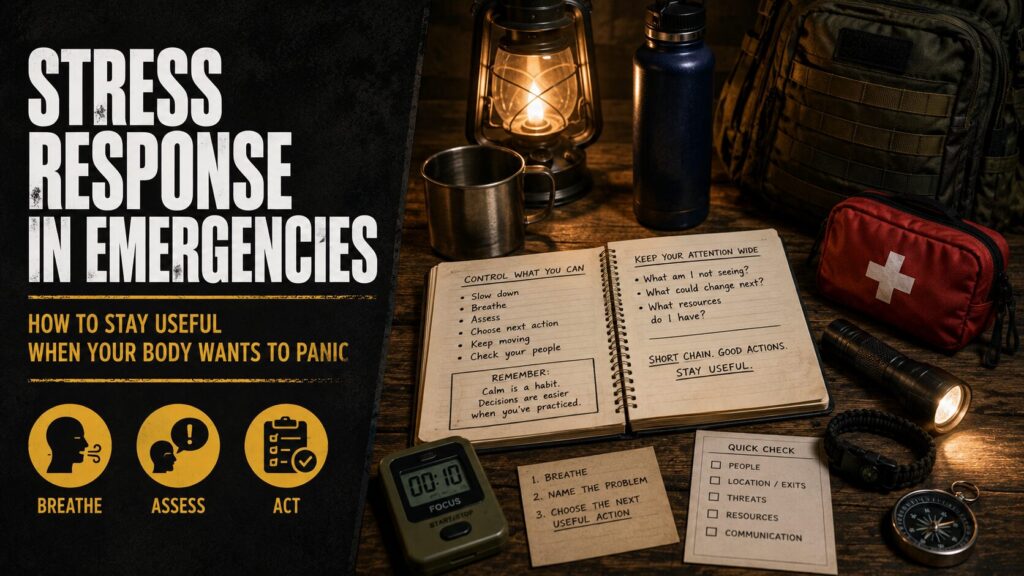
I use a simple pattern: breathe, name, choose.
Breathe once with control. Name the problem in plain words. Choose the next useful action.
Not the next perfect action. The next useful one.
For example, if the house suddenly goes dark, the first useful action might be, “Everyone stay where you are. I am getting the light.” If a child cuts a hand badly, it might be, “Pressure on the wound now.” If you smell smoke in an apartment hall, it might be, “Shoes on, keys in hand, check the door before opening it.”
That sounds almost too simple, but simple is what survives stress. Complicated plans look impressive at the kitchen table and fall apart when people are cold, scared, tired, or confused.
Stress Shrinks Your Attention
One of the most dangerous parts of the stress response is narrowed attention. You focus hard on one thing and stop seeing the rest.
That can be useful if the one thing is the actual threat. It is dangerous when the thing you are staring at is only part of the problem.
I once watched a group of people during a building alarm focus entirely on whether the alarm was “real.” They debated it in the hall instead of moving toward the exit. The signal was not asking them to solve the building’s entire safety picture. It was asking them to take the first safe action while more information came in.
This is where situational awareness matters. You are not trying to be paranoid. You are trying to keep your attention wide enough to notice exits, people, weather, sound changes, smells, water on the floor, blocked roads, or a family member who has gone quiet. The article on situational awareness before trouble gets close is worth reading because it teaches the habit before pressure shows up.
A good field question is: “What am I not seeing because I am staring at this?”
Ask that during a blackout. Ask it during a medical problem. Ask it in traffic. Ask it in a store when the mood changes.
That question pulls your attention back open.
Why People Freeze
Freezing is not laziness. It is not stupidity. It is often the body holding still while the mind tries to catch up.
The problem is that modern emergencies punish delay. A burst pipe keeps dumping water. A small flame becomes a room fire. A crowd gets thicker. A phone battery keeps dropping. The longer a family waits to make the first move, the fewer options remain.
The fix is to pre-decide small actions.
Do not wait until a crisis to decide where flashlights live, who grabs medication, where the meeting spot is, or which neighbor you can check on. The more you decide while calm, the less your brain has to invent while flooded with stress.
This is also why written plans matter. A family emergency plan is not paperwork for the sake of paperwork. It is a way to remove decision load when people are under pressure.
The Body Needs a Job
In a stressful moment, people do better when they have a clear job.
“Calm down” is not a job.
“Hold this flashlight on the breaker box” is a job. “Stand by the door and count everyone” is a job. “Put shoes on the younger kids” is a job. “Text Aunt Linda that we are safe” is a job. “Fill these two containers while the tap still works” is a job.
I have seen this change a person’s whole state. Give someone a clear, useful action and their breathing often steadies because their attention has somewhere to go.
This matters for families. In a household emergency, the loudest person is not always the most useful person. The quiet person may need a task. The scared child may need a task. The adult who is spiraling may need one clean instruction, not a lecture.
Keep the instruction short.
Use names.
Point to the object if needed.
Say what done looks like.
“Mike, take this radio to the table and turn it to the local station. Tell me when you hear a weather update.” That is much better than, “Somebody figure out what is happening.”
Signals Most People Ignore
Stress gives warning signs before it becomes full panic. Learn to catch them early.
Watch for repeated questions. That often means the person did not absorb the answer. Give a shorter instruction or write it down.
Watch for clumsy hands. Fine motor skills get worse under pressure. Use simple tools, larger motions, and clear lighting.
Watch for fixation. If someone keeps doing the same useless thing, interrupt gently and give a new task.
Watch for silence. A person who stops talking may be overwhelmed, injured, or mentally stuck.
Watch for false certainty. Stress can make people grab the first explanation and defend it too hard. “It is probably nothing” can be just as dangerous as panic.
Watch for rushing. Speed feels productive, but rushed movement causes dropped keys, missed turns, forgotten medication, and bad calls.
Watch for crowd mood changes. A line that gets louder, a road that stops moving, or a store that suddenly feels tense can tell you more than any official update at that moment.
These signals do not mean disaster is guaranteed. They mean you should widen your attention and prepare the next useful action.
How to Train the Stress Response at Home
You do not need military training to get better under pressure. You need small realistic repetitions.
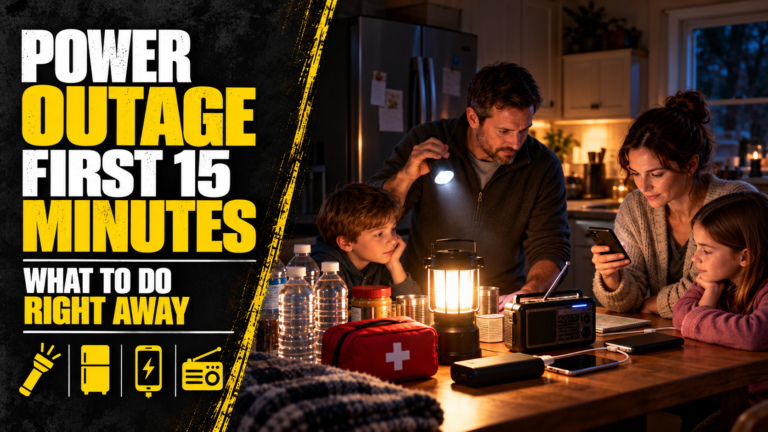
Walk through a blackout drill once. Not a dramatic drill. Just turn off the lights in your mind and ask, “Where is the first flashlight? Who needs help? What do we do first?”
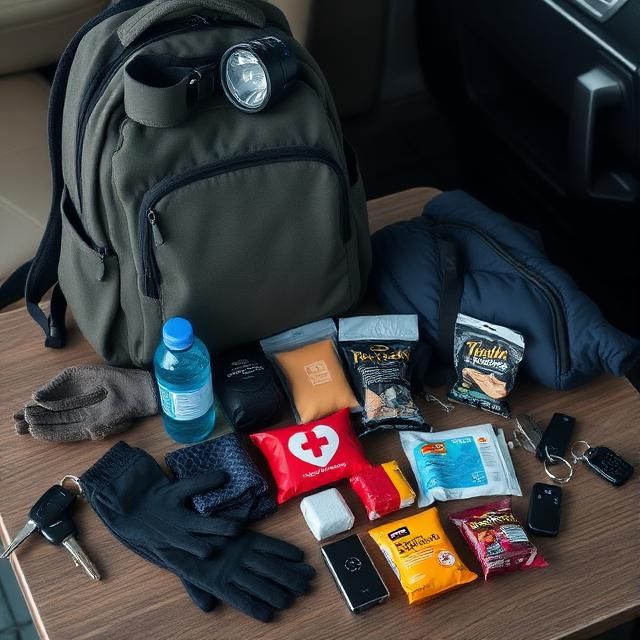
Practice finding your first aid kit without thinking. Practice opening it. Practice putting gloves on. Practice direct pressure with a towel. Practice saying, “Call 911 and put it on speaker.”
Practice leaving the house with shoes, keys, wallet, medication, phone, and pets. Time is not the main point. Smoothness is the point.
Practice two routes home without GPS. Practice where your family meets if the house is not safe. Practice using a battery radio before you need it.
The value is not perfection. The value is reducing novelty. Emergencies become more dangerous when every single action is new.
For the panic side of this, read panic in emergencies and what actually helps before it spreads. Panic is easier to manage before it becomes contagious.
A Simple Reset for the Moment Itself
When you feel yourself getting flooded, use a physical reset.
Plant both feet.
Lower your shoulders.
Take one slower breath than your body wants.
Look left, look right, then look at the problem again.
Say the next action out loud.
This does two things. It gives your body a signal that you are not helpless, and it gives your mind a short command to follow.
In a real emergency, I do not want fancy mental tricks. I want something a tired person can remember at 2 a.m. with the alarm beeping and a child crying. Feet. Shoulders. Breath. Look. Act.
That is enough to break the first wave.
Build Calm Into the Household Before You Need It
A household does not become calm by accident. It becomes calm because ordinary systems are already in place.
Flashlights have a home. Shoes are easy to find. Documents are backed up. Water is stored. Medication is tracked. Everyone knows the meeting spot. Emergency contacts are written down. The car is not always on empty. The adults have talked about who leads which task.
Stress feeds on uncertainty. Every small preparedness step removes one piece of uncertainty before the emergency begins.
This is not about pretending bad things cannot happen. It is about refusing to let the first minute turn into a mess that makes everything worse.
Key Takeaways
- The stress response is normal, but it can narrow attention, reduce coordination, and damage judgment.
- The first useful move is often to slow your reaction, not to solve the whole emergency at once.
- Simple instructions beat complicated plans when people are scared or tired.
- Pre-decided household actions reduce the mental load during pressure.
- Early stress signals include repeated questions, fixation, silence, rushing, and false certainty.
Step-by-Step Actions
- Choose one emergency scenario your household is most likely to face, such as a blackout, injury, or evacuation.
- Write the first three useful actions for that scenario in plain language.
- Assign simple household jobs by name, not by vague group instruction.
- Practice the first five minutes of the scenario without drama or fear tactics.
- After practice, fix the one thing that caused confusion, delay, or searching.
- Repeat monthly with a different scenario until the basics feel ordinary.
Checklist
- [ ] Flashlights have a known home and working batteries.
- [ ] First aid kit can be found and opened quickly.
- [ ] Emergency contacts are written down outside the phone.
- [ ] Household meeting spot is known by everyone.
- [ ] Each adult knows their first job during a blackout, injury, or evacuation.
- [ ] Children have simple age-appropriate tasks.
- [ ] Medication, keys, shoes, wallets, and phones can be gathered quickly.
- [ ] Family members have practiced one calm emergency walk-through.
- [ ] Everyone knows to breathe, name the problem, and choose the next useful action.