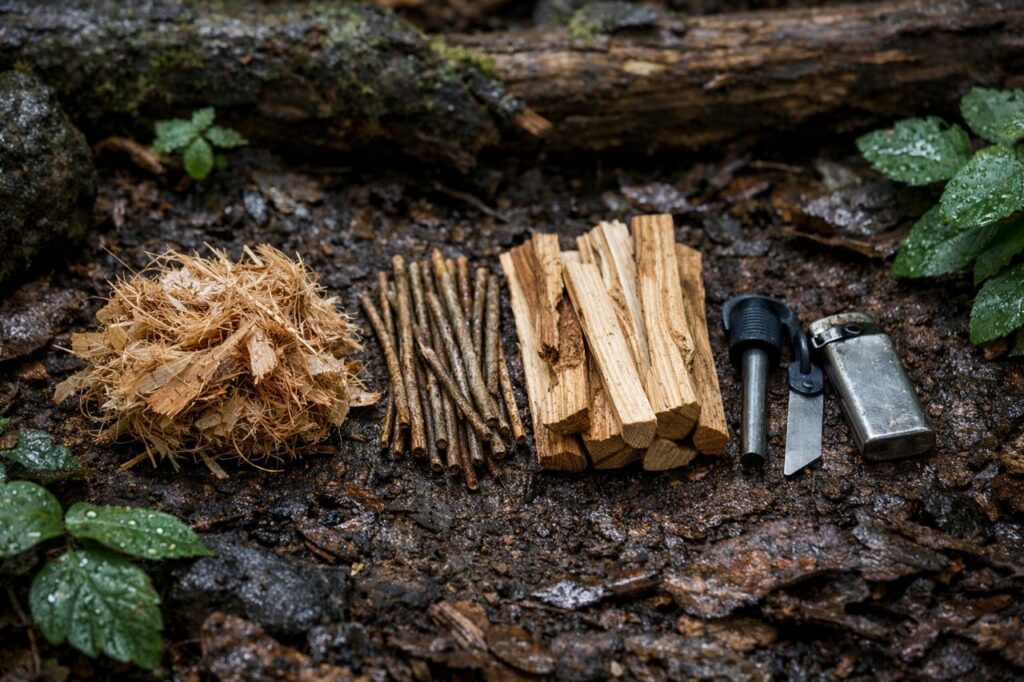
Fire Starting Basics Before the Spark
I think a lot of people learn fire starting backwards.
They focus on the dramatic moment. Spark, flame, success. That part is satisfying, sure, and it is what people remember from demonstrations. But in real conditions, especially when a person is cold, tired, rushed, or dealing with damp material, the spark is usually the easy part. The hard part is everything you did or failed to do before it.
A good fire is not really started when the match lights. It starts when you choose the spot, sort the material, protect the flame path, and build something small enough to catch and steady enough to grow. That sounds almost too basic, but basic is where most failures happen.
I have seen people put a strong lighter flame under a messy pile of sticks and then act surprised when nothing happens except smoke and frustration. That is common. They had heat. They had fuel. They even had oxygen. What they did not have was the right fuel in the right size, in the right order, with enough dryness to carry a weak little flame into a real fire. That’s usually the issue.
What Fire Actually Needs
Everyone hears about the fire triangle early: heat, fuel, oxygen. That is true, and it is useful, but it becomes more useful when you stop treating it like a school poster and start treating it like a practical checklist.
Heat is your ignition source. Match, lighter, ferro rod, ember, battery and steel wool, whatever.
Fuel is not one thing. That matters. Fuel is a ladder. Tinder first, then very small kindling, then slightly larger kindling, then fuel wood. If those sizes jump too fast, the fire stalls. A lot of beginners go from bird’s nest tinder to finger-thick sticks and then wonder why the flame dies. It dies because the gap was too big. The fire could not make the jump.
Oxygen sounds obvious, but people smother fires constantly by packing material too tightly. They build a pretty pile instead of a breathable one. The first little flame gets trapped, starved, and buried under enthusiasm. Happens all the time.
So the simple version is this: dry material, graduated sizes, room for air, and enough patience to let each stage become what it needs to become.
That last part is not a chemistry point exactly. Still matters.
Tinder, Kindling, and Why Size Is Everything
If I had to reduce beginner firecraft to one habit, it would be this: gather much more small material than you think you need.
Not more big wood. More small wood.
Tinder is your first receiver. It must catch quickly and hold flame long enough to ignite the next stage. Depending on where you are, that can mean dry grass, shredded bark, fatwood scrapings, birch bark, dry pine needles, char cloth, cotton treated with petroleum jelly, feathered inner bark, or shavings you make yourself with a knife. The keyword is not natural. The keyword is dry.
Kindling comes next, and this is where people get lazy. Good kindling should move in stages: matchstick-thin, pencil-thin, then finger-thin. I like to think of it as building a bridge from fragile flame to durable fire. If the bridge has missing pieces, the flame falls through.
One practical observation that people remember once they actually need it: thumb-thick sticks are not small wood. They are already fairly large in the early life of a fire. If your flame is still delicate, thumb-thick material may as well be a wet log.
That sounds exaggerated, but not by much.
Fuel wood is last. You do not rush it in. You feed it once the smaller structure is burning well enough that adding larger wood supports the fire instead of crushing it.
The Environment Matters More Than People Want It To
A fire on a calm dry afternoon is one thing. Building a survival fire in wet conditions is another thing completely.
This is why fire starting is not really one skill. It is a bundle of small decisions.
Ground moisture matters. Wind direction matters. Shelter matters. Whether your wood was lying directly on wet soil matters. Whether your tinder has been riding inside your jacket or sitting exposed in your pack matters. These details feel minor until they all lean the wrong way at once.
I think this is also where people get misled by demonstrations. Many demonstrations happen in controlled conditions with pre-selected material and dry backups close at hand. There is nothing wrong with that for teaching fundamentals, but it creates false confidence if a person mistakes demonstration success for field readiness.
A more honest mindset is this: assume conditions will steal efficiency from you. Then build margin.
Bring redundant ignition sources. Carry some dependable tinder, and keep the rest of your essential survival gear organized enough that you can reach it quickly. Process extra fine kindling before you need it. Choose a site that helps you instead of one that merely exists.
Choosing a Fire Site Without Getting Casual
A decent fire site does two jobs at once: it helps ignition and reduces risk, especially if you may also need shelter nearby.
You want a spot protected from unnecessary wind, clear of low overhanging fuel, and separated from dry grass, leaf litter, roots, and other material that can carry fire where you do not want it. If the ground is wet, snowy, or saturated, build a base from dry sticks or split wood so your first flame is not sitting directly on moisture.
That base matters more than some people think. Tiny fires lose heat quickly. If the ground is pulling heat out of your tinder bundle from below, your ignition source has to work harder to compensate. Sometimes people blame their ferro rod or their lighter when the real problem is that they tried to build the whole thing on a cold wet sponge.
If local conditions or land rules prohibit open fire, that settles it. Do not improvise your own exception. Survival skills are not an excuse for sloppy judgment.
Common Ignition Methods and What They’re Good For
Matches and lighters are still the simplest solution for most people. That is not cheating. That is practicality.
A lighter gives repeatable flame and buys you time. Waterproof matches are useful backup, especially if packed correctly. If you carry both, you are already ahead of a lot of avoidable failure.
A ferro rod is durable, weather resistant, and excellent in practiced hands. But it throws sparks, not sustained flame, so your tinder prep has to be better. That is the trade. People buy ferro rods because they look rugged, then discover they are not magic. A spark shower into poor tinder is still poor firecraft.
Friction methods like the bow drill have value as knowledge and as backup capability, but they are not where I would start someone who is still struggling to light dry tinder with a modern ignition source. There is a place for primitive methods. I just do not like watching basics get skipped because people are drawn to the romantic version first.
Learn reliability before drama. Usually the smarter order.
A Realistic Bad-Condition Scenario
Say it has rained off and on since morning. You are not in a cinematic survival collapse. You are just wet, colder than you want to be, and trying to get a cooking fire or warming fire going before light fades.
That is a good teaching scenario because it strips out fantasy and leaves the real work.
First, I would stop hunting for miracle dry wood lying openly on the ground. Most of that will be damp enough to waste time. I would look for protected material instead: dead standing wood, the dry interior of split branches, bark that shelters dry fibers underneath, resinous pieces, or wood from the underside of downed material that has not been soaking in mud.
Then I would process aggressively. Not gather vaguely. Process. Shave curls. Split sticks. Expose dry inner faces. Make a real tinder bundle, not a token handful. Build a serious pile of pencil-thin kindling before even trying ignition.
This is where people lose discipline. They get one tiny flame, panic with optimism, and start feeding it oversized sticks because they want to be done. Then the fire collapses and morale goes with it.
A better sequence is slower. Protect the ignition point with your body or a windbreak. Light the tinder. Feed it the thinnest material first. Let it strengthen. Then slightly thicker material. Then more. Once you hear that steadier crackle and see the structure holding its own, then you move up.
If smoke increases but flame weakens, something is off. Usually damp fuel, poor airflow, or material that is too large too soon. That is useful feedback, actually. Fire talks pretty clearly if you pay attention.
And maybe that is one of the better lessons in all this: a weak fire usually does not need heroics. It needs correction.
Fire Maintenance Is Part of Fire Starting
I do not think people separate these phases correctly. Starting the fire and maintaining it are often treated like different skills, but in practice the first few minutes of maintenance determine whether the fire was truly started at all.
A fire that briefly flares and dies was not really established.
Once your initial flame is stable, the next job is continuity. Keep fuel sizes appropriate. Avoid crushing the structure. Protect coal development. If you are using the fire for warmth, cooking, signaling, or drying, start thinking about purpose now, not ten minutes later.
Different purposes favor different fire shapes and fuel strategies. A quick cooking flame is not the same as a long-burning warming fire. A signal fire is another thing again. Basics first, yes, but basics should lead somewhere practical.
One small habit I like: before you sit back and enjoy the success, gather your next round of fuel. Not later. Right then. A young fire can consume small wood fast, and if you wait until it begins collapsing to fetch more, you may find yourself rebuilding instead of maintaining.
That is another ordinary failure point. People win the first minute and lose the next five.
Safety and Shutdown Still Count as Firecraft
A good fire is controlled. If it is not controlled, it is not a survival asset. It is a liability wearing a warm face.
Keep the fire small enough to manage. Know what surrounds it. Keep water, sand, or soil available if appropriate. Never assume a fire is out because visible flame is gone. Coals hold heat longer than impatience does.
When you are done, extinguish it completely. Stir. Wet. Stir again. Feel for remaining heat with care. If conditions or regulations require a different shutdown method, follow that. The point is not ritual. The point is certainty.
There is a kind of laziness that creeps in after the useful part is over. Food is cooked, hands are warm, mood improves, and people start acting like the problem is solved. That is often when judgment slips a little.
Don’t let it.
What Fire Starting Basics Really Mean
Fire starting basics are not about memorizing a list of methods and acting impressed by spark showers. They are about understanding sequence, fuel preparation, environmental friction, and patience under small pressure.
That may sound less exciting than primitive-skill theater, but it is more useful. Useful tends to age better.
If someone wants to become dependable with fire, I would have them practice the boring parts on purpose: sorting material by size, building dry tinder bundles, lighting in wind, lighting on damp days with protected inner wood, getting a flame to transition cleanly into kindling, then into working fuel. Do that enough and the whole subject stops feeling mystical.
Not easy, exactly. Just legible.
And that is usually what you want from a foundation skill. Not glamour. Not tricks. Just a repeatable way to turn preparation and attention into heat when the conditions are less friendly than you hoped.
Key Takeaways
- Fire success usually depends more on preparation than on the ignition source itself.
- Tinder, kindling, and fuel wood need to be sorted in clear size stages.
- Damp ground, wind, and wet material quietly ruin a lot of otherwise decent fire attempts.
- A weak young fire usually needs smaller, drier material and better airflow, not more force.
- Safe firecraft includes site choice, control, maintenance, and complete extinguishing.
Step-by-Step Preparedness Actions
- Build two or three fire kits with redundant ignition sources and keep one in your bag, vehicle, or home kit.
- Practice gathering and sorting tinder, pencil-thin kindling, finger-thin kindling, and larger fuel before you need them under stress.
- Test at least two ignition methods, such as a lighter and a ferro rod, so you know what each one demands from your tinder prep.
- Practice building a small protected fire on damp ground using a dry base of sticks or split wood.
- Add dependable backup tinder to your kit so bad weather does not force you to rely entirely on found material.
- Rehearse extinguishing fires completely so shutdown is part of the skill, not an afterthought.
Quick Preparedness Checklist
- Primary lighter
- Backup lighter or ferro rod
- Reliable dry tinder
- Pencil-thin kindling
- Finger-thin kindling
- Larger dry fuel wood
- Wind-sheltered fire site
- Dry base material for wet ground
- Water or soil for extinguishing
- Gloves or simple hand protection
Skills Practiced in This Module
- fuel selection
- tinder preparation
- kindling progression
- weather-adjusted fire building
- fire maintenance
- safe extinguishing