Most families already have a family emergency plan. They just don’t call it that. It lives in assumptions. One parent assumes they will leave work first. Somebody assumes the school will hold the kids. Everybody assumes cell service will work, the car will start, the dog will come when called, the flashlight batteries are still good, and home will stay the natural meeting place because home is always the answer until it suddenly isn’t.
That’s the problem. Normal life covers for bad planning. Routine hides a lot. The school day starts and ends when expected. Roads stay open. Phones connect. Power hums in the background and makes the whole house feel more organized than it really is. Then you get a strong storm, a gas leak nearby, a fast evacuation, a long outage, even a simple school closure that hits at the wrong hour, and the family finds out what was never actually decided.
Who picks up whom. Who has the spare key. Which neighbor the kids are allowed to go to. What happens if one adult is unreachable for six hours instead of sixty minutes. Where the prescription medication is, not vaguely, but exactly. These things sound obvious when the house is quiet. Under stress they get slippery fast.
I think that’s why a lot of family emergency plans fail before they even exist. People imagine some heavy-duty binder with color tabs and maps and checklists and all the rest of it. Too much ceremony. The whole thing starts to feel like a hobby project, or office paperwork dragged into the house. Then it gets postponed. What families actually need is simpler and, honestly, more useful: default decisions made ahead of time.
A good family emergency plan is a stack of pre-decided answers. If we have to leave the house now, we meet here. If we can’t call each other, we check in through this person. If the kids are at school and the roads are a mess, this adult is primary and this adult is backup. If home is unsafe, this is where we regroup next. Not glamorous. Still important.
One practical observation I keep coming back to is that households run on habits more than memory. Ask people where the flashlights are and you may get three different answers, none of them completely wrong. Ask who always notices weather alerts first, who usually has medicine in a bag, who remembers numbers, who knows the neighbors, who drives the route past the school anyway, and now you’re dealing with reality. That’s what the plan should be built on. A family’s actual operating system, not the neat version of itself it imagines on a productive Sunday.
So I’d start with people, not stuff. Write down everyone in the household. Add anybody who matters to your real daily rhythm: a grandparent who helps with pickup, a babysitter, an older teen who watches younger siblings after school, a nearby relative, maybe a trusted neighbor if that’s normal in your life. Then think about the interruptions most likely to hit your household. Fire. Severe weather. Blackout. Chemical spill. Flooded roads. Water outage. A sudden need to leave the neighborhood. It does not have to be dramatic to matter.
Most families do not need separate master plans for fifteen scenarios. They need one strong core plan and a few adjustments. The core questions are pretty plain. Where do we meet outside the house if we need to leave immediately. Where do we meet if the block or neighborhood is a problem. Which out-of-area contact can act as a message relay. Who is responsible for children, pets, medications, important papers, and the one or two things that are truly annoying or expensive to replace. How long should each person stay where they are before moving to the next step.
That last part is worth more thought than people usually give it. Time changes the problem.
A one-hour disruption is mostly a communication issue. An eight-hour disruption becomes a food, water, charging, and pickup problem. Overnight turns into shelter, clothing, sleeping, pet supplies, cash, sanitation, and maybe prescriptions that suddenly matter a lot more. Same event, different shape depending on how long it drags on. If a family plan doesn’t account for time even a little, it can look good on paper and still fall apart by dinner.
The out-of-area contact idea is old, but it still holds up. Sometimes local networks get crowded or patchy while a text to someone outside the area goes through. Not always. Good enough to keep in the plan. And there’s another benefit — one person outside the mess can become the relay instead of every family member trying and failing to update everybody else separately.
Here’s where things often get messy, though. Families talk about intentions and mistake them for assignments. That never works for long. “We’ll get the kids” is not an assignment. “I’ll grab what we need” is not an assignment either, not unless somebody knows exactly what that means. A useful plan names primary and backup roles. Who gets the children. Who handles pets. Who grabs the medication pouch. Who takes the document folder or lockbox. Who confirms everyone is out. If there’s only one adult in the home, the plan should say exactly which outside person is the realistic backup. That’s not weakness. That’s just honest planning.
Picture a normal ugly day. A thunderstorm crosses the area in late afternoon. Several intersections lose traffic lights. School dismissal gets delayed, then staggered. One parent is stuck well across town. Another is closer but in the same traffic jam as everybody else trying to get to the schools. Cell service works badly enough to be irritating and not quite reliable. A middle-schooler gets dropped off nearby, walks home, finds the power out, and can’t open the garage because the door opener is dead. They keep texting. Some messages send. Some don’t. Nobody is in mortal danger, but stress ramps up because the family is improvising everything in real time.
Now run that same evening with a decent family plan. The parent who is closer is already designated as primary for weather-related pickup problems. If both adults are delayed beyond a certain point, the backup person is activated without debate. The middle-schooler already knows that if the house is inaccessible or feels wrong, they go directly to the designated neighbor and leave a short note in the agreed place if possible. The younger child knows to stay with school staff until a named adult or named backup arrives. Everyone who can text sends one short status update to the out-of-area contact: location, okay or not okay, next move. No long explanations. No repeated calling that burns battery and attention.
That is what planning buys you. Not perfect control. Just less confusion, which is usually enough to matter a lot.
Communication is where I think families trust technology a little too much. Phones are useful. Phones are not the plan. Younger kids should have simple contact cards in a backpack if they’re old enough to manage them. Older kids should know at least one important phone number from memory, even if that sounds old-fashioned. Adults should keep key numbers somewhere other than their phone. Paper still works when the battery doesn’t. That’s boring advice, maybe, but a lot of preparedness is boring right up until it suddenly looks smart.
Meeting points matter for the same reason. They need to be obvious, limited, and stupidly easy to remember. One spot immediately outside the home. One neighborhood fallback. Maybe one wider-area location if evacuation is realistic where you live. A tree across the street. The church parking lot. A relative’s house outside the flood zone. Something plain. Too many options create hesitation. People don’t need a menu when they’re rattled. They need a small ladder of choices.
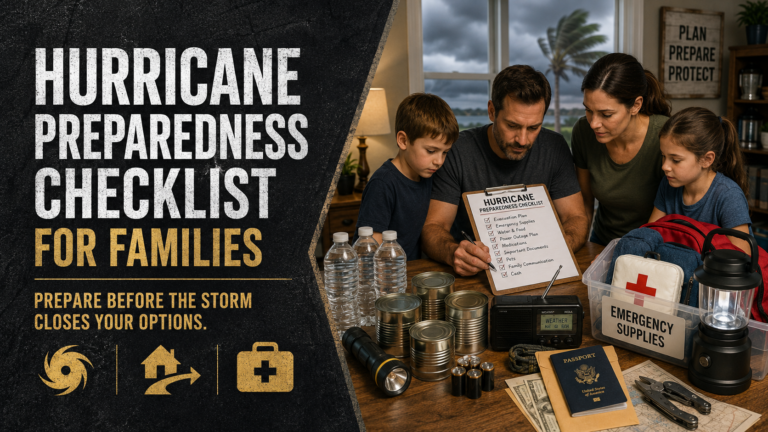
The plan also has to connect to actual supplies in actual places. Water. Flashlights or headlamps. Phone chargers and battery banks. Basic first aid. Spare keys if that makes sense. Prescription meds. Copies of identification and insurance cards. Pet food. Comfort items for kids. I think people underrate comfort items, honestly. A child with a familiar stuffed animal or blanket is easier to move, settle, and care for than a child handed some clever piece of emergency gear they don’t care about.
Access matters more than quantity in a lot of homes. Supplies hidden in three closets and one overloaded junk drawer are not really shared resources. They’re just objects the household owns in theory.
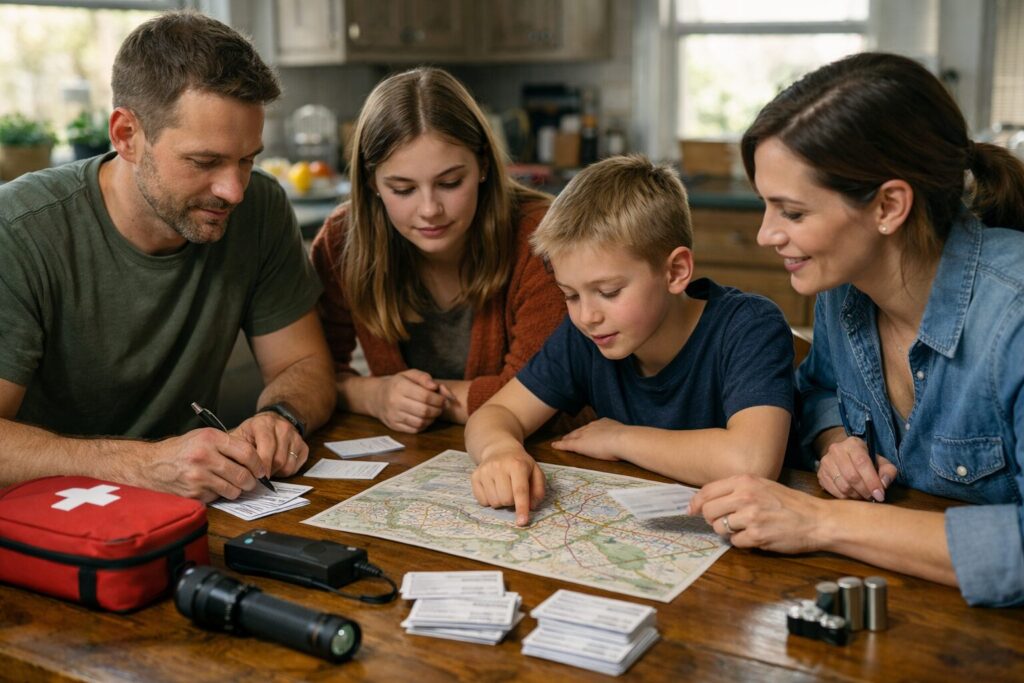
So walk the plan. Literally. Stand at the front door and talk through what happens if you have to leave in two minutes. Then do a version for a school-day disruption. Then one for a nighttime fire alarm. Maybe one for a power outage that runs through the next morning. You’ll find weak points immediately. Dead batteries. Outdated numbers. A child who doesn’t know the backup person by name. A pet carrier buried behind storage bins. A document folder nobody can grab quickly because it’s inside something else. Good. Better to find that out on a calm evening.
Children should be included without dumping adult anxiety on them. Younger kids need simple, repeated directions. Go here. Stay with this person. If you can’t find us, go to this neighbor. Older kids can handle more: sending a short text, using a battery bank, helping with a younger sibling, following a backup route if that is truly safe and appropriate. Keep the plan age-sized. Preparedness gets weird when adults start performing seriousness instead of building something a child can actually remember.
I’d also resist the urge to perfect the plan before writing it down. That kills momentum. Write the first workable version. One page is enough for most families, maybe two. Print it. Save it digitally too, yes, but print it. Put copies where adults can get to them without thinking hard. Update it when schools change, jobs change, medications change, phone numbers change, people move, life shifts around. Because it will.
Mostly I want a family emergency plan to reduce friction. That’s the standard. Not whether it looks polished. Not whether it covers every improbable event. Just whether it helps worried people do the next sensible thing a little faster, with a little less confusion. If it can do that, it’s already doing real work.
Key Takeaways
- Family emergency plans work best as simple default decisions, not oversized binders.
- The plan should match a household’s real habits and routines, not an ideal version of them.
- Out-of-area contacts, paper numbers, and clear meeting points make communication more reliable, especially when you have already worked through a family emergency communication plan template.
- Primary and backup roles reduce the classic problem of everybody assuming someone else handled it.
- Walking through the plan at home reveals the practical failures that matter most.
Step-by-Step Preparedness Actions
- List each household member and the few outside people who regularly affect pickup, care, or communication.
- Choose one immediate meeting point, one neighborhood fallback, and one wider-area backup if needed.
- Assign primary and backup responsibility for children, pets, medications, documents, and transportation.
- Make simple printed contact cards for adults and children who are old enough to carry them.
- Gather core emergency supplies in a few easy-to-reach locations known to more than one person.
- Walk through at least two realistic disruptions, such as a power outage during school pickup or a nighttime evacuation.
- Update the plan whenever addresses, schools, jobs, medications, or phone numbers change.
Quick Preparedness Checklist
- Printed family contact list
- One out-of-area contact
- Immediate home meeting point
- Neighborhood fallback location
- Flashlight or headlamp
- Battery bank and charging cable
- Prescription medications
- Copies of important documents
- Pet supplies if needed
- Comfort item for children
Skills Practiced in This Module
- emergency planning
- family communication
- evacuation coordination
- household organization
- scenario-based thinking
- role assignment under stress