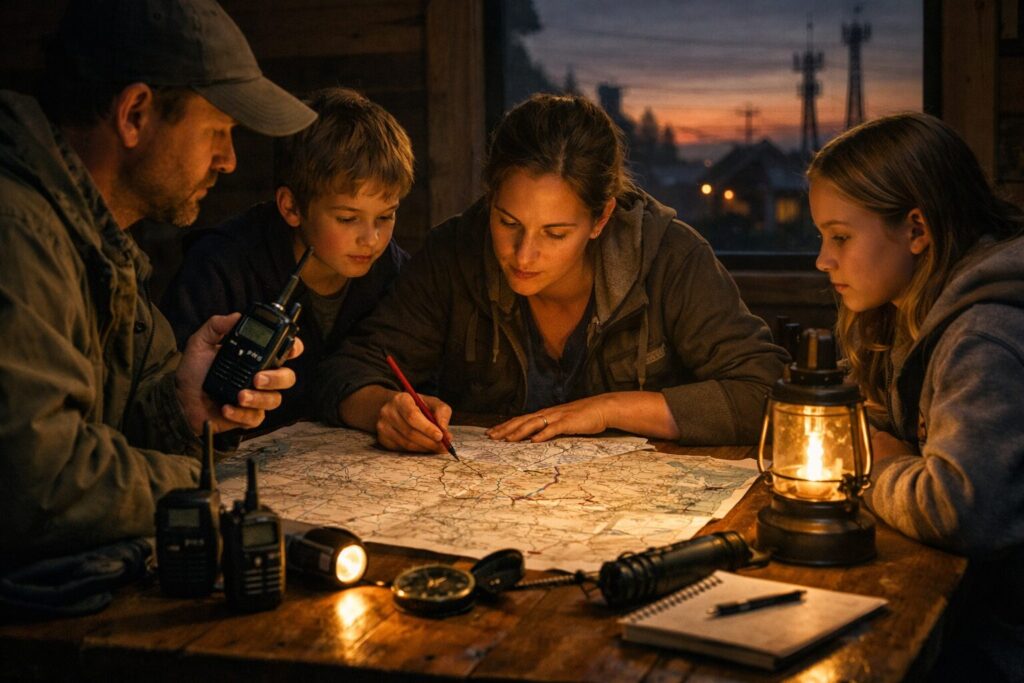
When the Lines Go Quiet You Need Emergency Communication
People tend to assume communication will always be there. Phones, text messages, email, social media — some version of a signal always seems to exist. Even during storms or blackouts, most outages feel temporary. A few hours maybe. Then everything lights back up again.
But infrastructure has a strange fragility to it.
Cell networks depend on towers, backhaul connections, routing systems, power, and a web of companies coordinating quietly in the background. The internet is even more layered than that. Take out enough pieces — storms, power failures, overloaded networks — and suddenly the system stops behaving the way we expect.
When that happens, confusion spreads faster than the actual emergency.
I’ve watched families end up separated simply because nobody stopped to think through the obvious question ahead of time: How do we find each other if the normal channels disappear?
Not a complicated question. But most people never really ask it.
A communication plan doesn’t need to be elaborate. Actually the opposite tends to work better. The best ones are simple enough that people remember them under stress.
Communication Plans Are Mostly About Decisions Made in Advance
The moment an emergency starts is the worst possible time to invent a plan.
People assume they’ll “figure something out.” Maybe drive around looking for each other. Maybe keep trying the phone every few minutes. Maybe head home and hope everyone else does the same.
Sometimes that works.
Often it doesn’t.
The problem is uncertainty. Or really, too many possibilities.
If nobody knows what anyone else will do, every decision becomes a guess. People improvise. They drive around. They wait. They worry.
Good communication planning removes that guessing.
A basic plan usually answers a few practical questions:
- Where do we meet if we cannot communicate?
- Who is responsible for checking on specific people?
- What locations do we try first, second, and third?
- What time intervals do we attempt contact?
That may sound almost too simple. But clarity beats complexity most of the time.
Imagine a power outage across a large city. Cell networks overloaded. Internet intermittent.
One family has a plan: everyone goes to the same relative’s house if phones fail for more than four hours.
Another family doesn’t.
The first group reconnects fairly quickly.
The second group spends half the night worrying and trying different things.
Planning isn’t dramatic. It’s quiet logistics.
Designating a Primary Meeting Location
This is one of the most overlooked pieces.
A physical rendezvous point solves a surprising number of problems.
If communication disappears entirely — which does happen — people still know where to go.
The location should meet a few conditions:
- Familiar to everyone
- Reachable by multiple routes
- Reasonably safe during common emergencies
- Close enough that people can reach it on foot if necessary
For families, this is often a home or a trusted relative’s house.
But sometimes a second location makes sense. Especially in urban areas where evacuation might occur.
For example:
Primary meeting location: home.
Secondary meeting location: a park two miles away that everyone knows.
Now if one location becomes inaccessible, the fallback already exists.
It removes hesitation. Or at least most of it.
The Quiet Value of an Out-of-Area Contact
Something interesting happens during large emergencies.
Local networks fail first.
Long-distance networks sometimes remain functional longer because traffic routes differently.
That’s why many communication plans include a designated out-of-area contact.
Everyone in the group knows the same person outside the affected region.
If local calls fail, someone may still be able to reach that contact from another location. A pay phone, a landline, a borrowed phone — anything.
Then that person becomes the message relay.
Example:
You reach the out-of-area contact and say:
“I’m safe. Heading to the meeting location.”
Later someone else checks in.
Now the relay passes the message along.
It sounds a little old-fashioned. In some ways it is.
But simple systems often survive infrastructure failures better than modern ones.
Radios: The Tool Most People Ignore
Phones are amazing technology. But they’re also fragile in emergencies because they depend on networks.
Radios don’t.
A basic handheld radio works even if every cell tower in the region goes dark.
Now, that doesn’t mean radios are magic. They still require planning and familiarity. But once people understand how they work, they become incredibly useful.
Common options include:
FRS radios
These are the small walkie-talkies people buy at outdoor stores. They require no license and are simple to operate. Range is usually short — a mile or two in real conditions — but that’s often enough for neighborhood coordination.
GMRS radios
Similar to FRS but more powerful. They require a license, though the process is straightforward. The added range can make a noticeable difference, especially in suburban or rural areas.
Amateur (ham) radio
This opens a much larger world of communication. Local networks, repeaters, regional contacts, and sometimes global communication depending on equipment.
Ham radio requires study and licensing, but many emergency communication networks operate through it.
I’ve noticed something interesting over the years.
People who first explore radio communication often assume it’s complicated.
Then they try it once.
After that, it starts to feel oddly reassuring.
A direct signal between two radios doesn’t rely on anyone else’s infrastructure.
Just physics. Mostly.
Pre-Arranged Communication Windows
One mistake people make is trying to communicate constantly.
That burns batteries and creates frustration.
Instead, it helps to establish scheduled communication windows.
For example:
Every hour at the top of the hour.
Or every two hours depending on the situation.
Everyone attempts contact during those windows.
If no contact occurs, people conserve power and try again later.
This system keeps communication predictable and prevents devices from draining unnecessarily.
Radio operators have done this for decades.
It works well. Usually.
Messages Should Be Short and Clear
Stress changes the way people communicate.
Some people talk too much. Others forget important details.
A useful habit is practicing structured messages ahead of time.
A simple format works well:
Location
Status
Intent
For example:
“At the library. Safe. Walking home.”
Or:
“Stuck at work. Safe. Staying overnight.”
No extra details needed.
Short messages transmit faster and reduce confusion.
You might be surprised how effective that becomes when communication is limited.
Children Should Understand the Plan Too
Adults sometimes design elaborate plans that children never hear about.
Then an emergency happens.
Children follow instinct instead of the plan.
That’s not their fault.
If a communication plan exists, everyone in the household should know it. Even younger kids can understand basic instructions like:
“If we can’t call each other, go to this place.”
Simple repetition helps.
People remember what they practice.
Maps Still Matter
Digital maps are convenient. But they rely on power and connectivity.
Paper maps remain one of the most underrated tools in preparedness.
They allow people to identify routes, landmarks, and alternate meeting points without electronics.
A simple printed map with key locations marked can prevent a lot of confusion.
Sometimes the older tools survive longer.
Sometimes they just sit quietly in a drawer until the moment someone suddenly needs them.
The Human Side of Emergency Communication Planning
One thing I’ve noticed about emergency planning — it’s rarely about equipment.
It’s about clarity.
People who communicate well ahead of time tend to handle emergencies more calmly.
They know where to go.
They know what others will do.
They aren’t guessing.
A communication plan does something subtle. It replaces uncertainty with expectation.
That change alone reduces panic.
You don’t need complicated gear.
You need a few clear decisions made before the moment arrives.
And maybe, occasionally, a reminder that technology is helpful… but not always guaranteed.
Once people accept that, their planning tends to get sharper. Or at least more realistic.