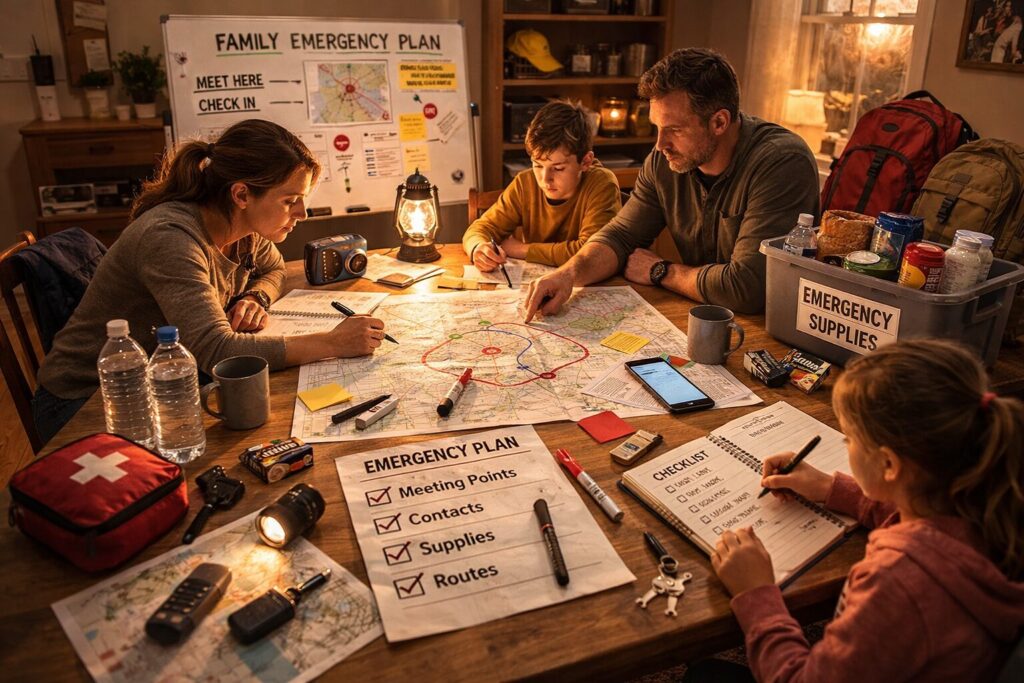
Most family emergency plans fail for one simple reason.
They exist in a folder.
Or a drawer somewhere.
Or in the back of someone’s mind where it feels responsible enough just to have thought about it once. That feels like planning, even when it isn’t.
The problem isn’t that families don’t care. It’s that most plans are built in comfort and expected to function in chaos. And those are two very different environments. It sounds obvious when you say it like that, but people still design plans for calm days and assume they’ll hold up when everything’s loud and moving fast.
Stress changes the way people think. It narrows attention. It scrambles recall. Even simple tasks start to feel oddly complicated. So the first thing I accept is this: if the plan isn’t simple enough to execute when everyone’s heart rate is elevated, it probably won’t work. Or it won’t work the way you imagined it would.
That realization changes how I approach everything. Or at least it should.
Clarity Before Complexity
When families start planning, they usually jump straight into gear lists. Flashlights. Food storage. Generators. Backup chargers. That’s fine. Useful, obviously. But equipment is secondary.
The real plan is about decisions.
Who calls whom?
Where do we meet?
What happens if we’re separated?
Who makes the call if someone is injured?
If those answers are vague, the rest doesn’t matter very much. You can own every piece of equipment on the market and still hesitate at the wrong moment.
I prefer to start with three basic scenarios:
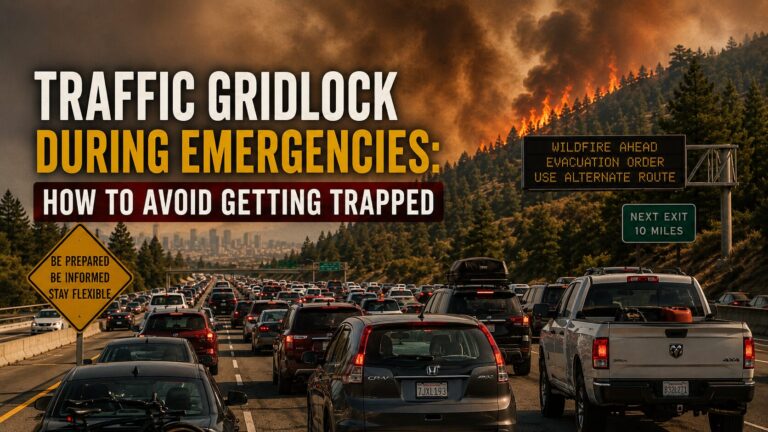
- A sudden evacuation.
- A shelter-in-place event.
- A communication blackout.
Almost every realistic emergency falls into one of those categories, or overlaps them a bit.
Evacuation is about movement. Shelter-in-place is about staying put longer than you’d like. Communication blackout is about uncertainty, which might be the hardest part.
The mistake I see often is trying to account for every possible disaster — earthquake, wildfire, power grid failure, chemical spill, storm surge. That becomes overwhelming fast. You end up building a plan that looks thorough but feels heavy. But if I can handle movement, endurance, and communication failure, I’m covering most of the practical ground. Not everything. Just most of it.
Now, here’s where most plans quietly fall apart.
They’re not rehearsed.
If It Isn’t Practiced, It’s Fiction
I’ve seen families write beautifully organized emergency plans. Color-coded binders. Printed maps. Contact sheets laminated.
Then I ask a simple question: if the power goes out right now, who grabs what?
Silence.
That’s not criticism. It’s just human nature. We assume that knowing something once means we’ll recall it later. But stress interferes with recall. Familiarity doesn’t equal readiness. It only feels like it does, which is part of the problem.
I prefer something much simpler.
Walk through it.
Actually simulate it.
Turn off the lights one evening and say, “Okay. Power’s out. What do we do?” See what happens. You’ll notice gaps almost immediately. Someone doesn’t know where the flashlight is. Someone else forgot the spare batteries are in a different drawer. Maybe the phone battery is already low and nobody checked.
Good. That’s useful.
A plan that reveals its weaknesses during a calm drill is a gift. A plan that reveals them during a real emergency is a liability. And most plans haven’t been tested even once, not in any real way.
The Meeting Point Rule
Every family needs two meeting points.
One close. One far.
The close one is for neighborhood-level disruptions. Fire, gas leak, something that forces you out of the house but not out of the area. Maybe it’s the large oak tree across the street. Maybe it’s a neighbor’s driveway. It doesn’t need to be dramatic or clever.
The far one is outside your immediate zone — a relative’s house in another part of town, a familiar public location, somewhere that doesn’t rely on your local infrastructure.
And here’s the important part: everyone must be able to explain how to get there without GPS.
I don’t assume that maps will load. I don’t assume phones will function normally. If someone in my family can’t describe the route in basic terms — major roads, landmarks — then we haven’t finished planning. Not really. We’ve just talked about it.
It sounds old-fashioned, but physical maps still matter. Even a printed screenshot of your area is better than nothing. Paper doesn’t crash. At least not in the same way.
Communication Isn’t Automatic
In large-scale events, cell networks clog. It doesn’t take much. A regional storm can overwhelm towers within minutes.
One thing that often works when voice calls don’t is text messaging. Text uses less bandwidth and sometimes slips through when calls fail. That’s useful to know. It’s not guaranteed. Sometimes nothing works.
But I never rely on a single method.
I encourage families to choose an out-of-area contact — someone who lives in a different city or state. Everyone in the family checks in with that person. It becomes a communication hub. Instead of five people trying to call each other in a panic, they all send one message to the same contact.
That reduces chaos. Or at least it can reduce it.
I’ve seen this work. A friend of mine lived through a regional power outage that lasted several days. Local communication was unreliable, but his sister two states away became the central point of coordination. It wasn’t dramatic. It wasn’t cinematic. It was steady. Calm. Organized enough to keep everyone informed.
That’s what you want most of the time.
Roles Prevent Paralysis
In stress, people freeze.
They wait for direction.
If no one has a defined role, everyone hesitates. And that hesitation costs time. Not a lot of time, maybe, but enough to matter.
I prefer assigning simple responsibilities:
- One person gathers the emergency bag.
- One person checks on pets.
- One person verifies utilities are shut off if evacuation is required.
- One person makes sure doors and windows are secured.
It doesn’t need to be complex. In fact, the simpler the better. Complicated systems collapse under pressure. Or they get ignored.
Children can have roles too. Age-appropriate ones. Maybe it’s grabbing their own small bag. Maybe it’s staying physically attached to a parent. Giving them responsibility reduces fear. It gives them something specific to focus on, something to do with their hands.
When people know what to do, they move. When they don’t, they stall. And once people stall, it spreads.
Build for Realistic Time Frames
Another mistake I see is planning only for extremes.
Either people assume rescue will be immediate, or they prepare for total collapse. Both are emotional reactions, usually.
Most real emergencies fall somewhere in between.
Power outages that last 24–72 hours.
Temporary road closures.
Supply disruptions that resolve within days.
So I start by building for three days.
Water. Basic food. Light. Warmth or cooling depending on climate. Medications. Critical documents stored safely and accessible.
Three days covers most disruptions. Beyond that, you can scale. But if you can’t comfortably manage three days without outside support, that’s the baseline to fix first. It’s a reasonable starting line, even if it feels small.
And yes, it’s practical to store water. One gallon per person per day is a common guideline. That’s not paranoia. That’s math. Hydration needs don’t disappear just because the power did. They just become more obvious.
The Psychological Layer
This is the part people underestimate.
Fear spreads faster than fire.
In a crisis, children watch the adults. Adults watch each other. If the tone is frantic, everything escalates.
A working emergency plan creates emotional stability as much as logistical readiness. When everyone knows there’s a system — even a simple one — anxiety drops. Not entirely, but noticeably. It doesn’t make things easy. It just makes them steadier.
I’ve noticed something over time. The families who prepare thoughtfully tend to worry less, not more. Because uncertainty shrinks when you’ve already considered scenarios. You don’t eliminate fear. You take some of the sharpness off it.
Preparedness isn’t about expecting disaster. It’s about reducing mental noise. About knowing you’ve at least thought things through. Maybe not perfectly. But enough.
There’s a difference.
Documents and Redundancy
Important documents matter more than most people realize.
Identification. Insurance information. Medical records. Contact lists.
Digital copies are fine, but I don’t rely solely on cloud access. A waterproof folder with copies of critical documents takes very little space. In a rushed evacuation, having those documents in one known location eliminates frantic searching. And frantic searching wastes time you don’t really have.
Redundancy matters. A spare set of house keys. Extra phone charger. Backup batteries stored together, not scattered across drawers where you’ll forget them.
Disorganization during normal life becomes amplified during emergencies.
So I simplify storage. Centralize essentials. Make it obvious. Obvious beats clever, most days.
Adapt the Plan to Your Environment
A family in a wildfire-prone region has different priorities than one in a hurricane zone or an urban apartment.
I don’t believe in generic preparedness. I believe in localized awareness.
If flooding is common in your area, do you know your floodplain status? If winter storms regularly knock out power, do you have safe backup heat options? If you live in a high-rise building, how will you evacuate if elevators are disabled?
The plan should reflect reality, not imagination.
I don’t chase rare, cinematic threats. I focus on what’s statistically and historically plausible where I live. That keeps the plan grounded. It keeps it from drifting into something theatrical.
Preparedness grounded in context is rational. Preparedness detached from reality drifts into anxiety. And anxiety makes people either overreact or do nothing.
Review It. Lightly. Regularly.
Plans decay over time.
Phone numbers change. Children grow older. People move. Supplies expire quietly on a shelf.
I like to revisit emergency plans twice a year. Nothing dramatic. Just a quiet review. Replace expired items. Confirm meeting points. Make sure everyone still remembers their role. Sometimes that’s all it takes. Sometimes it reveals something you forgot.
It doesn’t need to be an event.
Five minutes is often enough. Ten, maybe.
The goal isn’t perfection. It’s familiarity.
Because when something unexpected happens — and eventually, something will — the brain reaches for what feels known.
If the plan feels known, it gets used.
And that’s really the measure of whether it works. Not how impressive it looks on paper. Not how detailed it sounds in conversation.
It works if, in the middle of noise and uncertainty, everyone already knows what to do.
Not because they memorized it.
Because they’ve walked through it before. Once or twice. And that tends to be enough.