A long power outage plan starts before the lights go out. Two hours without power can be an inconvenience. Three days can force a household to change how it eats, stays warm, gets water and decides whether to remain at home. Buying more batteries does not solve all of that. Refrigeration, safe indoor temperatures, water pumping, sewage systems, medical equipment, communications, fuel and access to supplies may all become problems on different schedules.
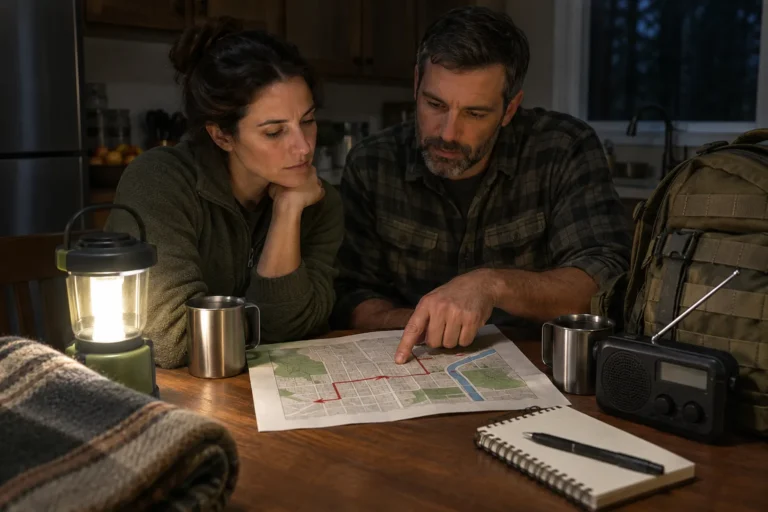
Before the lights go out, answer three questions: What must keep working? How long can each backup carry it? What condition means it is time to leave? Put the answers where everyone in the house can find them.
Contents
- Build a Long Power Outage Plan Around Household Needs
- The First Hour
- Hours 1–12
- Hours 12–24
- Day Two and Beyond
- A Practical Three-Day Example
- Power and Fuel
- What May Fail Next
- Key Takeaways
- Step-by-Step Actions
- Checklist
Build a Long Power Outage Plan Around Household Needs
Walk through an ordinary day at home. Where does electricity quietly do work? A well pump may stop immediately. Municipal water may continue through stored pressure or backup power, then become unreliable. A gas furnace may still need electricity for its blower and controls. A phone can keep working while the local cell tower's backup power lasts, but that is not guaranteed.
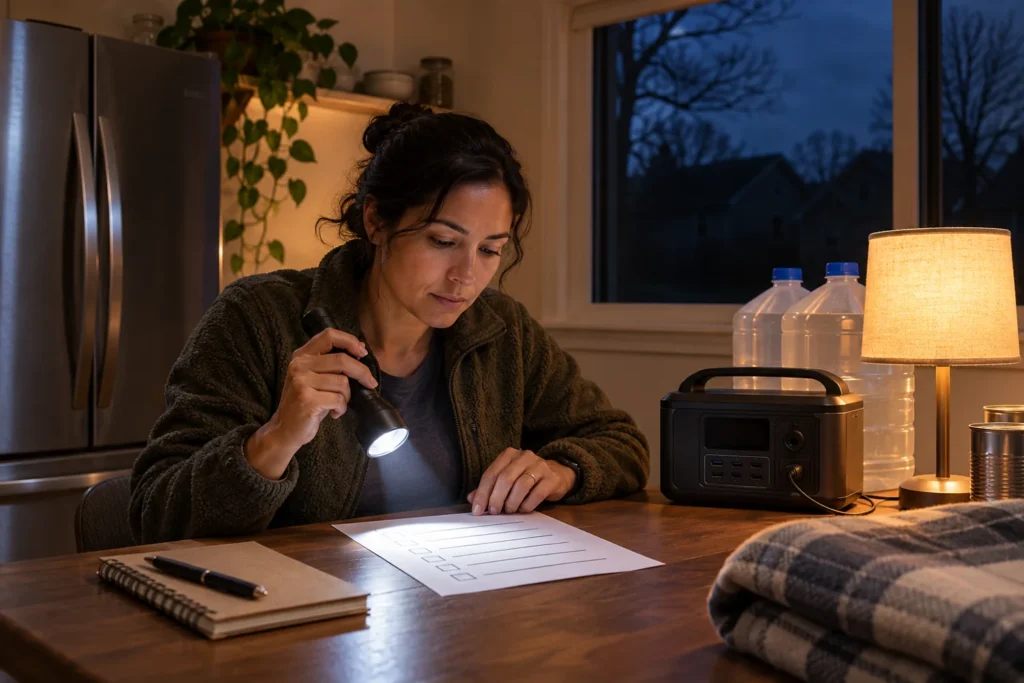
Make a household dependency sheet with six columns: essential function, electrical dependency, backup, measured endurance, warning sign, and action when the backup fails. Record the test date as well.
A backup that lasted eight hours during a mild-weather test may run for much less time when a pump, furnace blower or other load cycles more often. For example, a charged power bank might keep one phone available for limited check-ins, but it cannot guarantee cellular service. A generator might power a refrigerator but not an electric range, and its useful duration depends on safe fuel supply.
A capacity label is not a promise of runtime. Try the backup with the equipment you actually intend to run, and record what happens.
The First Hour: Establish What Happened
Check whether the problem is a tripped circuit, your building, your street or a wider outage. If a breaker has tripped, do not repeatedly reset it or investigate damaged electrical equipment in unsafe conditions.
Report the outage to the utility if necessary; a neighborhood social-media post is not a substitute for a utility report. If there are downed wires, sparking equipment, floodwater near electrical systems or the smell of gas, move away and contact the appropriate emergency service or utility. Never approach a downed line or assume it is dead.
Use flashlights or headlamps rather than candles. Keep refrigerator and freezer doors shut. Record the approximate outage start time. Charge devices from stored power only as needed, and check utility notices using a battery radio or phone when service is available. Avoid tying up a phone with continuous refreshing.
If anyone relies on powered medical equipment, refrigerated medicine or temperature-controlled care, follow the equipment or care team's established backup plan immediately. Do not wait for a general household decision deadline.
Hours 1–12: Protect Your Options
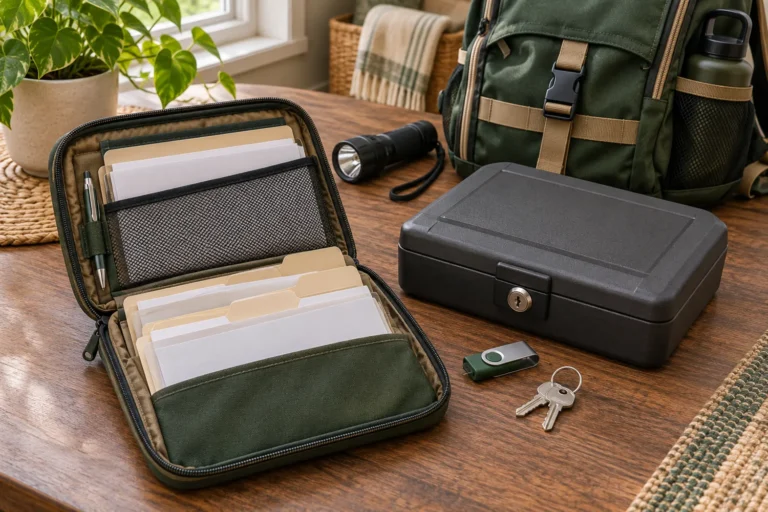
Move from normal household use to conservation. Put essential lighting in a few locations. Keep stairways and exit routes clear. Choose one charging station and a check-in schedule. Set aside drinking water rather than assuming faucets will continue indefinitely. Ready.gov recommends one gallon per person per day for at least three days for drinking and sanitation; use its basic emergency supply checklist as a starting point. Keep printed contacts and key records with your grab-and-go papers; our emergency document storage guide explains an offline record system.
Food safety needs its own clock. A closed refrigerator generally keeps food cold for about four hours; a full closed freezer about 48 hours and a half-full one about 24 hours. These estimates assume the doors stay shut.
For refrigerated perishables such as meat, fish, eggs and leftovers, follow the CDC's food safety guidance after an emergency: discard them after four hours without power unless you have reliably maintained safe refrigeration. Also discard perishables exposed above 40°F for two hours or more, or one hour when ambient temperatures exceed 90°F.
If you cannot establish a safe temperature history, discard questionable perishables. Frozen food with ice crystals remaining or a measured temperature of 40°F or below may generally be refrozen or cooked under USDA guidance. Use appliance thermometers and food-specific guidance; never taste food to judge safety.
If indoor temperatures are climbing or falling, identify the safest room and the people most vulnerable to heat or cold. Avoid improvised indoor combustion heating or cooking. Charcoal grills, camp stoves and fuel-burning generators must never be used indoors, in garages or near openings where exhaust can enter. Carbon monoxide cannot be detected by smell. The CDC's carbon monoxide safety guidance explains generator placement and other exposure risks.
Hours 12–24: Stop Planning Around a Quick Restoration
At this point, uncertainty matters as much as the outage itself. A restoration estimate may change. Water pressure can drop even if it worked earlier. Gas stations and stores may be unable to pump fuel or process payments. A building's powered access or wastewater system may not behave normally.
Check official utility and local emergency-management updates at scheduled intervals. Separate confirmed information from neighbor speculation. Tell household members which supplies are reserved, where to find lights, and when the next check-in will occur.
Inventory the supplies that can actually be used without grid power: drinkable water, food that requires no cooking, medicine, hygiene materials, batteries, cash, transportation fuel and safe shelter. Dry pantry food that needs a powered stove or substantial water is not an immediate meal.
Day Two and Beyond: Use Decision Triggers
Write the stay-or-go triggers while conditions are still manageable. Otherwise, each new problem turns into another debate at the worst possible time. For a simple way to choose the next safe action together, see our guide to decision-making under stress.
Stay only while the home remains safe, temperatures are manageable, sanitation works, required care is supported, and drinking water and food are adequate. Put a measurable threshold next to each concern: remaining usable water, indoor temperature trend, medicine or equipment backup time, and whether toilets can still be used. Check the shortest remaining margin first rather than averaging all supplies into a reassuring 'days remaining' figure.
Relocate before conditions become dangerous when you cannot maintain a safe temperature, required medical support, potable water or safe sanitation. Use official shelter information and a confirmed destination when possible. Do not drive through floodwater or into areas with downed power lines. A family member's powered house is not a reliable destination until you have confirmed that it has power and room.
Your trigger may differ from your neighbor's. A household with an infant, an older adult, a person with medical equipment, or animals requiring powered water systems may need to move sooner. A rural home with a well and septic pump faces different constraints from an apartment with municipal services.
A Practical Three-Day Example
Imagine a household of three loses power on a cold Friday evening. They have six gallons of stored drinking water, several no-cook meals, two power banks and a small generator. At the common planning baseline of one gallon per person per day, six gallons represents only two days for three people, before additional heat, illness, hygiene or animal needs. That arithmetic becomes an early resupply or relocation trigger.
The generator runs outdoors in an appropriate location, but its fuel supply is limited. The home has a furnace that requires a powered blower.
On Friday, the family verifies the outage, protects refrigerated food and starts conserving power. Saturday morning, they check their actual water and fuel reserves. The generator cannot be treated as continuous heat for three days merely because it can start the blower. They decide to use power for essential short periods only if the generator and heating equipment are safely compatible.
By Saturday afternoon, the indoor temperature is falling. The family checks official warming-center information and confirms a place to stay before roads become icy. Their decision is based on safe temperature and fuel endurance, not on a promise that power will return 'soon.'
This is a hypothetical planning example, not a universal operating schedule. Actual conditions and equipment determine the decision.
Power and Fuel: Know the Limits
A generator must be matched to the required running and starting loads, voltage and connection method. Never backfeed a household circuit through a wall outlet. Permanent connections require appropriate transfer equipment installed to applicable codes.
Operate portable generators outdoors more than 20 feet from doors, windows and vents, with exhaust directed away from the building, and follow manufacturer and local guidance. If you cannot meet the required separation, do not run the generator at that location. Never operate one in a garage, even with the door open.
Working carbon-monoxide alarms are a second layer of protection, not permission to place a generator too close. Refuel only after shutdown and adequate cooling.
A battery power station is quieter and avoids exhaust at the point of use, but it has finite stored energy. Estimate runtime by dividing usable watt-hours by the watts of the connected load, then reduce the result for conversion losses and real operating conditions.
A 500 Wh unit supplying a steady 50 W load has a theoretical ten-hour limit (500 ÷ 50 = 10); actual usable runtime will often be shorter because of conversion losses, reserve limits and changing loads. For equipment that cycles, measure energy used over several hours rather than treating its nameplate wattage as a continuous draw. Heating and cooking loads can drain batteries far faster than lighting or phone charging.
Watch What May Fail Next
A long outage can become a water problem, a temperature problem, a communication problem or a sanitation problem. Watch for changes: falling tap pressure, sewage backup, a refrigerator warming, a carbon-monoxide alarm, or a medical device nearing the end of its backup.
Do not assume a working faucet proves water is safe. Follow local boil-water, do-not-drink or do-not-use notices as written; boiling is not a remedy for every contaminant. If wastewater is backing up, stop using affected plumbing and follow local instructions.
After power returns, review the long power outage plan and write down what ran short first, which backup disappointed you and which decision took too long. Those are the fixes worth making before the next outage.
Key Takeaways
- A multi-day outage is a sequence of changing household dependencies, not just a longer lighting problem.
- Record each critical system, backup duration and failure trigger before an outage.
- Protect refrigeration early, but judge food by temperature and food-specific guidance.
- Monitor safe temperature, water, sanitation, medical needs and communications separately.
- Decide on relocation while routes and destinations are still usable.
- Generator and battery capacity must be checked against real loads and safe operation.
Step-by-Step Actions
- List essential household functions and their electrical dependencies.
- Test each backup and record its actual operating limits.
- Store drinking water and meals usable without grid-powered cooking.
- Set a communication schedule and identify reliable official information sources.
- Record the outage start time and protect refrigerated food.
- Monitor indoor temperature, water supply, sanitation and medical needs.
- Write specific triggers for staying, reassessing and relocating.
- Confirm at least one alternate safe destination and route.
- Practice a short no-grid household drill.
- After any outage, correct the first failed backup or missing supply.
Checklist
- Essential electrical dependencies listed: Yes / No
- Backup lights accessible: Yes / No
- Water and no-cook meals available: Yes / No
- Appliance thermometers available: Yes / No
- Medical and medication backup plan checked: Yes / No
- Safe heating/cooling contingency identified: Yes / No
- Generator connection, placement and fuel plan verified if applicable: Yes / No
- Carbon-monoxide alarms working: Yes / No
- Official information sources and check-in schedule written: Yes / No
- Sanitation failure plan written: Yes / No
- Relocation triggers and destination confirmed: Yes / No
- Household drill completed: Yes / No