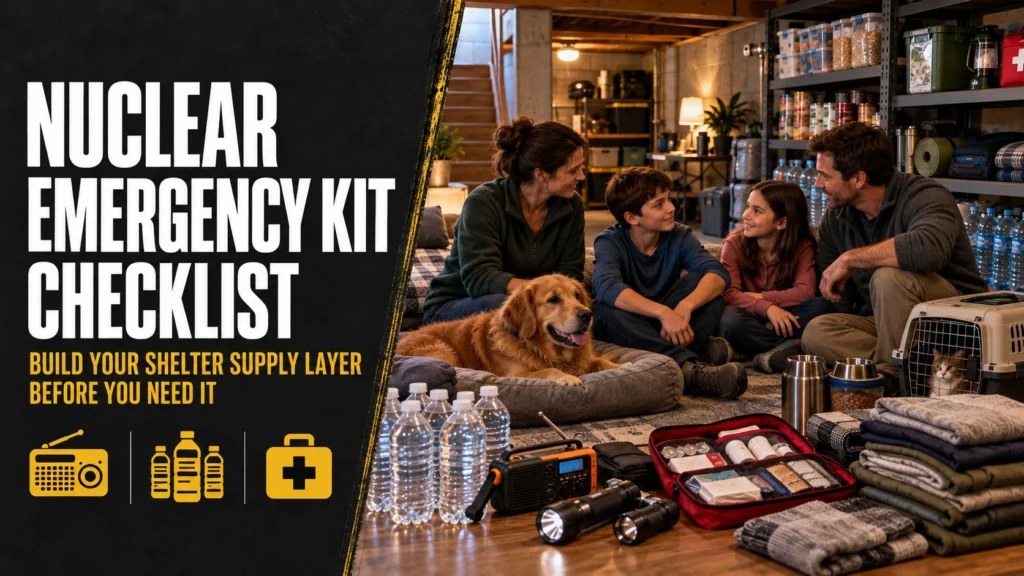
A nuclear emergency kit should help you do three things well: get into the best shelter you can reach, stay there without going back outside, and keep receiving reliable instructions while conditions change.
That is more important than owning exotic gear.
Federal guidance is consistent: get inside, stay inside, and stay tuned. FEMA says the best shelter after a nuclear detonation is underground or near the middle of a large building, away from the roof and exterior walls. CDC says staying inside for at least 24 hours can reduce exposure while radiation levels outside fall, unless officials give different instructions.
Build the kit around the place where you would actually shelter. Do not build a bag full of specialty equipment while leaving the basics scattered around the house.
Start With the Shelter, Not the Shopping List
At home, the best available location may be a basement, an interior room, or the middle of a larger building. At work, school, or another regular location, know the nearest substantial building you could reach quickly. Cars, mobile homes, and open outdoor areas provide poor protection compared with a solid building.
Use one test:
Could everyone in the household stay in the chosen shelter area for a full day without going back outside for something important?
If not, fix that gap first.
This is the same systems thinking used in a citywide blackout: the problem is rarely one failed device. It is several household systems becoming dependent on whatever still works.
What Belongs Within Reach of the Shelter
Keep the first layer in or immediately beside the shelter area:
- Safely stored drinking water
- Packaged, shelf-stable food that needs little or no cooking
- Essential prescription medications
- A battery-powered or hand-crank radio
- A flashlight or headlamp
- Spare batteries for critical devices
- A basic first-aid kit
- A charged phone power bank
- Sturdy shoes
- A clean change of clothes for each person
- Plastic bags for contaminated outer clothing
- Soap, clean cloths, and basic hygiene supplies
- Important contact information and documents
- Necessary infant, disability, medical-device, or mobility supplies
- Pet food, water, leash or carrier, medications, and records
The radio deserves special attention. Internet and cellular service may be damaged or overloaded. CDC recommends a battery-powered or hand-crank emergency radio, preferably one that can receive NOAA weather radio broadcasts, so you have another path to official instructions.
Do not bury it under six storage bins. New information may change what you should do next.
Protect Water and Food From Contamination
For a radiation emergency, the safest food and water are supplies already sealed or protected inside before fallout arrived.
FEMA guidance says packaged food and items that were inside a building can be used, while uncovered food or liquids left outdoors may be contaminated. That makes a household water storage plan useful even if the public water system has not failed.
Store foods that need little water to prepare. A shelf full of dry food that requires several pots of water can quietly consume the drinking supply you are trying to protect.
For the first day, simple wins: protected water, ready-to-eat food, a manual can opener if needed, and enough calories to keep everyone functional.
Add a Simple Decontamination Layer
If someone was outside after radioactive material began settling, the immediate problem may be radioactive material on clothing, hair, and skin.
CDC says removing the outer layer of clothing alone can remove up to 90% of radioactive material.
Keep a few simple items ready:
- Large plastic bags
- Clean replacement clothing
- Soap
- Clean water if available
- Disposable cloths or wipes
- A clean towel
- A simple mask or cloth covering for handling dusty contaminated clothing when needed
Remove outer clothing carefully, isolate it in a bag away from people and pets, wash exposed skin and hair when possible, and change into clean clothes.
A mask is not a radiation shield. It may reduce the amount of radioactive dust you breathe, but it does not stop penetrating radiation. Distance, time, and shielding are the larger protections.
That is why a basement or the interior of a substantial building matters more than an expensive respirator worn in a poor shelter.
Potassium Iodide Has a Narrow Job
Potassium iodide, or KI, gets more attention than its role justifies.
KI can help protect the thyroid from radioactive iodine in certain radiation emergencies. It does not protect the rest of the body, does not protect against all radioactive materials, and does not reverse radiation injury.
CDC says to take KI only when public-health or emergency officials, or a healthcare professional, instruct you to take it. Taking it unnecessarily can cause harm.
If KI is appropriate for your location and household, treat it as a specific medical countermeasure with instructions—not the centerpiece of the kit. Most important, never leave good shelter to go searching for KI after an emergency has begun.
What About Geiger Counters, Gas Masks, and Specialty Gear?
Specialized equipment can be useful in trained hands, but it should come after the basics.
A radiation detector does not create shielding, clean water, replace medicine, or tell you what officials know about conditions across a region. A gas mask does not turn a car into a fallout shelter. Plastic sheeting does not replace the mass of concrete, brick, earth, and distance that reduce external exposure.
For most households, the priority order is:
- A known shelter location
- Reliable water and ready-to-eat food
- Medicines and household-specific medical needs
- Communications and lighting
- Clean clothing and simple decontamination supplies
- Sanitation and pet supplies
- Backup power for critical devices
- Specialized equipment only when you understand what problem it solves
Preparedness gets stronger when every item has a job.
Build a Several-Day Supply Layer
The first 24 hours matter because officials may direct you to remain sheltered while outdoor radiation levels decline. A broader emergency can last longer.
Add several days of water and food, extra medications and medical consumables, sanitation supplies, batteries and charging capacity, cash, paper maps, spare eyeglasses or hearing-aid batteries, pet supplies, and simple tools you already know how to use.
Your existing 72-hour emergency supplies checklist is a strong foundation. The nuclear-specific layer is mainly shelter location, information, contamination control, and resisting the urge to leave good shelter too early.
Prepare an Evacuation Add-On Without Assuming You Should Go
A go-bag is useful, but it solves a different problem.
After a radiation emergency, officials may tell you to remain sheltered or later direct you to evacuate along a specific route. CDC says local officials will identify when to leave, where shelters are located, and which routes reduce exposure.
Prepare a small evacuation add-on with medicines, important papers, a change of clothes, sturdy shoes, phone charging, cash, hygiene items, and pet supplies.
Keep the decision rule clear:
The existence of a go-bag is not an instruction to go.
Leaving a protected building at the wrong time can increase exposure. If family members are already sheltered at schools, hospitals, nursing homes, or workplaces, CDC says they should generally remain sheltered there until officials say travel is safe rather than having relatives immediately cross the affected area to retrieve them.
A good family emergency plan should make that separation rule clear before an emergency.
Signals Most People Ignore
A nuclear emergency creates pressure to act, and that pressure can make movement feel safer than waiting.
Watch for these failure signs:
- Someone wants to drive across town simply because the family is separated
- Social-media rumors are replacing official instructions
- People are focused on KI, masks, or detectors while the shelter itself is poorly stocked
- The radio is packed where nobody can reach it
- Essential medication is stored outside the shelter area
- Pets cannot be brought inside quickly
- The household has food but not enough protected water
- Everyone knows where the gear is, but nobody has agreed on where to shelter
Those are system failures, not shopping failures.
Run a Ten-Minute Shelter Drill
Set a ten-minute timer and tell the household: “Radiation emergency. Get to the shelter location with what we need for the first day.”
Then look at what happened.
Did someone go upstairs for medicine? Was the radio dead? Did the pet hide? Was the water too heavy to move? Was there a clean set of clothes available? Did anyone know how to stop outside air from being pulled into the shelter?
Fix those problems one at a time.
The purpose of the drill is not fear. It is to make the first real response boring because the decisions have already been made.
Key Takeaways
- The best nuclear emergency kit starts with a good shelter location, not specialty gear.
- Keep water, food, medicine, communications, lighting, clothing, hygiene, and pet supplies near the shelter so you do not have to go outside.
- Removing contaminated outer clothing and washing exposed skin can sharply reduce radioactive contamination.
- Masks may reduce inhalation of particles but do not shield the body from radiation.
- KI protects only the thyroid from radioactive iodine and should be taken only when officials or a healthcare professional instruct you to use it.
- Stay inside until officials say it is safe to leave; a packed go-bag is not a reason to evacuate early.
Step-by-Step Actions
- Identify the best shelter location at home and practical shelter locations at work, school, and other places you regularly spend time.
- Move a first-day supply of water, food, medications, radio, lighting, clean clothing, hygiene items, and household-specific supplies within easy reach of the home shelter.
- Add bags, clean clothes, soap, wipes, and towels for simple contamination control.
- Make sure everyone understands that masks and KI have limited roles and do not replace shelter.
- Expand the basic supply layer to cover several days of normal emergency needs.
- Prepare a separate evacuation add-on with medicines, documents, clothing, cash, charging, and pet supplies.
- Write down the rule that nobody leaves shelter merely to reunite unless officials say travel is appropriate or there is an immediate life-threatening reason.
- Run a ten-minute shelter drill and fix every missing item or confused step you find.
Checklist
☐ Best home shelter location identified
☐ Backup shelter location identified
☐ Water and ready-to-eat food stored near shelter
☐ Essential medicines available
☐ Battery or hand-crank radio working
☐ Flashlights, batteries, and phone charging ready
☐ First-aid kit available
☐ Clean change of clothes for each person
☐ Bags and basic decontamination supplies ready
☐ Household medical and accessibility needs covered
☐ Pet food, water, carrier/leash, and medication ready
☐ Important contacts and documents accessible
☐ Several-day emergency supply layer built
☐ Evacuation add-on prepared
☐ Family understands the shelter-first rule
☐ Ten-minute shelter drill completed