

Free printable resource / household preparedness
Know where your water is and what needs attention next.
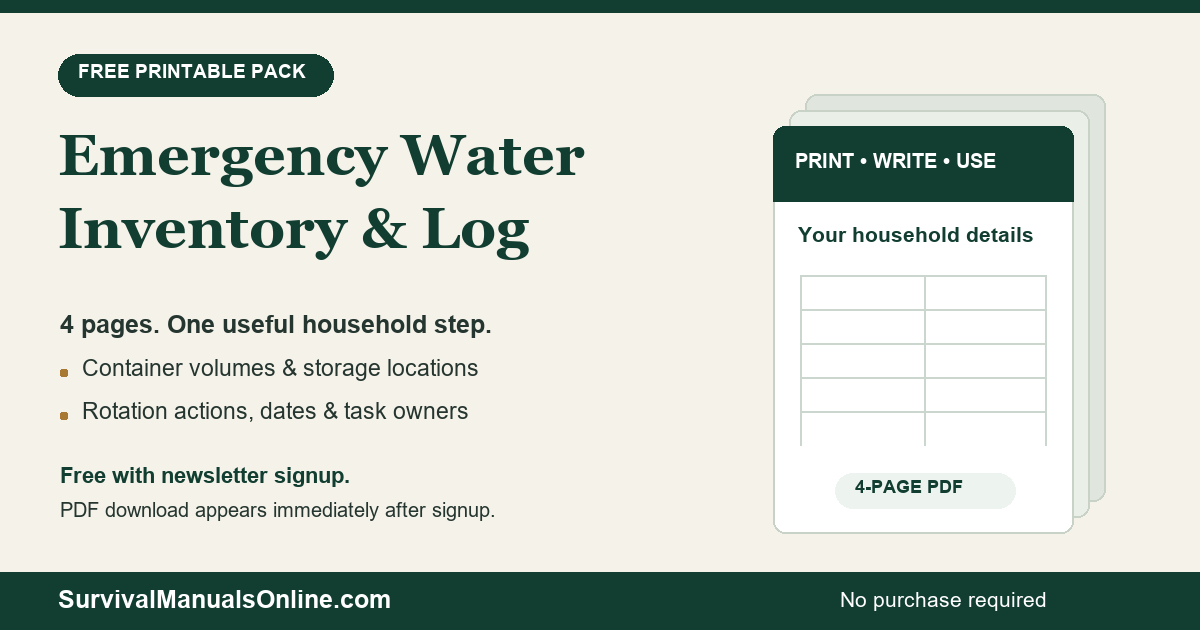
An emergency water inventory is useful when it describes the water you actually have, not just the containers you meant to fill. This free four-page printable helps you identify each container or batch, record actual volume and storage location, assign rotation actions, and compare available supplies with your household plan.
Join the newsletter & get the free pack
Your download link appears on the page after signup. It is not sent by email.
What is inside the free printable pack?
Container register
Give each container or batch an ID. Record actual volume, fill or label date, and the exact place where it is stored.
Rotation & condition log
Track reviews, container condition, due actions, and the person responsible. Keep self-filled containers separate from commercially bottled water.
Household availability
Compare planned amounts with usable supplies in a consistent unit. Record access, dispensing, transport, and assistance gaps.
Review & follow-up
Use a short inspection routine and action list to keep the record current after use, replacement, or a change in storage.
Get your free four-page worksheet pack
Join the Survival Manuals Online newsletter for preparedness tips and product updates. Your PDF download appears immediately after you submit the form.
No purchase required. Request removal from the email list through our Contact page. Read our Privacy Policy. We ask for your email only; keep completed household worksheets privately with trusted people.
Know someone who would use this?
Share the free worksheet pack with a family member or friend. The link explains the newsletter signup and gives them their own download.
Or copy this page link:
Get a preview image for sharing
Save this card to share alongside the page link.
 Download the preview image
How to use this emergency water inventory
- Give the supply an identity. Label each container or clearly defined batch, then use the same identifier in the register. You should be able to match an entry to the water in front of you without relying on memory.
- Count actual volume. Record the amount present, not a container's maximum capacity. Use a consistent unit when adding totals. Do not count empty jugs, a filter, or a possible future source as stored drinking water.
- Separate the date types. For containers you fill, record the fill date. For commercial water, copy the relevant label date. Keep a condition review separate from a replacement deadline; one column should not pretend to answer every safety question.
- Assign the next action. CDC advises replacing self-filled stored water every six months and observing the expiration date for store-bought water. Put the applicable action in the log and name who will carry it out.
- Check whether the water is usable in practice. Can someone locate the supply, lift or dispense it safely, and reach it if one storage area is unavailable? Write down the problem rather than counting an inaccessible reserve as a complete plan.
- Update after use or replacement. Change the actual volume, record the new date where appropriate, and schedule a review. Use official advisories and current CDC guidance for safety decisions; a tidy spreadsheet or worksheet cannot establish water quality.
For the wider decisions and background, read our Household Water Storage Checklist and Household Water Storage Guide. This printable supplies a place to record your own plan, rather than replacing those guides.
Avoid the most common inventory mix-up
A household may have three different things on one shelf: a commercially bottled case, a food-grade container filled at home, and an empty spare jug. Listing all three as “water” hides the differences. The register separates their identity, actual volume, and dates so the next action is clear. An empty container remains useful equipment, but it is not part of the stored-water total.
| Planning example | Question to resolve | Useful next action |
|---|---|---|
| Self-filled container | Is the fill date known? | Record the applicable replacement action and owner. |
| Commercially bottled case | What does its label say? | Copy the date and review storage condition. |
| Empty spare jug | Is any drinking water actually present? | Record it as equipment, outside usable-water totals. |
| Large container in storage | Can the intended user dispense it safely? | Arrange suitable access or assistance. |
Questions about the free printable
Is this PDF free, and can I type into it?
The four-page PDF is free with newsletter signup. It is designed to print and fill in by hand, rather than as an interactive PDF form. Print additional copies whenever you need more room. No purchase or paid membership is required.
How is this different from a water storage checklist?
A checklist helps you decide what to set up. The inventory records your actual containers, volumes, locations, review dates, and next actions. Use it alongside the existing storage guides.
Should every container have the same rotation date?
No. CDC distinguishes self-filled stored water from store-bought water. Record the applicable fill or label information and keep condition checks separate.
Does it calculate how many days of water I have?
No. It is a print-and-write organizer. Use consistent units and current official guidance when setting your household target. Account for the needs of the people and pets in your plan.
Does a current date prove the water is safe?
No. Source, container suitability, storage conditions, handling, and official advisories still matter. The log helps you maintain a record; it cannot test or certify the water.
Build a household system one useful step at a time
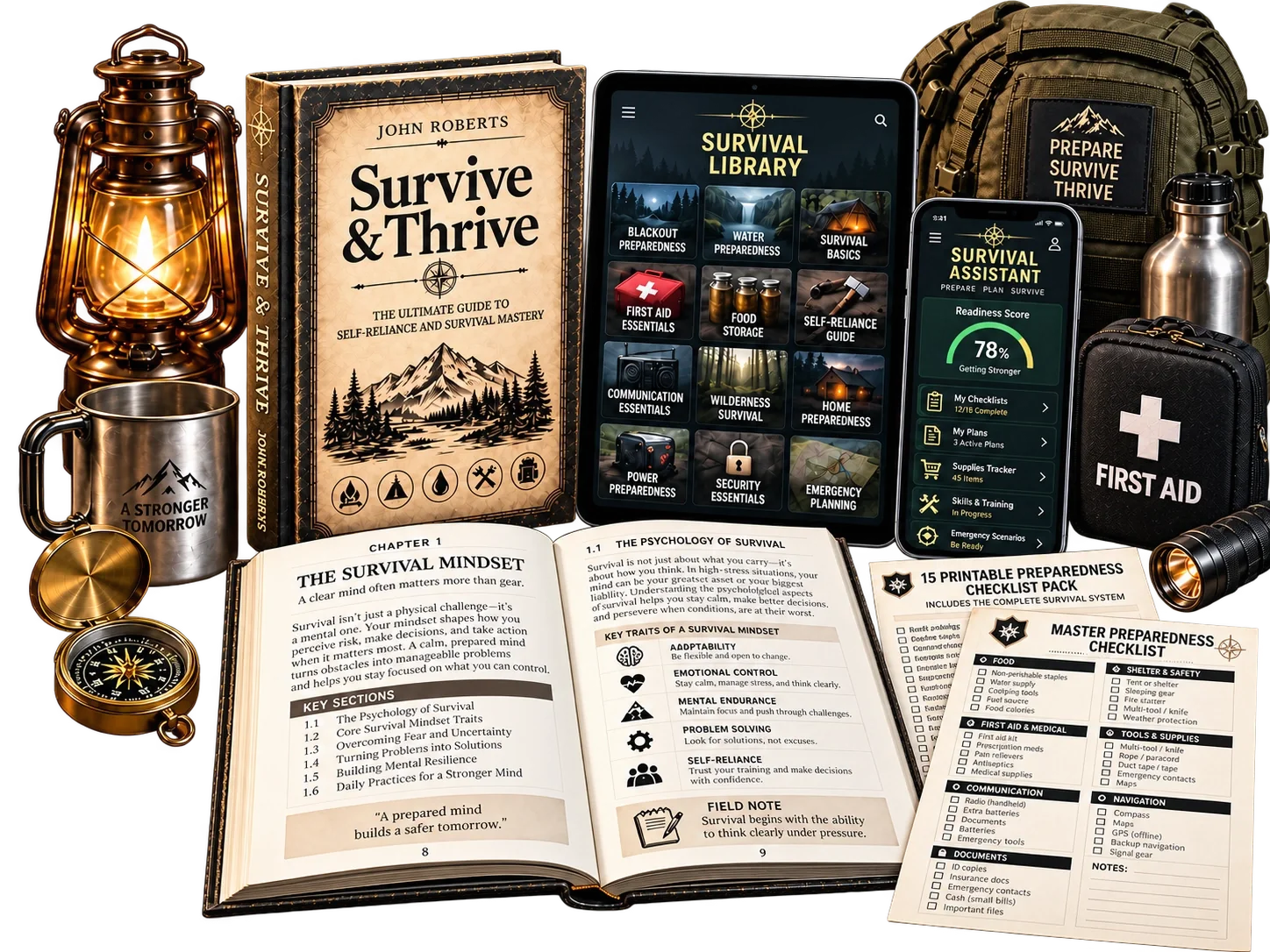
These original worksheets help you organize your own details. The Complete Survival System adds a 214-page guide, 15 action checklists, Survival Assistant, quickstart tools, and a library of 950+ reference manuals. The free pack complements those resources; it does not distribute the paid checklist pack.
Get the free worksheets or choose another practical starting point on our Free Resources page.