The emergency shelter question gets real fast
People talk about shelter like it is just a camping topic, and I think that throws people off. In real emergencies, shelter is usually less romantic and more immediate than that. It is not about building some picturesque lean-to because you read a survival book once and liked the diagrams. It is about protecting the body from exposure, wind, precipitation, ground contact, heat loss, sun, exhaustion, and all the stupid little ways bad conditions stack up when you are already having a rough day.
A lot of emergency situations are survivable right up until shelter is handled badly. That part matters. People can go without food for longer than they are comfortable imagining. Water becomes serious fast too, obviously. But bad shelter decisions can start punishing you within hours, sometimes sooner, depending on temperature, rain, wind, fatigue, and whether you are dry to begin with.
And this is where people get a little confused. They hear “emergency shelter” and think of wilderness survival only. The thing is, emergency shelters matter in cities, suburbs, roadside breakdowns, evacuations, storm damage, winter travel, blackouts, and any situation where the building you expected to protect you either stops doing its job or is no longer available. That is a much broader problem than most people prepare for.
Shelter is really about control
I think it helps to simplify shelter down to what it is actually doing.
A good emergency shelter gives you control over exposure.
That means control over wind, rain, snow, cold ground, direct sun, and sometimes visibility too. It does not have to be comfortable. Comfortable is nice. But comfort is not the standard in the beginning. The standard is whether it reduces the speed at which conditions are making you worse.
That matters because exposure is cumulative. Wind on wet clothes is not just annoying. Cold ground under a tired body is not just inconvenient. Heat trapped badly in direct sun is not just uncomfortable. These things wear people down in layers, and once somebody gets cold enough, soaked enough, overheated enough, or tired enough, their decisions get worse. Then the shelter problem becomes a judgment problem, and that is when people start making choices that look dumb later and felt reasonable at the time.
So when I look at emergency shelters, I do not start with architecture. I start with the basic question: what is hurting me here, or what will be hurting me in the next hour if I do nothing?
The first shelter is often the one already nearby
This is another place people drift into fantasy.
In a real situation, the best emergency shelter is often not something you build from scratch. It is the best protected space you can identify, improve, and use quickly.
That could be a vehicle, though vehicles have obvious limits. It could be a building corner out of the wind. It could be an intact room in a damaged house. It could be a covered loading area, a maintenance structure, a tarp rigged between fixed points, a snowbank hollowed carefully if conditions are severe enough and you know what you are doing, or a debris shelter if you are truly out in the open and options have collapsed.
People like to skip straight to “how to build a shelter,” but usually the better skill is “how to recognize shelter potential fast.”
That takes a different eye. You start looking for barriers, dry ground, drainage, windbreaks, overhead protection, insulation options, and materials that can be turned into a roof or wall without wasting energy. The idea is not elegance. The idea is advantage.
A simple scenario makes this clearer
Say somebody is driving home in late fall, maybe early winter, and a chain of small problems turns into a real one. Car slides off a secondary road, no injury worth calling dramatic but enough to shake them up, weather worsening, tow response uncertain, daylight dropping. Phone battery low. They have a jacket, maybe gloves, a bag in the trunk, not much else.
A lot of people in that situation make one of two bad choices. They either stay passive too long because they assume rescue is imminent, or they leave the vehicle too casually because they are restless and uncomfortable. Neither impulse is automatically smart.
The vehicle, even disabled, may still be the best shelter structure available. Not perfect. But structure matters. Wind protection matters. Visibility for rescuers matters. Existing enclosure matters. If the vehicle can still give some insulation from wind and precipitation, it is already doing more than an improvised open-air shelter probably will in the first stage.
Now, if the vehicle is unsafe where it sits, or conditions make staying impossible, then the problem changes. But even then, the lesson is the same: use what already exists first, improve it second, and build from scratch only when you actually need to.
That applies in more places than roadside incidents. It applies after storm damage, after power failures, during displacement, after broken windows, during transit interruptions, after getting stranded somewhere less forgiving than expected. The shape changes. The logic mostly doesn’t. It overlaps with the same kind of plain planning that matters in a family emergency plan people can actually use, where the first good decision is often the one that reduces confusion and buys you time.
What a shelter needs to do first
This is where practical thinking helps more than gear obsession.
In the early phase, a shelter should do a few things well enough:
- block wind
- reduce contact with wet or cold ground
- keep precipitation off you, or at least reduce it
- preserve body heat when cold is the threat
- reduce direct sun and trapped heat when heat is the threat
- let you rest without steadily getting worse
That is it. Not small, but basic.
People get themselves in trouble when they try to solve secondary problems before primary ones. They fuss over shape before dryness. They fuss over neatness before insulation. They fuss over roominess before wind protection. If the weather is cold and wet, I would rather have an ugly cramped shelter that keeps me dry-ish and out of wind than a spacious one that leaks and drains my heat into the ground.
Ground contact gets overlooked a lot. Too much, honestly. Even when overhead cover is decent, lying or sitting directly on cold ground will pull heat out of you faster than people want to believe. Cardboard, seat cushions, branches, dry leaves, foam pads, spare clothes, even loosely piled debris — anything that creates separation helps. Not equally, but enough to matter.
Improvised shelters are really material management
When people do have to improvise, the quality of the shelter comes down less to cleverness and more to materials, site choice, and energy discipline.
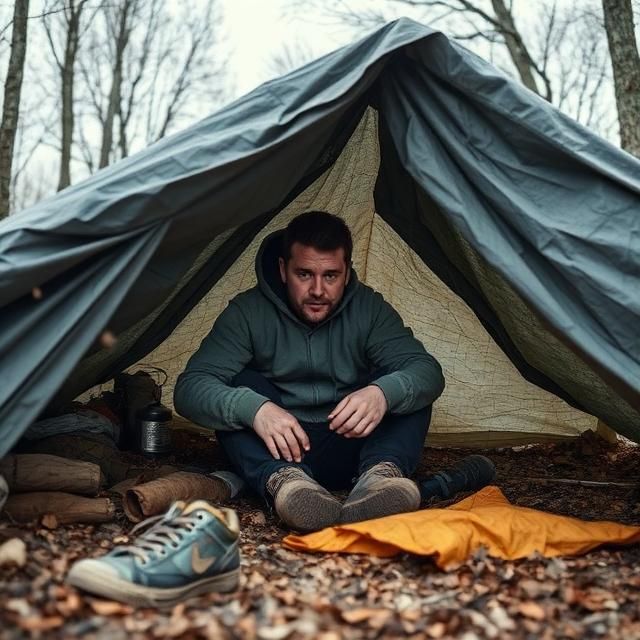
A tarp is an obvious advantage. Ponchos can do more than people expect. Contractor bags are ugly but useful. Plastic sheeting, cordage, blankets, moving pads, spare clothing, car floor mats, broken branches, pallets, cardboard, scrap wood, dense brush — none of these are glamorous, but a lot of emergency shelter work is just combining ordinary materials in a way that blocks loss.
And that phrase matters. Blocking loss.
In cold conditions you are blocking heat loss. In hot conditions you are blocking water loss and solar overload. In rain you are blocking wetting and the heat loss that follows it. In wind you are blocking convective stripping. That sounds technical when written out, but on the ground it is pretty plain. You are trying to stop the environment from taking too much from you too quickly.
So maybe the better way to think about shelter building is not “Can I make something impressive?” It is “Can I make conditions less punishing in the next twenty minutes?”
That question leads to better shelters.
Site selection is usually more important than people want it to be
A mediocre shelter in a smart location can outperform a better shelter in a dumb one.
Do not build in runoff paths if rain is likely. Do not settle in low spots that collect cold air when you have other options. Do not set up directly under unstable limbs. Do not crowd yourself into a place that gains overhead cover but loses drainage. Do not choose a location only because it looks sheltered from one angle.
If wind is your main threat, find the windbreak first. If rain is the threat, think drainage and overhead cover together. If cold is the threat, think wind plus ground insulation plus dryness. If heat is the threat, prioritize shade and airflow, not a sealed trap that cooks you worse.
This is why people need to resist copying one generic shelter idea for every problem. Shelter is conditional. The environment decides more of the design than your preferences do.
What people should have ready before they need any of this
I am a big believer in carrying shelter components that do not take much space but solve real problems.
A few things go a long way:
- compact tarp or poncho tarp
- cordage
- contractor bags
- emergency bivy or blanket, preferably not the flimsiest novelty version
- work gloves
- foam pad or something that can act as a ground barrier when practical
- dry spare layers in a vehicle or bag when season demands it
That is not a complete system for every event. It doesn’t need to be. It is a friction reducer. It gives you more choices, which is one of the most valuable things in a bad situation.
And maybe that is the larger preparedness lesson here. Emergency shelters are not only about surviving some extreme wilderness event. They are about reducing the number of ways an ordinary disruption can turn into a medical problem, a judgment problem, or a panic problem. A lot of that comes down to carrying the right basic gear before things get rough, the same kind of thinking behind building a basic survival kit that covers more than people expect instead of waiting until you are already cold and improvising badly.
Good shelters buy you time
That is really what shelter does in the end. It buys time.
Time to warm up a little. Time to think more clearly. Time to wait safely. Time to reorganize gear. Time to reassess a route. Time for weather to shift. Time for help to find you. Time to stop the environment from grinding you down faster than it should.
That does not sound dramatic, but a lot of survival is not dramatic. A lot of it is just refusing to let conditions compound unchecked.
If somebody remembers one thing about emergency shelters, I would want it to be this: do not think first about building something impressive. Think first about reducing exposure, using what is already available, insulating yourself from the ground, and conserving energy while you improve your position.
That approach works in more places than people realize. And when the day is ugly enough, that is the sort of plain, unglamorous thinking that keeps people functional. It sits close to the same mindset behind preparing for power failures before normal systems drop out and the same practical realism that matters during citywide blackouts when the systems you count on go quiet.