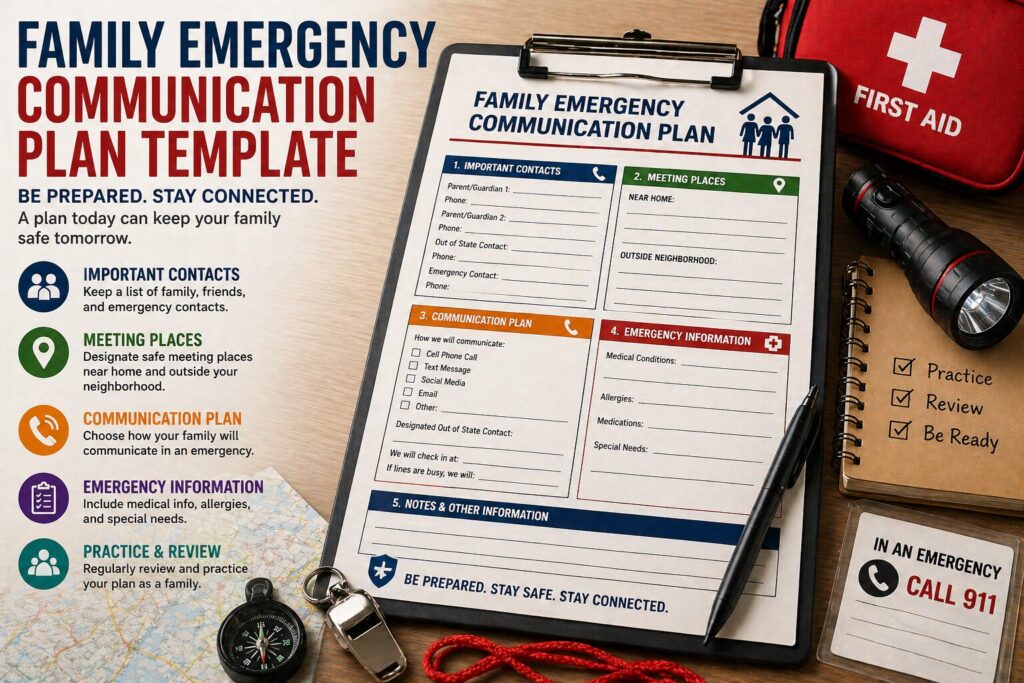
Family Emergency Communication Plan Template: What to Decide Before Phones Fail
Most communication plans fail for a simple reason: nobody decides the details until everyone is already stressed.
At that point people start calling, texting, guessing, repeating themselves, and hoping the network holds long enough to keep the family coordinated. Sometimes it does. Sometimes it does not. Either way, uncertainty makes everything feel more chaotic than it needs to be.
A family emergency communication plan gives people a structure to fall back on before phones, power, or normal routines stop cooperating.
What a Family Communication Plan Should Answer
- Who should each person contact first?
- What if local calls fail?
- What if text messages work but voice calls do not?
- Where do we meet if we cannot reach each other?
- Who is the out-of-area contact?
- How long do we wait before switching to the fallback plan?
- What do children need to remember?
- What do older relatives need written down?
If those answers are vague, the plan is not ready yet.
Basic Family Emergency Communication Template
Primary household contact order:
Parent/guardian 1:
Parent/guardian 2:
Children:
Other household members:
Out-of-area contact:
Name:
Phone:
Relationship:
Why this person was chosen:
Primary meeting point:
Location:
When to use it:
Secondary meeting point:
Location:
When to use it:
If phones are overloaded:
Use text first?
Wait how long before retrying?
What is the fallback action if no one can connect?
Important medical or access notes:
Medications:
Mobility concerns:
School/work pickup issues:
Pets:
How to Use the Template Well
- Keep it short enough that people can actually remember the core parts.
- Print it instead of relying only on phones.
- Put a copy where the household can reach it quickly.
- Make sure children know the primary and backup meeting points in plain language.
- Use one out-of-area contact so not everyone is trying to coordinate through five different threads.
- Review it occasionally instead of assuming one conversation made it permanent.
The cleaner the plan, the better it holds when stress rises.
When This Matters Most
This kind of plan matters during blackouts and wider disruptions, including:
- Blackouts
- Storms
- School or workplace disruptions
- Road closures
- Wildfire evacuations
- Regional cell-service overload
- Any event where family members may be separated when normal routines break
A communication plan is not dramatic preparedness. It is just one of the easiest ways to reduce preventable confusion.
Quick Family Communication Checklist
- Primary contact order decided
- Out-of-area contact chosen
- Primary meeting point chosen
- Secondary meeting point chosen
- Children know what to do in simple terms
- Printed contact sheet exists
- Fallback plan for overloaded cell networks exists
- Plan reviewed recently
If your family already has supplies but does not have a communication structure, that is a gap worth fixing. Stress spreads fast when nobody knows the next step.