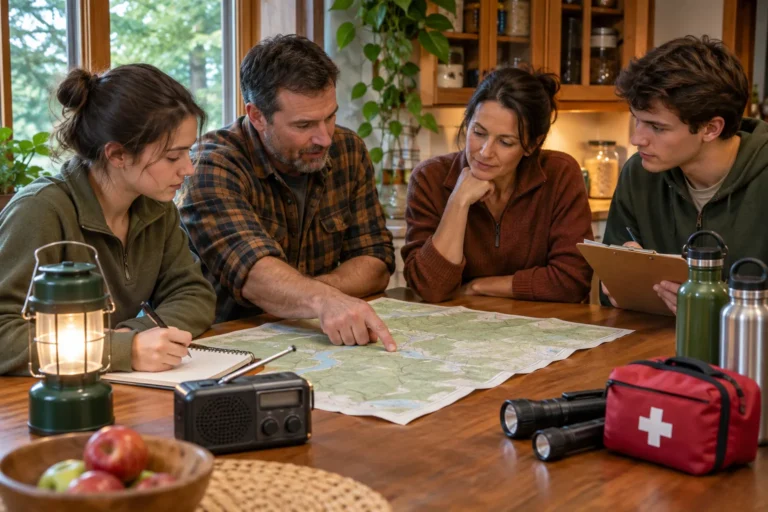
Power outage lighting should make essential tasks and routes safe while conserving batteries. Start with personal lights, then add small shared light sources.
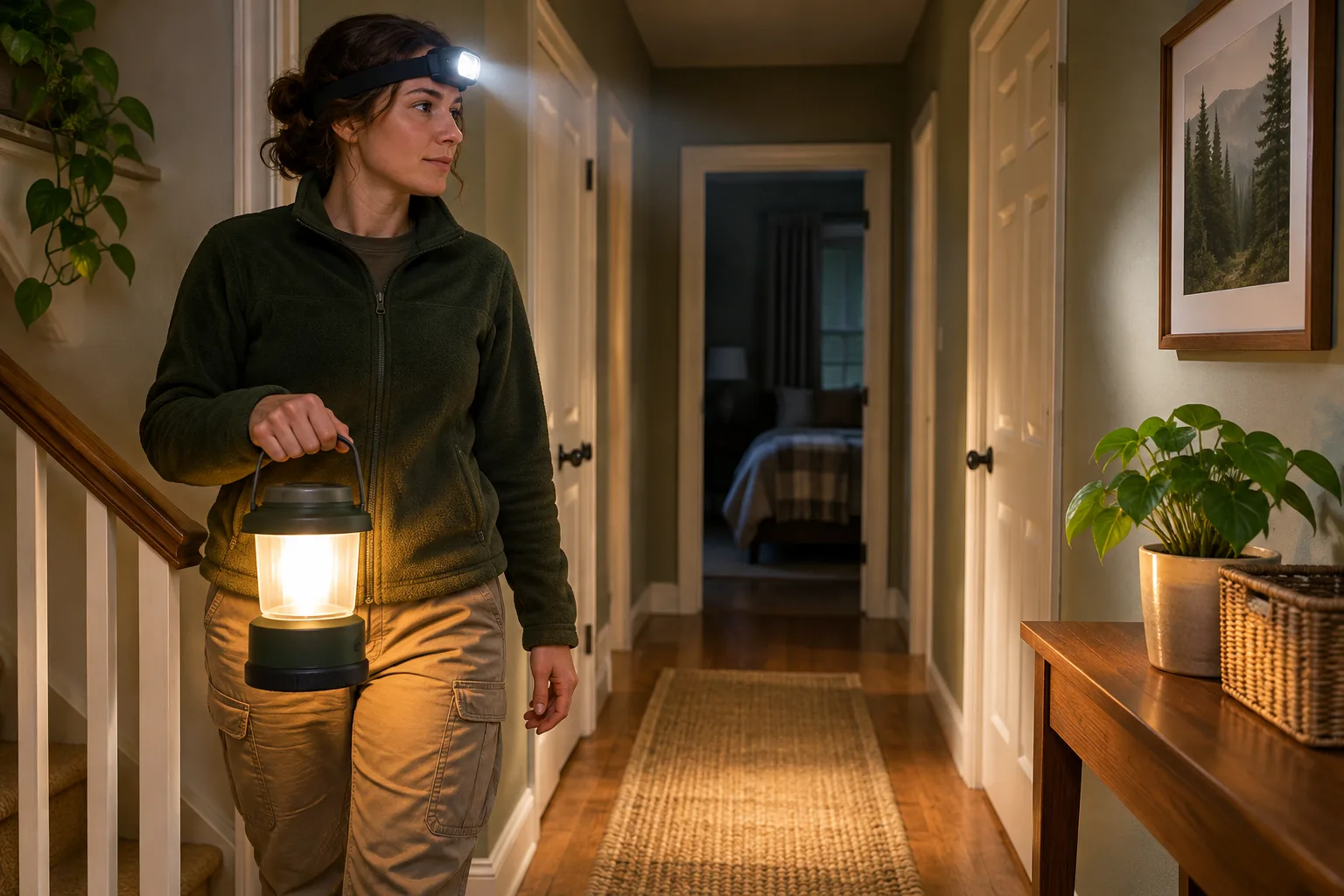
When the power goes out at night, light stops being a convenience and becomes part of the safety system. You need enough to move without falling, find supplies, check on people, and handle the outage without creating a second emergency.
Keep the plan simple. Use battery-powered light first. Give each capable person a light they can control. Light the routes people will actually use, especially the path from sleeping areas to the bathroom, any stairs, and the room where everyone will gather. Avoid open flames. The house does not need to look normal during a blackout. The parts that matter need to stay usable.
If the outage has just started, handle immediate hazards first. The broader first-response sequence in The First 15 Minutes of a Power Outage explains how lighting fits with checking people, protecting food, preserving communications, and figuring out the scope of the outage: read the first 15 minutes guide.
Power Outage Lighting: Build a Lighting Layer, Not One Bright Room
One bright flashlight is not a lighting plan. It works until one person needs the bathroom, another is checking a child, and somebody else is trying to find the breaker panel or emergency supplies. Then the whole household is waiting on one beam.
Think in layers instead.
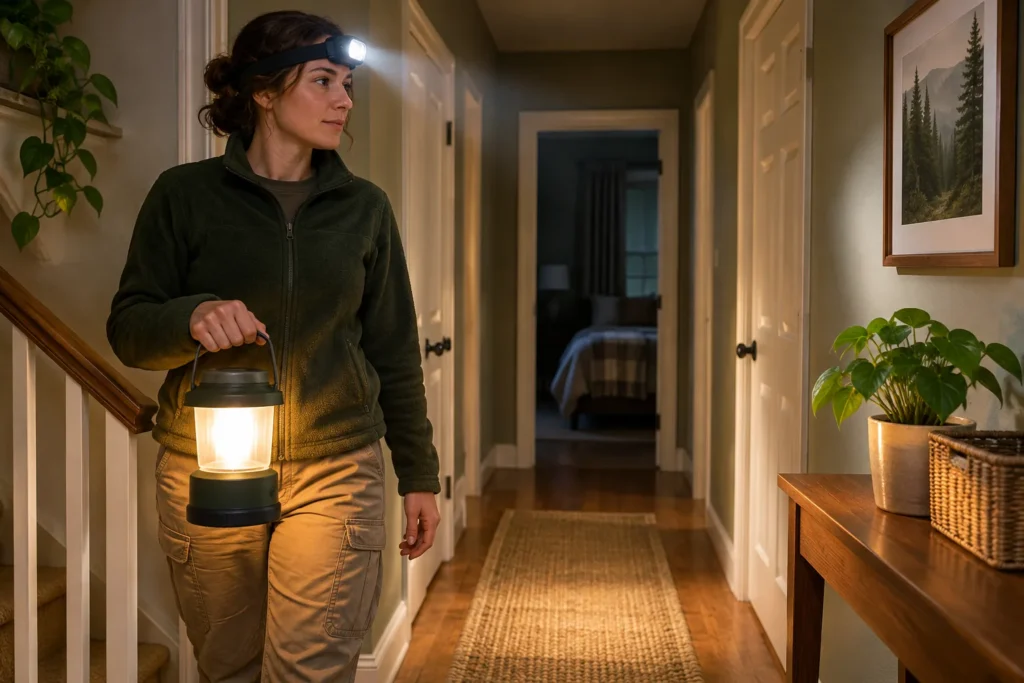
The first layer is personal light. Every adult or capable child should have a flashlight or headlamp they can operate. Headlamps earn their place quickly because both hands stay free for carrying water, helping somebody, opening doors, or doing simple tasks.
Your second layer is route lighting. Put modest battery lanterns or other stable lights at the places people repeatedly move through: the main hallway, stairs, bathroom entrance, kitchen work area, and the room where the household is gathering.
Your third layer is task lighting. Keep a stronger flashlight for checking outside from a safe location, inspecting a utility area, reading labels, or handling a specific problem.
This layered approach uses less battery power than trying to flood every room with light, and it reduces the chance that the entire household becomes dependent on one device.
The Dark Changes How People Move
The first problem is often ordinary movement through a suddenly unfamiliar version of your own home. A chair has shifted. Shoes are in the hallway. The dog is lying in the wrong place. Stairs are harder to judge. A child wakes up looking for a parent. An older adult gets up for the bathroom. None of those situations is dramatic, but in darkness they are exactly how a minor outage can turn into an injury.
That is why lighting should follow movement, not room size.
Before you spend batteries illuminating a living room, make the route between sleeping areas, the bathroom, and your main gathering area easy to navigate. Clear clutter from those routes. Put lights where they can be found without crossing a dark room to reach them.
A useful household instruction is:
“Keep your light with you. Walk, don’t rush. Tell someone before you go upstairs, downstairs, or outside.”
That is enough. In the dark, a short rule people will actually remember is more useful than a page of instructions.
Use Flashlights and Battery Lanterns Instead of Candles
The CDC recommends battery-powered flashlights and lanterns rather than candles during power outages because candles add a fire hazard to a situation that already has reduced visibility and disrupted routines.
The problem is not just the candle. It is the candle plus a disrupted house. People are carrying supplies, opening cabinets, checking rooms, dealing with children or pets, and trying to solve problems in poor light. A flame that seemed controlled can be forgotten, bumped, placed too close to something combustible, or left behind when everyone moves to another room.
Battery lanterns and LED flashlights remove that open-flame problem. They can safely cover many jobs that would otherwise tempt people to use candles; place and use them according to the manufacturer’s instructions, and keep them where they will not be buried under bedding or other materials.
If your emergency-lighting plan currently depends on candles, replace that dependency with several battery-powered lights distributed around the house. If a candle is the only light available in an immediate emergency, treat it as a temporary last resort: keep it on a stable, noncombustible surface, well away from anything that can burn, never leave it unattended, and replace it with battery light as soon as you can.
Do Not Waste Battery Power Trying to Recreate Normal Electricity
The instinct is to fight the darkness by making every room bright. Resist it. You are not trying to recreate normal electricity; you are trying to preserve safe movement and useful work for as long as the outage lasts.
One well-placed lantern in the room where everyone gathers can replace several lights scattered through empty rooms. A headlamp can provide exactly the light needed for a task without lighting the entire kitchen. A low setting can be enough for hallway navigation while preserving the high setting for situations that actually require it.
If your lights have multiple brightness levels, use the lowest level that safely does the job. Save maximum output for short inspections or difficult tasks.
Also separate lighting batteries from batteries needed for radios, medical equipment, or other critical devices. Do not discover on the second night that every spare battery went into decorative or unnecessary lighting on the first night.
Remember the rule: light the people, the routes, and the task. Everything else can stay dark.
Put Lights Where You Can Reach Them Before You Need Them
A flashlight you cannot find in the dark is not emergency lighting. It is stored equipment.
Keep at least one flashlight in a fixed, known location in the main sleeping area. Keep another near the main living area. If your home has multiple floors, keep lighting on each floor so nobody has to navigate stairs in darkness to retrieve it.
Do not store every flashlight, lantern, and battery in one emergency tote in the basement or garage. Central storage is useful for reserves, but immediate-use lights should already be where people live.
For apartments, the same principle applies with an added concern: hallways, stairwells, access systems, and elevators may behave differently during an outage. The Apartment Blackout Checklist covers those building-specific problems in more detail: read the apartment blackout checklist.
Signals Most People Ignore
A blackout will tell you where your lighting plan is weak. Pay attention to what becomes annoying, confusing, or unsafe.
A flashlight that is dim during the first hour is telling you the batteries or device are not ready for a long outage. A lantern that nobody can find without using a phone flashlight is telling you its storage location is wrong. A staircase that feels unsafe even with a small light may need a better dedicated light position. A household that immediately drains phone batteries for illumination does not have enough independent lighting.
Watch human behavior too. If people keep leaving lights behind, give them headlamps or assign each person one flashlight. If children repeatedly move through dark areas, establish one lit gathering room and clear rules about where they can go. If everyone keeps turning lights to maximum brightness, explain that the outage may last longer than expected and battery reserves are part of the plan.
Treat those problems as information. The outage is giving you a free test of the system and showing you what to fix before the next one.
A Five-Minute Lighting Drill
You can test the system without waiting for a storm.
One evening, turn off the normal lights for five minutes without shutting off any essential equipment. Start in the room where you normally spend the evening.
Can you reach a flashlight without using your phone? Can everyone else do the same? Can you safely reach the bathroom? Can you move between floors? Can you find spare batteries? Can you illuminate the kitchen well enough to prepare a simple meal? Can you identify the safest main room for the household to gather?
This is not an endurance test. You are hunting for friction: somebody cannot find a light, a route feels unsafe, a switch is confusing, or the spare batteries are buried somewhere that made sense in daylight.
If you bump into furniture, move the emergency light. If a child cannot operate the flashlight, choose a simpler one. If the headlamp strap is tangled around other gear, store it ready to wear. If all the batteries are loose in a drawer and you cannot tell which are fresh, organize them.
Five minutes of that test can teach you more than another shopping trip.
What to Keep in a Practical Blackout Lighting Kit
You do not need a complicated pile of lighting gear. You need several dependable lights with overlapping jobs. If practical, standardize around as few battery types as possible so your reserve supply stays simple.
Keep a flashlight or headlamp for each person who can safely use one. Add one or two stable battery lanterns for shared areas. Keep spare batteries that match your devices, or rechargeable lights backed by charged power banks or another reliable charging method. A small low-output light for the bathroom or hallway can conserve larger batteries.
Test the lights periodically. Remove leaking or damaged batteries. Recharge rechargeable units before severe weather when you have warning. Keep one reserve light unused unless the outage lasts long enough to need it.
And keep smoke alarms working. A power outage is not the time to reduce fire detection because the house is operating differently than normal.
If Your Main Lights Fail
Plan as though one light will fail, because eventually one will. Batteries die. Rechargeable lights get forgotten. Switches break. Flashlights get dropped.
Two dependable ways to make light matter more than one impressive flashlight.
If a primary light fails, move to the backup rather than improvising an unsafe flame. Consolidate the household into fewer rooms if necessary. Reduce unnecessary movement. Use lower brightness settings. Preserve one dependable light for nighttime bathroom trips and urgent tasks.
If you reach the point where the home cannot be navigated safely, especially with children, older adults, mobility limitations, or medical needs, lighting has become more than an inconvenience. Reduce movement first. If the household still cannot safely manage essential trips or care needs, a safer powered location may be the better option when travel itself is safe.
Key Takeaways
- Treat emergency lighting as a safety system, not a comfort item.
- Use flashlights, headlamps, and battery lanterns instead of candles.
- Give people personal lights and place shared lights along the routes they actually use.
- Use the lowest brightness that safely handles the task so batteries last longer.
- Store immediate-use lights where they can be reached in darkness, not only in one central emergency bin.
- Watch what goes wrong during an outage or short drill and use those failures to improve the system.
- Keep redundant lights and batteries so one failure does not leave the household in darkness.
Step-by-Step Actions
- Put one immediately reachable flashlight or headlamp in each main sleeping area.
- Assign a personal light to each household member who can safely use one.
- Place stable battery lighting near stairs, the bathroom route, the kitchen work area, and the main gathering room.
- Clear shoes, cords, toys, and other trip hazards from the routes people will use after dark.
- Replace candle-dependent blackout plans with battery-powered lighting.
- Gather compatible spare batteries or verify that rechargeable lights and backup charging are ready.
- Choose one main room to light during a prolonged outage instead of illuminating empty rooms.
- Use lower brightness settings for routine movement and save high output for short tasks.
- Run a five-minute lights-out drill and note every point of confusion or difficulty.
- Fix the storage, battery, equipment, or movement problem the drill reveals.
Checklist
- [ ] Flashlight or headlamp reachable from sleeping area
- [ ] Personal light available for each capable household member
- [ ] Battery lantern available for shared space
- [ ] Stair and bathroom routes can be illuminated
- [ ] Main walking routes clear of trip hazards
- [ ] No dependence on candles for routine blackout lighting
- [ ] Spare batteries organized and usable
- [ ] Rechargeable lights charged
- [ ] One reserve light protected for later use
- [ ] Smoke alarms operational
- [ ] Household knows the main gathering area
- [ ] Five-minute blackout drill completed
Put the Plan Into Practice
Place lights alongside the supplies in your 72-hour emergency checklist, and test them during your maintenance review. The CDC power-outage guidance recommends battery lighting rather than open flames.