

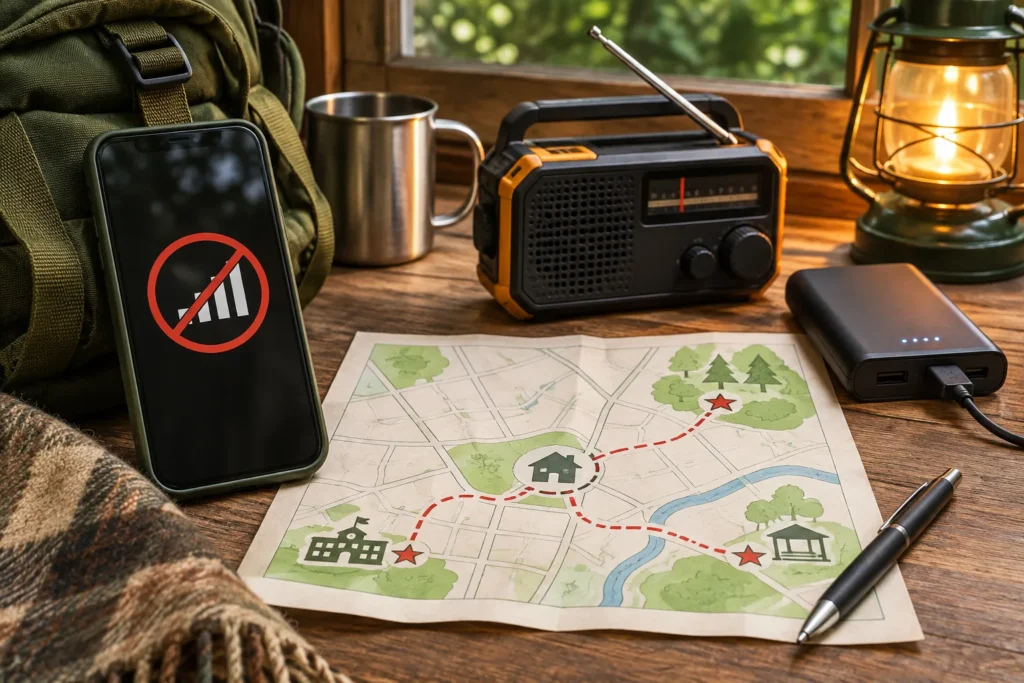
A cell service outage needs a communication plan that works even when calls, data, or both fail. Prepare short messages, meeting points, and an independent information source.
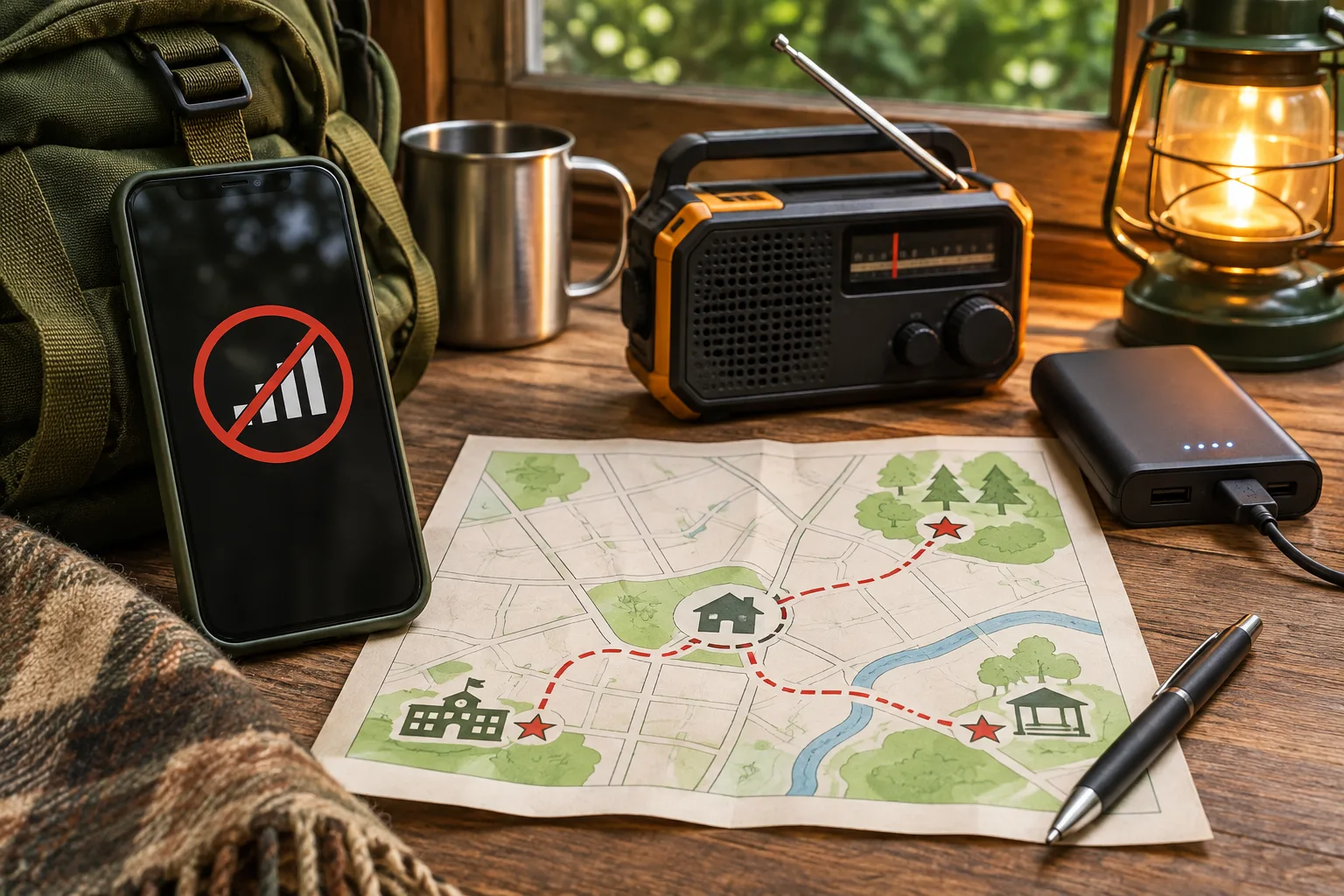
When cell service goes down, stop treating the phone like the plan. Repeated calls, redials, and “Did you get this?” messages can burn battery while your household still has no clear picture of who is safe, where people are, or what happens next.
A better response is simple: figure out which communication paths still work, send short useful messages, conserve the phone you have, and fall back to a plan that does not require a live conversation.
Your phone and the cellular network are two different things. A fully charged phone can be useless for calls if towers, backhaul, local power, or network capacity are affected. At the same time, one service can fail while another still works. Voice may be unreliable while a short text gets through. Mobile data may fail while home Wi-Fi still works. The point is not to guess why the outage happened. The point is to test your available paths in a sensible order.
Cell service outage: use a Communication Ladder Instead of One Backup
A household communication plan should work like a ladder. If one rung fails, you move to the next instead of standing there fighting with it.
For most households, the ladder looks like this:
- If someone needs emergency assistance, attempt 911 using the safest available method.
- For ordinary family status, try one short SMS/text rather than a long voice call.
- If another internet path works, use your agreed messaging service or email.
- Report to a designated out-of-area contact who can relay household status.
- If electronic communication fails, follow predetermined meeting locations and time rules.
- Use an independent source such as a battery-powered radio for official information when phone-based information is unavailable.
The strength of this ladder is not the number of devices. It is the agreement behind them. Everyone knows what to try first, when to stop fighting a failed path, and what happens when electronic communication disappears entirely.
First, Find Out What Is Actually Failing
Do a quick check before assuming the entire cellular system is dead.
Look at the obvious things first. Is your phone in airplane mode? Does another household member using the same or a different carrier have service? Does Wi-Fi work? Can you send a text even though calls fail? Is the power out locally? Can you receive information even if you cannot place a call?
Do not spend twenty minutes troubleshooting during an emergency. The goal is to identify a working path, not diagnose the carrier's infrastructure.
A useful rule is: test once, change paths, then preserve resources.
If a call fails, try a short text. If mobile data fails but Wi-Fi works, use the internet path. If neither works, stop staring at the phone and move to the next part of the household plan.
Keep Family Messages Short and Complete
During an outage, a useful message should reduce the need for another message.
Use four pieces of information:
WHO / WHERE / CONDITION / NEXT
For example:
“Ed — at home — safe — staying here until 6 PM, then using the backup meeting point if needed.”
That is better than “Are you okay?” followed by a string of messages trying to reconstruct where everyone is and what they intend to do.
If you are separated, the person receiving the message should know three things immediately: where you are, whether you need help, and what you are going to do next. Agree on a simple acknowledgement too. A reply such as “RECEIVED — STAY THERE” or “RECEIVED — MEET AT BACKUP AT 6” closes the loop without starting a long conversation. If no acknowledgement arrives, follow the time and meeting rules instead of assuming the message was seen.
Do not assume delivery is immediate. A text can be delayed, and a sent indicator is not the same thing as a completed family plan. If your household has a time rule and meeting rule, people can act even when no reply arrives.
Pick One Out-of-Area Contact Before You Need One
A designated contact outside your immediate area gives separated household members a common relay point. If you want a one-page structure for contacts, meeting points, and fallback rules, use the Family Emergency Communication Plan Template.
The arrangement should be simple. Everyone knows the same person's name and number. If local family members cannot reach one another reliably, each person tries to report status to that contact. The contact can then tell the others who has checked in, where they are, and what they reported.
Write the number down. Do not store the only copy inside one phone.
A paper contact card in a wallet, school bag, vehicle, or emergency kit can solve a surprisingly basic failure: the phone works, but the owner does not know anyone's number without opening the contact list.
Children and older family members need a plan they can actually follow. “Use the emergency communication plan” is not an instruction. “Text Aunt Lisa and tell her where you are, then stay at the school pickup point until 5:30” is.
Decide Where You Will Meet Before the Network Fails
Communication planning eventually becomes movement planning. The same handoff between contact rules and movement rules is covered in Household Evacuation Planning That Works Before You Have to Leave.
Choose a primary household meeting point and a backup point. The first might be immediately outside the home for a house-level emergency. Another should make sense if family members are already away from home or the neighborhood is inaccessible.
Add a time rule. Without one, two people can keep moving around trying to find each other.
For example: if direct contact is impossible, everyone who can safely do so goes to the agreed primary location and waits until the agreed time. Only then does the backup rule take effect. This prevents a common failure pattern: one person leaves the meeting point to search just as the other person arrives.
The exact locations depend on your household, work, schools, transportation, local hazards, and official instructions. The important part is that the decision is made before everyone is stressed and disconnected.
Never travel into a dangerous area just to obtain a signal or reach a meeting point. Official evacuation, shelter, fire, flood, and other life-safety instructions take priority over a family reunification plan.
Treat Battery Power as Part of Communications
During a prolonged outage, your battery is communication capacity.
Reduce unnecessary screen time. Turn down brightness. Stop streaming. Close applications you do not need. If reception is poor and the phone is constantly searching for a network, pay attention to battery drain. Use a power bank or other safe charging option when available, but do not assume a charged phone guarantees connectivity.
The same rule applies to information. Refreshing social media every thirty seconds is not a communication strategy. Decide what information you actually need: evacuation orders, weather warnings, road conditions, family status, or restoration information. Check deliberately, then put the phone down.
Do Not Assume a “Landline” Will Survive a Power Outage
A home phone can be a useful alternate path, but the label alone tells you very little.
Cordless handsets need power. Many modern home-phone services depend on internet equipment or powered network equipment. If you intend to use a home phone as a backup, test what happens when household power and internet equipment are unavailable.
The same principle applies to every backup device: know what it depends on.
A radio that needs batteries you do not have is not independent. A messaging app that requires working internet is not independent of the network. A power bank that has not been charged is not stored power. Preparedness improves when you trace dependencies instead of counting devices.
Build an Independent Information Path
Family communication is only half the problem. You also need reliable information about what is happening around you.
A battery-powered or hand-crank radio can provide an information path that does not depend on your phone's cellular connection. Local emergency management, public-safety agencies, weather services, and broadcasters may also provide information through whatever channels remain available.
Do not make one app, one social account, or one carrier your only source. During a disruption, information channels can fail separately just like communication channels do.
This is where a small preparedness setup beats a complicated one: a charged phone, written contacts, backup power, an independent radio, and a household plan cover several different failure modes without requiring everyone in the family to become a communications hobbyist.
Run a No-Call Family Drill
A communication plan that has never been tested is mostly a theory.
Try a short drill on an ordinary day. Tell everyone to assume voice calls are unavailable for the next thirty minutes. Each person should know:
- who the out-of-area contact is;
- the primary and backup meeting locations;
- the family status-message format;
- where written contact information is kept;
- which information source to use if phones cannot provide updates.
Then look for friction.
Does one person have all the numbers? Does nobody know the backup meeting point? Is the power bank empty? Does the radio have dead batteries? Does the plan depend on a child remembering an app password? Those are useful failures to discover at the kitchen table instead of during a real outage.
Plan for Periods of Complete Silence
The real test of a communication plan is what happens when nothing gets through. If every instruction begins with “call me” or “wait for my text,” you do not yet have an offline plan. You have a phone plan.
Give each household member a default action for the situations you can reasonably anticipate. A school-age child might stay with the school's established release procedure rather than leaving to search for family. An adult at work might remain there until a set time unless officials direct otherwise. Someone already at home might stay put if the home is safe. The details are household-specific, but the principle is the same: no message should not automatically mean improvise.
Also decide how old a message can be before you stop treating it as current. During a disrupted network, delayed messages can arrive out of order. A status text saying “leaving work now” is useful only if you know roughly when it was sent. Put the time in important messages when timing affects the decision: “4:20 PM — leaving work — going directly home.”
That small habit makes delayed communication easier to interpret and reduces unnecessary movement.
Common Mistakes When Cell Service Is Unreliable
Hammering the call button. If voice calls are failing, repeated redialing wastes battery and keeps you focused on a path that is not working. Try another path and keep successful calls brief.
Writing long messages. Send the information needed to make the next decision. WHO / WHERE / CONDITION / NEXT is usually enough for a family status update.
Assuming every service failed together. Voice, SMS, mobile data, Wi-Fi, and home internet are different paths. Test them separately without spending all day troubleshooting.
Depending on information stored only in a phone. Keep critical contacts and meeting information somewhere else too.
Buying equipment without assigning a job to it. Every backup should answer a specific question: How do we contact each other? How do we get official information? How do we power the device? What do we do when that option fails?
Leaving reunification vague. “We'll meet somewhere” is not a plan. Pick locations and a time rule.
Key Takeaways
- A working smartphone is not the same thing as a working cellular network.
- When voice service is unreliable, test other available paths instead of repeatedly redialing.
- Short family messages should communicate who, where, condition, and next action.
- A designated out-of-area contact can give separated family members one common relay point.
- Predetermined meeting locations and time rules let the plan continue even when no message gets through.
- Battery power and independent information sources are part of the communication plan, not separate concerns.
- Test backups by tracing what they depend on: electricity, internet, batteries, passwords, or a particular network.
Step-by-Step Actions
- Choose one out-of-area contact and make sure every household member has the number on paper as well as in a phone.
- Choose a primary and backup meeting location that make sense for your household.
- Set a simple time rule for when the backup meeting plan takes effect.
- Agree on the WHO / WHERE / CONDITION / NEXT message format.
- Identify which communication paths your household can use: SMS, Wi-Fi messaging, email, home phone, or other appropriate options.
- Add backup charging and an independent information source such as a battery-powered radio.
- Run a thirty-minute no-call drill and write down every point where the plan fails.
- Fix those failures, then keep the written plan where household members can reach it.
Checklist
- [ ] Out-of-area contact selected
- [ ] Contact number written on paper
- [ ] Primary meeting location selected
- [ ] Backup meeting location selected
- [ ] Time rule agreed
- [ ] WHO / WHERE / CONDITION / NEXT format understood
- [ ] Backup charging available and charged
- [ ] Independent radio/information source available
- [ ] Critical information stored somewhere besides one phone
- [ ] No-call household drill completed
Put the Plan Into Practice
The Red Cross emergency planning guide supports a household contact and meeting plan. Its power-outage guidance also covers independent communications equipment. Check your own provider’s device-specific backup and emergency-calling instructions before an outage.