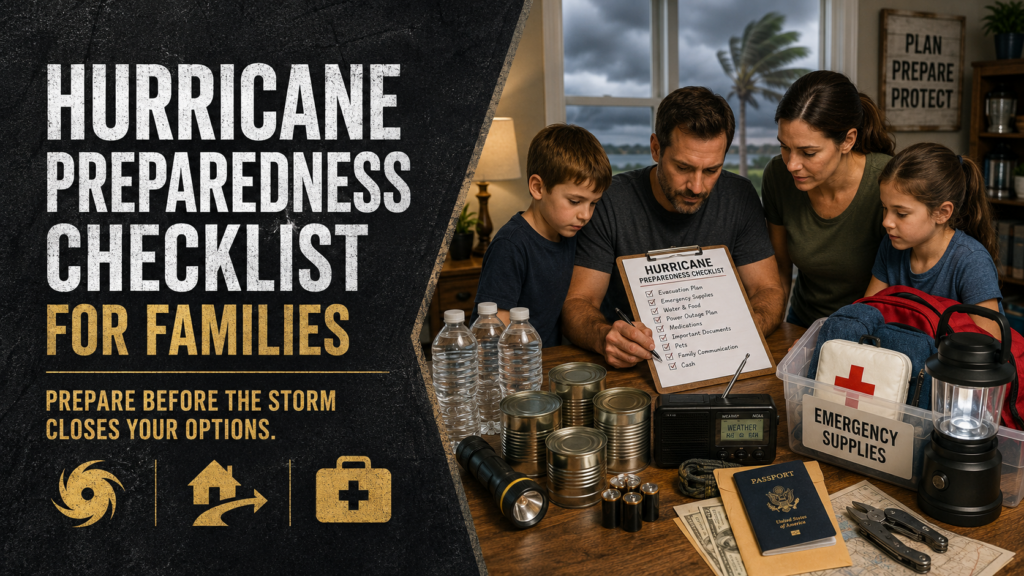
Hurricane Preparedness Checklist for Families: What to Do Before the Storm
A hurricane usually gives you something many emergencies do not: time.
That sounds like an advantage, and it is. But it also creates one of the biggest problems with hurricane preparation.
When a storm is still three or four days away, normal life keeps going. People go to work. Kids go to school. The forecast moves a little east, then a little west. The shelves are still stocked. The gas station looks normal.
So it feels reasonable to wait.
Then suddenly everyone is trying to do the same things at the same time.
Gas lines get longer. Bottled water disappears. Hardware stores get picked over. Hotels fill up. Evacuation traffic starts moving. A decision that was easy yesterday becomes difficult today.
That is why good hurricane preparedness is not mostly about owning more emergency gear.
It is about making important decisions while you still have choices.
Your family should already know whether you may need to evacuate, where you would go, how you will receive warnings, what happens if the power stays out for several days, how pets will travel, and what conditions mean it is time to stop preparing and start acting.
A hurricane warning should not begin your plan.
It should activate one.
1. Know What Can Actually Hurt You
People naturally focus on the hurricane itself.
But a hurricane is really several emergencies traveling together.
Depending on where you live, the main danger could be:
- storm surge
- inland flooding
- flash flooding
- destructive wind
- falling trees
- tornadoes
- extended power outages
- blocked roads
- contaminated water
- disrupted cell service
- closed pharmacies and stores
A family living near the coast may need to think first about storm surge and evacuation.
A family 100 miles inland may never see the ocean rise, but they can still lose power for days, have trees come down across roads, or experience serious flooding.
That distinction matters.
You do not prepare for the word hurricane.
You prepare for the specific failures that hurricane can cause where you live.
Before hurricane season gets busy, find out whether your home is in an evacuation zone or flood-prone area. Learn which roads local officials use as evacuation routes and identify more than one way out.
Do that now, not while a storm is on the map.
Checklist:
- Know whether your home is in an evacuation zone
- Know your local flood risk
- Identify at least two evacuation routes
- Know where your local emergency information is published
- Understand the hurricane hazards most likely at your location
2. Decide What Would Make You Leave
Evacuation becomes harder when the family has not agreed on what would trigger it.
One person wants to leave early.
Another thinks the storm will turn.
Someone else does not want to sit in traffic.
That debate can consume exactly the time you should be using to move.
Your clearest trigger is simple:
If authorities order your area to evacuate, leave.
Your household may also need an earlier trigger if someone requires additional time.
That can include:
- older adults
- infants or young children
- people with mobility limitations
- people dependent on medical equipment
- families without reliable transportation
- households traveling with several pets
- anyone who needs an accessible shelter
Imagine two families living in the same evacuation zone.
One couple can throw two bags into the car and leave in ten minutes.
The family next door has a wheelchair, three children, two pets, medications that need refrigeration, and only one vehicle.
Those families do not really have the same evacuation timeline.
Choose your primary destination before a storm threatens.
Then choose a backup.
That may be:
- a relative’s home
- a hotel
- a public shelter
- another safe location outside the threatened area
Do not build your entire evacuation plan around finding something available after everyone else has begun looking.
For the larger household plan, use the Family Emergency Plan.
Checklist:
- Primary evacuation destination chosen
- Backup destination chosen
- Primary route identified
- Alternate route identified
- Family knows who makes the final leave decision
- Medical and mobility needs addressed
- Pets included in evacuation planning
3. Build Two Supply Systems
A hurricane can put your family in two very different situations.
You may have to leave.
Or you may remain home while electricity, water, stores, roads, and communications stop working normally.
Those situations require different supplies.
A large tote full of canned food is useful at home.
It is not very useful when you are trying to load a car quickly.
Keep a portable go-kit for evacuation.
That should contain things you would regret leaving behind or have difficulty replacing:
- identification
- medication
- important documents
- phone chargers
- power banks
- flashlights
- portable food
- drinking water
- first-aid supplies
- clothing
- hygiene items
- child necessities
- pet supplies
- some cash
Then maintain deeper household supplies for staying home through an outage.
That includes more food, more water, lighting, batteries, sanitation supplies, medications, and whatever your household needs when stores are unavailable.
Your 72-Hour Emergency Supplies Checklist is a good starting point.
For hurricane planning, though, I would think beyond exactly 72 hours.
A major outage does not care when the third day ends.
4. Store Water Before Water Becomes a Problem
Water is easy to ignore because it is normally always there.
Turn the handle and it comes out.
That changes quickly when infrastructure is damaged.
Hurricanes can cause:
- boil-water notices
- power loss at pumping systems
- contamination
- broken mains
- private well failures
- pressure loss
If you use a private well, the connection is especially simple:
No electricity may mean no water.
That surprises people because the well itself is still full.
The pump simply cannot move the water.
Store drinking water before a storm is close enough to create a buying rush.
Use food-safe containers and keep them away from gasoline, chemicals, pesticides, or anything with strong fumes.
Several smaller containers are often better than one enormous container. They are easier to carry, easier to rotate, and one failure does not ruin your entire supply.
Your broader water system is covered in Household Water Storage That Still Works When the Tap Stops.
Checklist:
- Drinking water stored
- Water included for pets
- Portable water available for evacuation
- Containers are food-safe
- Backup water-treatment method available
- Well-dependent household has a power-loss plan
5. Assume the Power Outage May Last Longer Than You Want
The first hour without power usually feels manageable.
The refrigerator is still cold.
The phones still work.
The house still feels normal.
The real difficulty begins later.
By the next day, batteries are lower. Food is warming. The house may be hot and humid. Cell service may be unreliable. Fuel may be difficult to find.
Before the storm arrives:
- charge every phone
- charge every power bank
- test flashlights
- replace weak batteries
- test the weather radio
- fuel vehicles
- locate extension cords
- freeze containers of water to help maintain freezer temperature
- prepare generator equipment if you use it
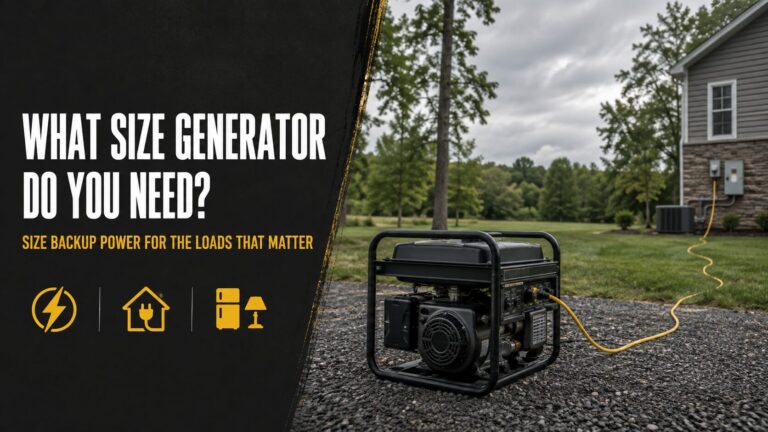
If you own a generator, decide what you are actually trying to power.
A refrigerator, freezer, sump pump, lights, medical equipment, and an entire central air-conditioning system are very different loads.
The guide What Size Generator Do I Need for a Power Outage? walks through that calculation.
And one rule is not negotiable:
Never operate a portable generator inside a house, garage, basement, shed, or enclosed space.
The storm is dangerous enough without adding carbon monoxide poisoning to it.
6. Walk Outside and Look for Tomorrow’s Debris
A surprisingly useful hurricane-preparation exercise is simply walking around your property.
Look at everything and ask:
What happens to this if the wind gets much stronger?
That patio chair is heavy on an ordinary afternoon.
It may not behave that way in hurricane-force wind.
Bring in or secure:
- patio furniture
- umbrellas
- grills
- trash cans
- toys
- tools
- lightweight planters
- bicycles
- lawn decorations
- loose building materials
Check gutters and drainage while it is still safe.
If you use shutters or pre-cut window panels, make sure you know which panel goes where.
A pile of unlabeled plywood in the garage is not much of a system when rain has already started.
Photograph the outside and inside of your home before the storm.
You are creating a simple record of what existed before any damage occurred.
That is one of those jobs that feels unnecessary right up until the moment you need it.
7. Do Not Depend on One Warning System
Phones have made emergency warnings much easier to receive.
They have also made it easy to forget that a phone depends on several other systems continuing to work.
Power.
Cell towers.
Internet connections.
Chargers.
Networks that are not overloaded.
Use overlapping warning methods.
That may include:
- Wireless Emergency Alerts
- local emergency-management alerts
- NOAA Weather Radio
- trusted weather apps
- local television
- local radio
Keep important phone numbers written down somewhere.
If family members may be separated, designate one person outside the affected area as the household contact.
Your Emergency Communication Plan can help organize that.
Signals Most People Ignore
The storm does not have to be at your doorstep for conditions around you to start changing.
Watch for smaller signals:
- gas stations becoming unusually busy
- bottled water disappearing
- hardware-store shelves thinning out
- schools announcing closures
- local shelters opening
- evacuation zones expanding
- utilities bringing in outside crews
- flood-prone roads being discussed by officials
- hotels filling outside the immediate danger area
One signal by itself does not tell you much.
Several at once tell you something important:
the community is beginning to shift from normal life into emergency response.
That is when your small preparation jobs should already be finished.
8. Give Children Simple Jobs and Simple Rules
Children do not need a complicated hurricane plan.
They need a few things they can remember.
Teach them:
- Stay with the family.
- Do not go outside during the storm.
- Stay away from windows.
- Bring only the item assigned to you.
- Follow the evacuation plan when told.
- Do not hide during an emergency.
A younger child might be responsible for carrying one small backpack.
An older child might make sure a phone power bank is packed.
Simple responsibility can reduce fear because the child knows what he or she is supposed to do.
If schools or childcare facilities may still be operating as weather approaches, know their emergency and release policies in advance.
Do not wait until the school sends an urgent message to figure out the plan.
9. Prepare Pets Before They Know Something Is Wrong
Animals often notice unusual weather, pressure changes, alarms, and household stress before people realize how much their behavior has changed.
A calm dog can suddenly hide.
A cat that normally comes when called may disappear under furniture.
That is why pet preparation belongs before the evacuation decision.
Have ready:
- carrier
- leash or harness
- pet food
- water
- bowls
- medication
- veterinary records
- identification
- waste supplies
Make sure tags and microchip information are current.
And confirm that your intended evacuation destination accepts pets.
A plan that ends with “we’ll figure out the dog when we leave” is not finished.
10. Treat Medical Needs as Core Emergency Equipment
Medication is not an accessory to the emergency plan.
Neither is medical equipment.
Keep a current written list of:
- medication names
- dosages
- allergies
- prescribing physician
- pharmacy information
- important medical conditions
Know what requires electricity.
That could include:
- oxygen equipment
- CPAP
- powered mobility devices
- refrigerated medication
- feeding equipment
- other medical devices
If losing power creates a medical emergency for someone in your household, that should influence your evacuation decision.
Do not wait for the electricity to fail before discovering how long backup batteries last.
11. Never Treat Floodwater Like a Puddle
Floodwater creates a dangerous illusion.
You can see the road continuing on the other side, so it feels as though the road must still exist underneath the water.
Sometimes it does not.
Water can hide:
- washed-out pavement
- missing road shoulders
- deep holes
- debris
- strong current
- downed electrical lines
Do not drive around barricades.
Do not assume a road is safe because you know it well.
A hurricane can change a familiar road in a few hours.
Avoid walking through floodwater too.
It can contain sewage, fuel, chemicals, sharp metal, broken glass, and electrical hazards.
12. Know Where to Shelter Inside — and When Not To
If you are remaining home and flooding is not the primary danger, identify the safest interior location available.
Generally, that means a sturdy interior area away from windows.
A smaller room with more walls between you and the outside usually offers more protection from flying debris than a large room surrounded by glass.
But hurricane planning has one complication that tornado planning does not always have:
the best place for wind may be the wrong place for flooding.
A basement may protect you from wind.
A basement filling with water is another emergency entirely.
That is why you must understand the primary hazard where you live.
If authorities order evacuation because of storm surge or flooding, the safest room in your house may not matter.
Your safest place may be somewhere else.
13. Finish the Last Jobs Before They Become Dangerous Jobs
There is a point where hurricane preparation should stop.
That point is earlier than many people think.
Finish these while conditions are still safe:
- fuel vehicles
- charge devices
- bring loose outdoor items inside
- fill clean water containers
- check evacuation information
- protect important documents
- prepare medication
- bring pets inside
- move vehicles away from obvious flood hazards where practical
- tell your out-of-area contact your plan
Then simplify.
Do not be the person on a ladder trying to attach something to the house after dangerous wind has already arrived.
Preparation is useful only while the preparation itself remains safe.
14. When the Power Goes Out
When electricity fails:
- Make sure everyone is safe.
- Use flashlights or headlamps.
- Keep refrigerator and freezer doors closed.
- Put phones in low-power mode.
- Preserve batteries for communication.
- Continue monitoring official information.
- Watch for water entering the home.
- Keep children and pets away from damaged areas.
- Use generators only in their safe outdoor location.
- Assume conditions may worsen again.
Do not use grills, charcoal, camp stoves, or generators inside.
And do not assume a sudden quiet period means the storm is finished.
Hurricanes can change character quickly.
15. Do Not Turn the Aftermath Into a Second Emergency
When the wind finally becomes quiet, people want to go outside.
That is understandable.
It is also when a different group of hazards appears.
Once officials indicate it is safe:
- wear sturdy shoes
- wear work gloves
- stay away from downed wires
- avoid damaged trees
- avoid unstable structures
- photograph damage
- report utility hazards
- monitor continuing warnings
- keep children away from debris
Be especially careful with chainsaws and power tools.
Cleanup injuries are common because people are tired, hot, stressed, and working around unstable material.
If you smell gas or suspect a leak, leave the area and follow utility or emergency instructions.
Do not create flames or sparks.
The hurricane may have passed.
The emergency may not have.
Key Takeaways
- Hurricane preparation works best when major decisions are made before the forecast becomes urgent.
- Know whether your household may need to evacuate and decide where you would go.
- Prepare separate supplies for evacuation and for staying home through an extended outage.
- Plan for failure of electricity, water, communications, fuel access, pharmacies, and stores.
- Include children, pets, medications, mobility needs, and medical equipment in the main plan.
- Use several warning methods instead of depending entirely on your phone.
- Understand whether wind, flooding, storm surge, or another hazard is the greater threat where you live.
- The last hours before a hurricane should be spent carrying out a plan, not inventing one.
Step-by-Step Actions
- Check whether your home is in a hurricane evacuation or flood-risk area.
- Choose a primary evacuation destination and a backup.
- Identify at least two evacuation routes.
- Decide what conditions will trigger your family to leave.
- Build a portable evacuation kit.
- Build deeper household reserves for an extended outage.
- Store drinking water for people and pets.
- Establish at least two independent emergency-warning methods.
- Write important family contacts on paper.
- Prepare pet carriers, leashes, food, medication, and identification.
- Test flashlights, radios, power banks, and generator equipment.
- Identify medical devices that depend on electricity.
- Walk around the property and identify loose items that need to be secured.
- Photograph the home and major possessions.
- Review the plan with the household before a storm threatens.
Hurricane Preparedness Checklist
Evacuation
- Evacuation zone checked
- Flood risk checked
- Primary destination selected
- Backup destination selected
- Two routes identified
- Evacuation trigger understood
- Vehicle fueled
- Local shelter information known
Emergency Supplies
- Drinking water
- Nonperishable food
- Manual can opener
- Flashlights/headlamps
- Spare batteries
- NOAA Weather Radio
- First-aid supplies
- Essential medications
- Phone power banks
- Hygiene supplies
- Sturdy shoes
- Work gloves
- Cash
- Important documents protected
Communication
- Wireless Emergency Alerts enabled
- Local emergency alerts enabled
- Weather radio tested
- Out-of-area contact chosen
- Important phone numbers written down
- Family meeting locations established
Home
- Outdoor furniture secured
- Loose yard items removed
- Gutters and drainage checked
- Window-protection plan ready if applicable
- Property photographed
- Generator positioned for safe outdoor use if needed
- Refrigerator/freezer plan reviewed
Family
- Children understand the plan
- Older adults included
- Mobility needs included
- Medications ready
- Medical equipment backup addressed
- School/work procedures understood
Pets
- Carriers accessible
- Leashes/harnesses ready
- Food and water packed
- Medication packed
- Identification current
- Pet-friendly destination confirmed
Final Check
- Everyone knows when the household will leave
- Everyone knows where to shelter if staying
- Go-kit is accessible
- Phones and power banks charged
- Vehicles fueled
- Official forecasts being monitored
- Preparation will stop before conditions become dangerous