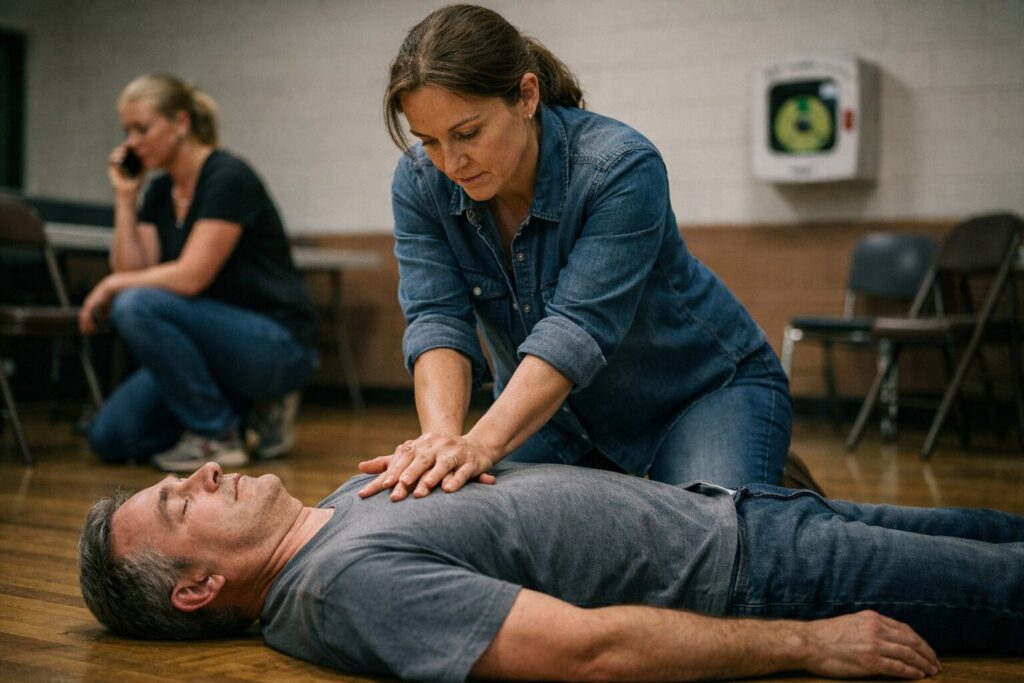
Sometimes a life comes down to a few quiet minutes.
Not dramatic minutes. Not movie scenes with shouting and chaos. Usually the opposite. Someone collapses. People look at each other. A strange pause fills the space while everyone tries to understand what just happened.
And the clock is already moving.
When the heart stops beating in a way that actually moves blood, oxygen stops reaching the brain. The brain really doesn’t like that. Permanent damage can begin in four to six minutes, sometimes sooner depending on the situation. Emergency services, even when things go smoothly, often take longer than that to arrive.
That gap between collapse and professional care is where CPR basics sits. Not really as a medical specialty. Just something ordinary people can do long enough to keep oxygen moving around the body.
That’s the real point of it. CPR doesn’t usually restart a heart the way movies show it. Most of the time it simply keeps blood circulating manually until defibrillation or more advanced care becomes available. It buys time. Sometimes only a little. Sometimes enough.
And more often than people think, that time matters.
Recognizing When CPR Is Needed
Cardiac arrest can look a little different depending on the person and the situation. But a few signals show up pretty regularly.
Someone suddenly collapses or becomes unresponsive. They don’t react when you speak loudly or shake their shoulders. Breathing might be absent, or it might look strange—gasping, irregular, shallow, something that just doesn’t look right.
Those gasping breaths confuse people sometimes. They’re called agonal respirations. They look like breathing at first glance, but they aren’t effective breathing. If someone is unconscious and only gasping occasionally, it’s treated the same as not breathing.
The decision point needs to stay simple.
Unresponsive. Not breathing normally.
Start CPR.
People hesitate here sometimes because they’re worried about being wrong. That hesitation is understandable. Still, the risk usually runs the other direction. If someone actually needs CPR, doing nothing for several minutes is far more dangerous than starting compressions unnecessarily.
The body can tolerate compressions reasonably well. The brain, on the other hand, does not tolerate oxygen deprivation for long.
So when in doubt, act.
The First Priority: Call for Help
Before anything else, emergency services need to be on the way.
If other people are around, direct someone specifically. Not a general “someone call 911.” Pick someone and point.
You. Call 911.
It sounds minor, but clear direction prevents that awkward moment where everyone assumes someone else already made the call.
If you’re alone, most modern phones can stay on speaker while you begin CPR. Dispatchers are trained to guide people through it. They do this all the time. Their instructions tend to be calm and straightforward.
That voice on the phone becomes part of the response, even if you never see the person.
Once the call is placed, the real work begins.
Chest Compressions — The Core of CPR
The heart sits between the breastbone and the spine. When compressions are done correctly, pressure on the chest squeezes the heart enough to push blood through the body.
It’s mechanical. Just basic physics, really.
Hands go in the center of the chest, on the lower half of the breastbone. One hand stacked on the other. Fingers interlaced or lifted so the pressure stays on the heel of the hand.
Arms straight. Shoulders directly over your hands.
Then push.
Hard and fast.
The recommended rhythm is about 100 to 120 compressions per minute, roughly the tempo of the song Stayin’ Alive. It sounds like a strange comparison, but the rhythm actually lines up fairly well.
Depth matters too. Adults generally need compressions about two inches deep. That feels forceful, because it is. Light pressure won’t move enough blood to matter.
And here’s something people don’t always realize: CPR is tiring.
After a minute or two, most people start feeling it in their shoulders and arms. That’s normal. Maintaining consistent depth and rhythm is the important part. If multiple rescuers are present, switching every couple minutes can help keep compressions strong.
Another detail that matters—allow the chest to fully recoil between compressions. When the chest rises back up, the heart refills with blood. Without that refill, circulation drops.
Push down. Let up. Push again.
That rhythm continues until help arrives or the person begins breathing normally again.
What About Rescue Breathing?
This part has changed a little over the years.
Traditional CPR included cycles of compressions and breaths—usually thirty compressions followed by two rescue breaths. That method is still taught in full CPR training and still has its place in certain situations.
But many bystanders hesitate because they’re uncomfortable with mouth-to-mouth breathing. That hesitation led researchers to study something interesting.
For adult sudden cardiac arrest, hands-only CPR—continuous chest compressions without rescue breaths—still improves survival compared to doing nothing.
Why? Because the blood already contains oxygen in the early minutes of cardiac arrest. The bigger problem is circulation. Compressions keep that oxygen moving.
So for most adult emergencies outside a hospital, hands-only CPR works reasonably well.
Children and drowning victims are a little different. In those cases oxygen deprivation often causes the arrest, so rescue breaths become more important. But in everyday adult situations—collapse in a store, workplace, sidewalk—continuous compressions are usually the most practical response.
In other words, don’t let uncertainty about breathing stop you from starting compressions.
Movement is better than hesitation.
Defibrillators and Why They Matter
You’ve probably seen them mounted on walls in airports, gyms, or office buildings. Small boxes labeled AED—Automated External Defibrillator.
They’re one of the more useful pieces of public medical equipment around.
Many cardiac arrests happen because the heart falls into a chaotic electrical rhythm. Instead of pumping normally, it quivers. A defibrillator sends a controlled electrical shock that can reset that rhythm.
Think of it like rebooting the heart’s electrical system.
The devices themselves are designed for ordinary people. Open the lid and they begin giving voice instructions. Pads go on the chest. The machine analyzes the rhythm automatically and only delivers a shock if it’s needed.
You can’t accidentally shock someone who doesn’t require it. The device simply won’t allow it.
The combination of early CPR and early defibrillation can improve survival rates quite a bit. Some communities have reported survival rates above 50 percent when both happen quickly.
Which is a big difference compared to waiting for paramedics to arrive before anything starts.
And honestly, a lot of people walk past AEDs every day without really noticing them.
They’re worth noticing.
A Moment I Still Think About
Years ago I watched a situation unfold at a small community event. Nothing dramatic about the setting—just people gathered in a hall, chatting, drinking coffee.
An older man collapsed near one of the tables.
For a second, nobody moved. That frozen moment again. People unsure whether to intervene.
Then a woman stepped forward. No hesitation. She checked for breathing, called out for someone to call emergency services, and started compressions.
Calm, steady rhythm.
Another person ran to grab an AED from the hallway. It arrived maybe two minutes later. Pads applied. Shock delivered.
By the time paramedics arrived, the man had regained a pulse.
The whole thing lasted maybe eight minutes.
What stuck with me wasn’t the medical part exactly. It was the difference one prepared person made. Everyone else cared. They just didn’t know what to do in the moment.
Knowledge turns that moment into action.
A Few Practical Details People Forget
Certain small habits make CPR more effective.
Firm surface matters. If someone collapses on a bed or couch, moving them to the floor helps compression depth. Soft surfaces absorb some of the force.
Kneeling close to the chest keeps your arms vertical, which helps maintain pressure without exhausting your shoulders quite so quickly.
And if multiple people are present, rotating compressors every couple minutes can make a difference. Fatigue sneaks up fast during CPR, and weaker compressions reduce circulation.
Another thing people worry about—broken ribs.
It happens sometimes. CPR applies a fair amount of force, especially in older adults with fragile bones. But in the hierarchy of problems, broken ribs are survivable. Cardiac arrest without circulation is not.
The priority stays the same: keep blood moving.
Training Changes Everything
Reading about CPR helps. Practicing it once or twice changes the experience quite a bit.
Hands learn the pressure. The rhythm becomes familiar. The hesitation fades.
Most CPR certification classes take only a few hours. Community centers, fire departments, workplaces—many offer them regularly. The cost is usually modest, sometimes free.
And the interesting thing is how quickly the knowledge spreads once someone learns it. One trained person often ends up explaining the basics to family members, coworkers, friends.
Preparedness tends to spread like that.
The First Few Minutes Belong to Bystanders
Emergency medicine is incredible. Paramedics bring advanced equipment, medications, and expertise that most of us can’t replicate.
But they arrive later in the timeline.
Those first few minutes belong to whoever happens to be standing nearby when something goes wrong. A stranger. A coworker. A friend. Sometimes just the person who decides to step forward.
That’s really the quiet truth behind CPR.
It’s not heroic in the cinematic sense. Mostly it’s repetitive work. Pressing on someone’s chest again and again while waiting for sirens.
Still, those minutes can hold a life in place long enough for help to take over.
And once you understand how it works, the moment feels less mysterious.
Just pressure, rhythm, and time.