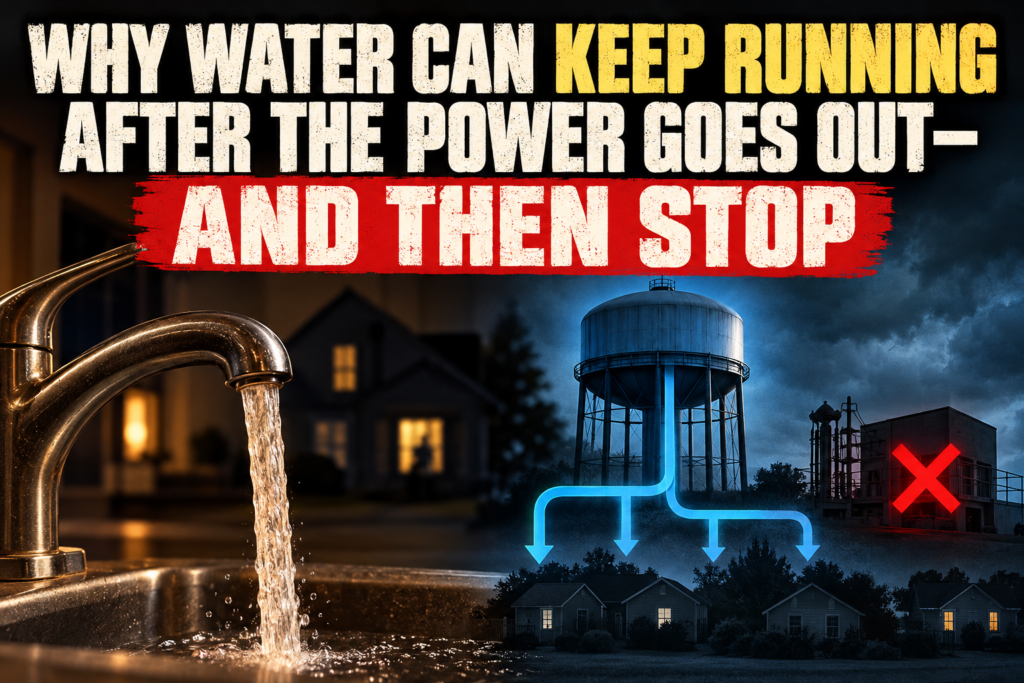
Water pressure during a power outage can be maintained by stored water, gravity-fed storage, or working backup power. It can stop later when those supports are depleted or another part of the system fails.
Your lights and your faucet are not controlled by one switch. The answer depends on the public utility, your building, and any private pump between the source and the tap. Initial flow is useful information, but it is not a promise of continued service or proof of safe water.
What maintains water pressure during a power outage?
A public supply may use pumps, treatment equipment, storage tanks, and different pressure zones. Elevated storage can provide pressure by gravity while pumps are unavailable. Once stored water is used, keeping service going depends on replenishment and the rest of the system.
The Prince George’s County water and sewer plan describes that gravity-storage function in the WSSC system. It illustrates the mechanism; it does not describe every water system or establish how long yours can operate.
Utilities may also have emergency generators. The EPA’s utility generator preparedness guidance treats backup electricity as a planning and maintenance need. Knowing that a utility owns generators is not enough to calculate uninterrupted service at your particular tap.
The building can lose water before the street does
Some buildings depend on electric pumps to deliver water internally. Your local main may remain pressurized while the part of the building serving your home loses its normal supply. NYC Emergency Management’s preparedness guidance specifically tells residents whose buildings use electric water pumps to keep bottled water available.
Ask your building manager which pumps or tanks serve your unit, whether backup power supports them, and where residents receive water-service notices. Do not assume that a lit lobby, an operating elevator, or a neighbor’s working faucet answers those questions.
Do not enter locked plant rooms, open roof tanks, or operate shared valves to investigate. Those are building or utility responsibilities. Your job is to understand the arrangement and keep an accessible household supply.
A private well has its own power dependency
A typical electrically pumped private well cannot keep pumping without electricity. Water already in a pressure tank or plumbing may provide limited flow before the faucet goes dry. Ohio’s health department describes this distinction in its private-water-system outage guidance.
The tank’s label is not a reliable measure of how much usable water remains at the moment of an outage. Do not assign a household endurance time from a tank’s overall size. Ask your well professional about your particular equipment and safe backup arrangements.
If flooding, damage, or contamination may have affected the well, restoring electrical power does not settle water safety. Follow local health guidance for assessment, testing, and return to use.
Keep flow and safety as separate questions
A faucet can deliver water during an advisory. It can also begin flowing again before an advisory is lifted. Neither appearance nor normal pressure is a substitute for current utility or public-health instructions.
The CDC distinguishes boil-water, do-not-drink, and do-not-use advisories. Those instructions address different hazards. Do not respond to every warning by boiling water: boiling is not a universal treatment for chemicals or toxins.
| Observation | What it does not establish | Next check |
|---|---|---|
| Water runs after the lights go out | That the supply will last for the whole outage | Utility updates, building pumps and household reserves |
| Pressure drops or flow stops | The cause, affected area, or safety of remaining water | Utility/building notices and any health advisory |
| Water looks clear | That it is free of contamination | The current instructions for your address |
| Pressure returns | That restrictions have ended | An official advisory update and any return-to-use instructions |
If safety is uncertain, use a known-safe stored supply for drinking and food preparation while checking official guidance. Follow the actual notice for uses such as brushing teeth, preparing infant feeds, ice, pets, and washing. Do not rely on a generic internet checklist when local instructions are more specific.
What to do during the outage
Check the provider’s official updates and your building’s notices early. Note the affected area and time of the message. Report an unexplained service loss through the appropriate utility or building channel; a family chat is not a service report.
Conserve water and follow any essential-use restrictions. Do not leave faucets open waiting for service to return. If you store water ahead of a forecast disruption, do so while the supply is known to be safe, using suitable clean containers. A filled bathtub should not be treated as a protected drinking-water reserve.
Plan sanitation separately. The existing article can you flush a toilet during a power outage? explains why wastewater arrangements matter as well as incoming water. A working faucet does not prove that a sewage pump is working.
Prepare without guessing a countdown
Claims that every town has a fixed number of hours of water after a blackout leave out too many variables. Demand, storage, pressure zones, pumps, backup power, damage, and building equipment all affect what happens. Ask your provider about its system, but build a household reserve without relying on an exact failure time.
Use how much emergency water to store to count your household needs. Keep containers where you can actually reach and handle them when elevators or lighting are unavailable.
Before the next outage, write down four things: your water source, any building or private pumps, the official advisory channel, and the location of your known-safe reserve. That is a stronger starting point than testing one faucet and assuming the water problem is solved.
Water is one example of electricity supporting a service that does not look electrical. The Power Grid Collapse Survival System connects that dependency with food, communication, sanitation, and the rest of the household plan.