
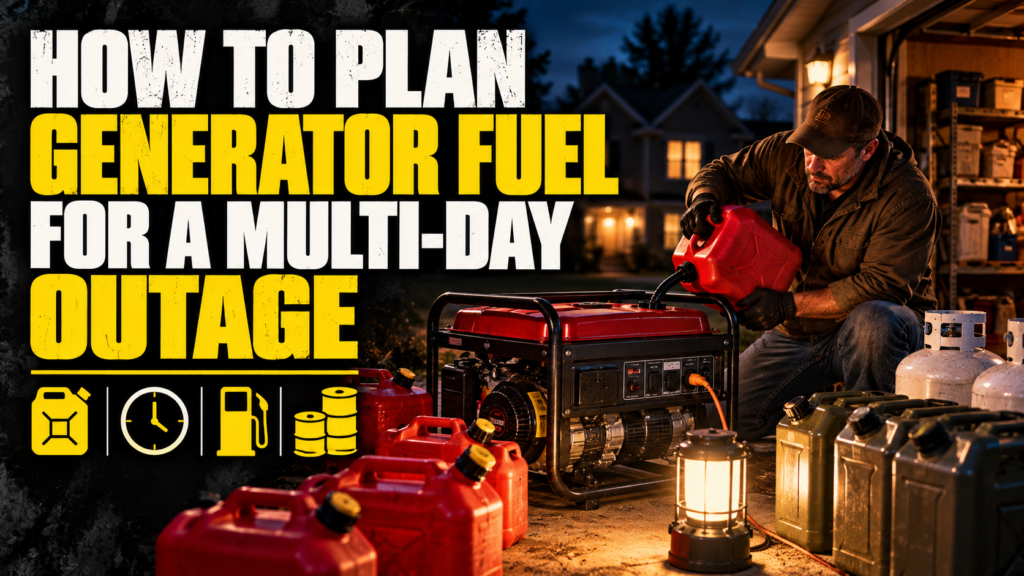
Generator fuel planning starts with the hours you intend to run the machine, the load it will carry, and its documented fuel use at that load. “Three days of fuel” means very little until you know whether that means six operating hours or seventy-two.
Work backward from the jobs that need electricity. Then calculate a fuel estimate, test the assumptions, and decide what happens when the fuel or safe operating time runs out. A longer shopping list of gasoline cannot fix a generator that has nowhere safe to run.
Separate electrical capacity from fuel endurance
Generator sizing asks whether the equipment can start and run your selected appliances. Fuel planning asks how long you can supply that electricity. You need both answers. A machine with enough wattage may still have a short useful operating window.
If you have not chosen your essential loads, start with what size generator you need for a power outage. Return here with the actual model, its manual, and the appliances you plan to support. Do not use a different generator’s fuel numbers because its advertised wattage looks similar.
Make an operating schedule before calculating gallons
Write down what needs power, when it needs power, and what would make an interruption unacceptable. Phone charging can usually fit into a planned window. Other equipment may need a different arrangement. A generic twelve-hour schedule is not proof that a refrigerator will maintain safe food temperatures, that a pump will meet demand, or that medical equipment has adequate backup.
| Planning item | Record this | Why it changes the answer |
|---|---|---|
| Essential jobs | Appliances and the service each provides | It gives you something to prioritize when fuel gets tight. |
| Operating windows | Hours per day, including overlapping jobs | An outage day is not automatically twenty-four engine hours. |
| Expected load | Which appliances will operate together | A light-load runtime claim does not describe a heavily loaded machine. |
| Fuel evidence | Exact model, fuel type, tank capacity, stated load and runtime | It keeps the calculation tied to equipment you actually own. |
| Interruption plan | Cooldown, refueling, maintenance and an alternative for critical needs | Fuel in a container does not create uninterrupted service. |
For a simple planning example, twelve operating hours per day over three days equals 36 operating hours. That is just arithmetic. Whether those hours can meet your household’s needs is a separate question.
Use the load stated beside the runtime
Manufacturer runtime figures are conditional. Keep the load description attached to the number when you copy it into your notes. “Up to eight hours” with the qualifying words removed is a poor planning input.
For example, Honda’s U.S. EU2200i specifications, checked in October 2026, list a 0.95-gallon tank and runtimes of 8.1 hours at one-quarter load and 3.2 hours at rated load. These figures illustrate the calculation; they are not a recommendation to buy this model.
Estimated fuel per hour = tank capacity ÷ stated runtime.
Estimated total fuel = estimated fuel per hour × planned operating hours.
| Published condition | Calculation | Fuel estimate |
|---|---|---|
| One-quarter load | 0.95 ÷ 8.1 × 36 | About 4.2 U.S. gallons |
| Rated load | 0.95 ÷ 3.2 × 36 | About 10.7 U.S. gallons |
The difference is large enough to change a household plan. Neither result is a promise about your actual appliances, weather, equipment condition, or usable fuel supply. Nor is this table permission to store that quantity at your property. Storage rules and safe space may put a lower limit on what is practical.
Do not draw a straight line between the two runtime figures and treat every intermediate load as a verified result. Use the manufacturer’s applicable data and a safe trial of your intended setup to refine the estimate. Do not assume the lower figure will cover a day with heavier demand.
Test the plan while a failed assumption is still manageable
Before an outage, follow the manual and test the equipment with the loads and connections you intend to use. Record the model, operating hours, appliances used, and fuel added under safe refueling conditions. Repeat observations are more useful than remembering that one tank “lasted most of the afternoon.” Do not improvise a fuel-level test on a running or hot machine.
Also record the jobs you could not complete. Did charging everything at once conflict with another appliance? Was someone available to handle shutdown and refueling? Did the planned site remain safe and usable? Those findings may change the operating schedule more than the gallon estimate.
Do not turn an estimate into an exact countdown. Keep room for uncertainty in both fuel use and outage duration. Choose a review point early enough to change plans, rather than waiting for the engine to stop. There is no single reserve percentage that guarantees success for every household.
Decide what happens if the next fuel trip fails
Treat replenishment as a separate dependency. A station being nearby does not establish that it will be open, powered, supplied, accessible, or able to take payment during your outage. Before relying on a refueling stop, check whether gas stations can operate during a power outage.
Write a primary plan using fuel already available to you, then a separate replenishment option that must be checked when needed. Avoid silently counting a future purchase as fuel already secured.
If the calculated amount exceeds what you can safely store or afford, revise the service plan. Reduce discretionary loads, use existing battery devices for suitable small jobs, or arrange another place to meet needs that cannot tolerate interruption. A life-critical electrical need deserves a plan agreed with the equipment supplier and care team before an emergency.
Keep storage and operation inside safe limits
The Consumer Product Safety Commission’s generator guidance calls for outdoor operation at least 20 feet from the home, with exhaust directed away from nearby buildings. Never run a generator in a home, basement, shed, or garage. Shut it down and let it cool before refueling. Maintain working battery-powered or battery-backup CO alarms as directed.
Check the manual for fuel requirements, maintenance intervals, and storage procedures. Ask your local fire authority about the permitted amount and location for stored fuel, and use containers intended for that fuel. Do not assume an apartment, attached garage, or utility room offers a suitable storage location.
If your property cannot provide a safe operating site, changing the fuel calculation will not solve the problem. Choose a different backup arrangement. Follow the equipment’s connection instructions; do not improvise a way to feed power through a household outlet.
Record your generator fuel planning assumptions
Record these six lines: exact generator model; selected loads; planned operating hours; fuel-use evidence and its load condition; fuel actually available; and the decision point for reducing demand or using another arrangement. Add the date of the last practical test.
That note should explain what the household can support and for how long under stated assumptions. It is more useful than a container marked “emergency gas” with no connection to a working schedule.
Generator fuel is one part of a longer outage plan. Water, food, communication, sanitation, and safe living conditions may still need independent backups. The Power Grid Collapse Survival System brings those household dependencies into the broader preparedness plan.