How Long Will Food Last in the Fridge Without Power?
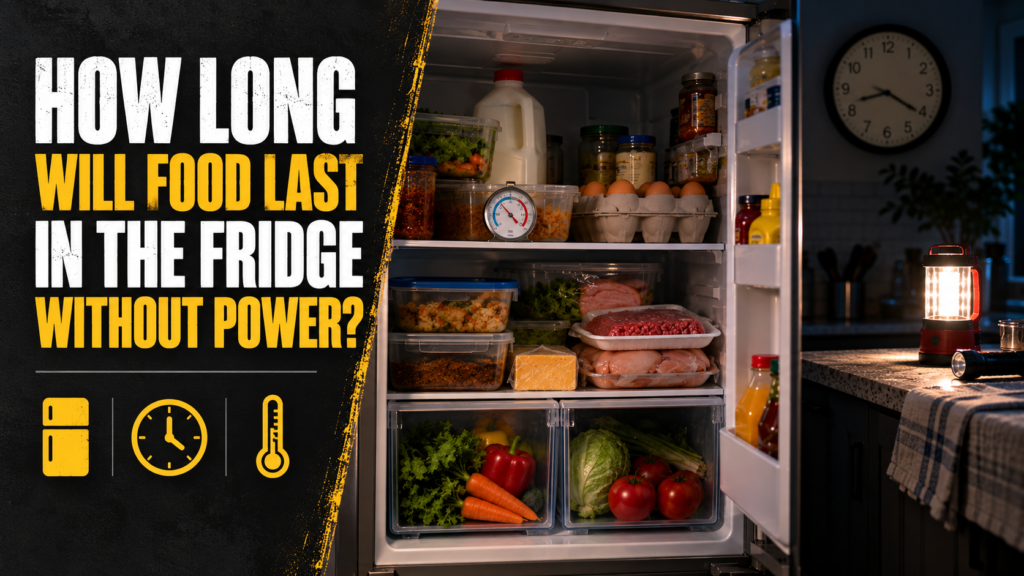
When the power goes out, leave the refrigerator and freezer shut. That simple move buys you time. A refrigerator that stays closed can generally keep food cold for about 4 hours. A full freezer can hold its temperature for about 48 hours, while a half-full freezer is closer to 24 hours. Those numbers are useful, but they are not expiration dates. They tell you roughly how long the appliances can hold cold. Whether a particular food is safe depends on what temperature it reached, how long it was warm, and, for frozen food, whether ice crystals remain. That distinction keeps you from making both common mistakes: throwing away good food just because the clock crossed a line, or keeping questionable food because it still looks and smells normal.
Remember 4 / 48 / 24
For outage planning, start here:
- Refrigerator, unopened: about 4 hours.
- Full freezer, closed: about 48 hours.
- Half-full freezer, closed: about 24 hours.
Every unnecessary door opening spends some of that cold reserve. If the power has been out for an hour, opening the refrigerator every 15 minutes to see whether the milk still feels cold works against you. An appliance thermometer is far more useful. Under normal conditions, keep the refrigerator at 40°F or below and the freezer at 0°F or below. During an outage, those thermometers give you evidence instead of a guess. The important point is this: 4/48/24 describes the appliance. Time and temperature decide the food.
Use the COLD Rule
When you are deciding what to do, use COLD: C — Closed. Keep the doors shut until you have a reason to open them. O — Observe. Check appliance or food temperatures when you can do so without repeatedly dumping cold air. L — Limit assumptions. “It feels cool,” “it smells fine,” and “it was frozen this morning” are not measurements. D — Decide. Use the actual time, temperature, and condition of the food to make the keep-or-discard call. It is a small framework, but it keeps the order right. Protect the cold first. Gather information second. Decide after that.
The Refrigerator: Four Hours Buys You a Decision Window
Federal guidance says refrigerated food should generally remain safe through a power outage lasting about 4 hours if the refrigerator stays closed. If you are getting close to that point and restoration is uncertain, stop treating the refrigerator as your only cold source. Put the perishables you most want to save—meat, poultry, fish, milk, eggs, leftovers and similar foods—into a cooler with enough ice or frozen gel packs to keep them at 40°F or below. Do that while the food is still cold. Waiting until the refrigerator has already warmed gives the cooler a harder job. When power returns, check temperatures promptly, before the refrigerator has had time to cool everything again. FDA guidance says refrigerated perishables that have been above 40°F for 2 hours or more should be discarded. If food has actually been sitting at room temperature, the usual limit is 2 hours, shortened to 1 hour when the surrounding temperature is above 90°F. That does not contradict the 4-hour refrigerator guidance. They answer different questions. Four hours is the approximate cold-holding window of a closed refrigerator. Two hours applies when you know a perishable food itself has been above 40°F. If you do not know how long a questionable perishable was warm, do not taste it to settle the argument.
The Freezer Gives You More Time
A closed freezer usually gives you a much larger buffer. A full stand-alone freezer can hold temperature for about 48 hours; a half-full one, about 24 hours. USDA notes that a refrigerator-freezer compartment may not hold frozen food as long as a stand-alone freezer. Here the clock is only the first clue. When power returns, check the freezer thermometer before the unit has much time to cool again. If it reads 40°F or below, the food may be refrozen. If you do not have a thermometer, look at the food itself. Frozen food that still contains ice crystals may be refrozen or cooked. Food measuring 40°F or below may also be refrozen or cooked. Quality can decline after thawing and refreezing, but softer texture or some flavor loss is different from a food-safety failure. What you should not do is replace the temperature check with a sniff test.
When the Outage Is Going to Last
A long outage changes the job. You are no longer waiting for the refrigerator to come back on; you are managing a limited supply of cold. Start with the refrigerator. Move the perishables worth saving into an iced cooler before the refrigerator loses its cold-holding window. Keep the cooler at 40°F or below and open it only when needed. Leave the freezer alone as much as possible. If you need something, decide what you want before opening the door and make one quick trip instead of browsing. Then reduce demand on both. Eat shelf-stable food and save the remaining cold for food that actually needs it. If your pantry is thin, Best Foods to Stockpile for an Emergency is a useful place to build that buffer. Food is only one part of a blackout. Preparing for Power Failures Before the House Starts Feeling Smaller covers the broader household problem. If you are considering backup electricity, What Size Generator Do I Need for a Power Outage? helps you work out the load before buying equipment.
Picture a 10-Hour Outage
The power fails at noon. At 3:30 p.m., there is still no reliable restoration estimate, and the refrigerator has stayed closed. This is the useful decision point. Instead of waiting for the four-hour mark to pass, you load an iced cooler with the meat, milk, eggs, leftovers and other perishables you want to protect. You keep the cooler at 40°F or below. The freezer stays shut. Power finally returns at 10 p.m. Now resist the temptation to say, “The refrigerator feels cool, so everything must be fine.” Check temperatures promptly and account for any known time the food spent above 40°F. Treat the freezer separately. Food that still has ice crystals or measures 40°F or below can be refrozen or cooked. If you are unsure what matters, ask three questions:
- How long was the power out?
- What temperature did this food reach, and for how long?
- If it was frozen, does it still have ice crystals or measure 40°F or below?
That is a better decision tool than trying to memorize a huge discard list while the lights are out.
A Few Things That Do Not Work
Do not taste questionable food to decide whether it is safe. Do not assume cooking can rescue food that spent too long inadequately refrigerated. Some hazards are not solved simply by heating the food later. Do not put food outside in snow or cold weather and assume you have created a refrigerator. Sunlight, changing outdoor temperatures, animals and contamination make that much harder to control than it sounds. Do not use these food rules for refrigerated medicines or medical products. Follow the product labeling and guidance from the manufacturer, pharmacist or appropriate medical professional. And if the outage comes with flooding, treat floodwater as a separate contamination hazard. Keeping food cold does not make flood exposure safe.
Prepare While the Power Is On
You do not need an elaborate system. A few cheap preparations make the next outage much easier to manage:
- Keep an appliance thermometer in both the refrigerator and freezer.
- Have a cooler large enough for the perishables you would realistically try to save.
- Freeze gel packs or containers of water ahead of storm season.
- Keep several shelf-stable meals that require little or no cooking.
- Know where you can obtain additional ice if a prolonged outage is likely.
The goal is simple: preserve the cold you have, measure instead of guessing, and make food decisions from evidence.
Key Takeaways
- Keep refrigerator and freezer doors closed as much as possible.
- Think 4 hours for a closed refrigerator, 48 for a full freezer, 24 for a half-full freezer.
- Those numbers describe cold-holding time, not automatic food expiration.
- Use actual temperature and known warm-exposure time when judging refrigerated perishables.
- Frozen food that still has ice crystals or measures 40°F or below may be refrozen or cooked.
- Smell, appearance and taste do not replace time-and-temperature evidence.
- A thermometer, cooler, ice and shelf-stable meals give you far more options during a long outage.
Step-by-Step Actions
- Record when the power went out.
- Keep the refrigerator and freezer closed.
- Check the outage estimate without opening the appliances just to inspect food.
- If the outage may run beyond about 4 hours, prepare an iced cooler and move refrigerated perishables while they are still cold.
- Keep cooler contents at 40°F or below.
- When power returns, check appliance and food temperatures promptly.
- Evaluate refrigerated perishables using known time above 40°F rather than smell or taste.
- Refreeze or cook frozen food that still has ice crystals or measures 40°F or below.
- Replace used ice and restock your shelf-stable food before the next outage.
Checklist
- Refrigerator thermometer installed: Yes / No
- Freezer thermometer installed: Yes / No
- Refrigerator normally at 40°F or below: Yes / No
- Freezer normally at 0°F or below: Yes / No
- Cooler available: Yes / No
- Ice or frozen gel packs available: Yes / No
- Shelf-stable backup meals available: Yes / No
- Outage start time recorded: Yes / No
- Appliance doors kept closed: Yes / No
- Food temperature checked before keep/discard decisions: Yes / No
- Frozen food checked for temperature or ice crystals: Yes / No
- Questionable food evaluated without tasting: Yes / No