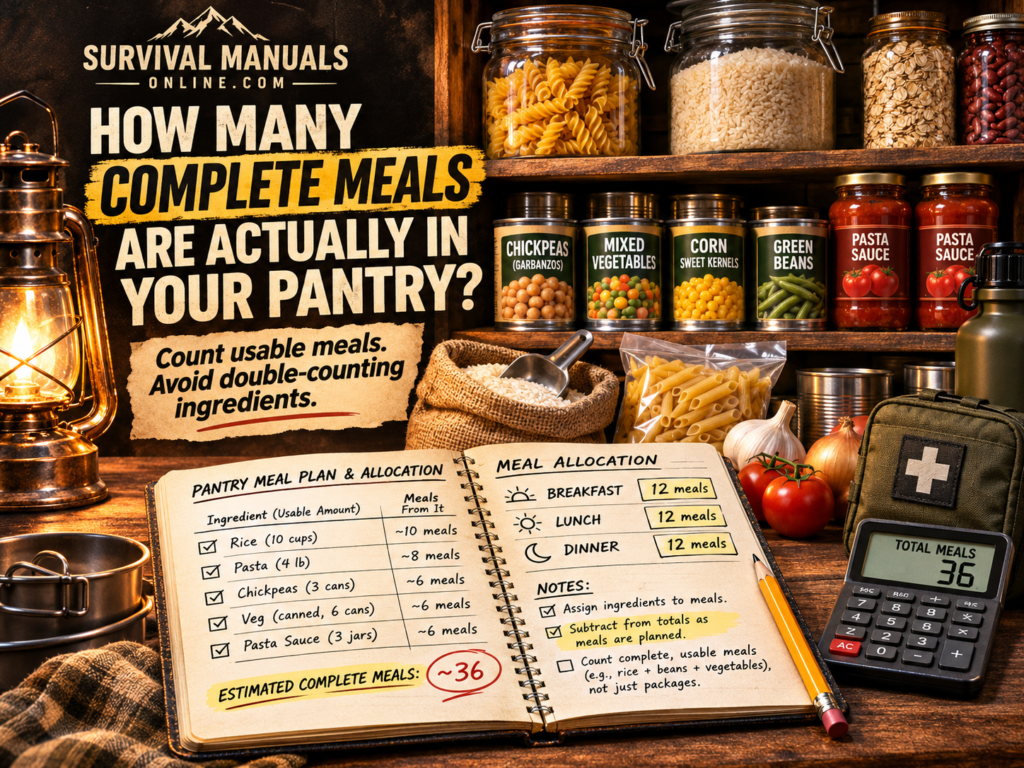
Count meals in your pantry by allocating food to actual dishes, then subtracting each ingredient as you use it. Counting cans or adding every label’s “servings” together will not tell you how many breakfasts, lunches, and dinners your household can make.
The useful result is a short meal schedule backed by food you own and a workable way to prepare it. Here is how to build that count without pretending the same can of beans can feed you twice.
Choose a unit before counting anything
Write down who the plan needs to feed. For this worksheet, a household meal means one eating occasion for everyone included in your plan. Four household dinners for four people are 16 individual dinner portions. They are not four days of food.
Keep breakfast, lunch, dinner, and any necessary snacks separate. If your household normally eats three meals daily, a seven-day schedule has 21 household meal slots to fill. That is a planning convention, not a recommendation that everyone needs the same portions or eating schedule.
“Complete” here means the ingredients and preparation requirements are accounted for. It does not mean a dish automatically supplies everything someone needs nutritionally. Build around meals your household actually eats, including dietary restrictions and the portions people need.
Count meals in your pantry from usable quantities
Record usable quantities, not just package counts. “Three bags of pasta” leaves too much unknown. “600 grams of dry pasta available” is something you can allocate. Note package size and whether the food is already open.
The FDA explains that a package may contain several labelled servings and that serving size is not a recommendation of how much to eat. Use the label to understand the food, then use your real household portions to plan the meal.
Set aside food that is spoiled, damaged, unsuitable for someone’s diet, or unavailable under your planned cooking conditions. Do not give yourself emergency credit for food you cannot safely use.
A worked example: five apparent dinners become four
This is an illustrative inventory, not a menu prescription. Assume the household has already tested these two dishes and adjusted the batch sizes to feed its four members. Replace every quantity with your own recipes and package sizes.
| Ingredient | Available | Dish A: pasta meal | Dish B: rice meal |
|---|---|---|---|
| Dry pasta | 600 g | 300 g per batch | None |
| Sauce | 3 jars | 1 jar per batch | None |
| Chickpeas | 6 cans | 1 can per batch | 2 cans per batch |
| Dry rice | 1,000 g | None | 250 g per batch |
| Vegetables | 6 cans | 1 can per batch | 1 can per batch |
Considered alone, Dish A can be made twice: pasta is the first ingredient to run out. Dish B appears possible three times: chickpeas run out before rice does.
But two plus three is the wrong total. Those calculations both assumed access to the same six cans of chickpeas.
Allocate two pasta meals first. That consumes all 600 grams of pasta, two jars of sauce, two cans of chickpeas, and two cans of vegetables. You now have four cans of chickpeas left. They support two rice meals, not three.
The final allocation is four household dinners: two pasta meals and two rice meals. For this example, that is 16 individual dinner portions. Some ingredients remain, but they do not form another batch of either planned dish.
The arithmetic is simple once the food has jobs. For each dish, divide the remaining amount of each required ingredient by the amount needed per batch. Round down. The smallest result limits how many batches you can make. Subtract that allocation before calculating another dish.
Put meals onto days, not just into a grand total
Now schedule what you counted. A dinner-heavy pantry can look substantial while leaving breakfast and lunch unresolved.
| Meal slot | Dish and portions | Food reserved | Preparation gap |
|---|---|---|---|
| Day 1 breakfast | Your tested household breakfast | Exact quantities deducted from inventory | Water, heat, utensils, or missing ingredient |
| Day 1 lunch | Your tested household lunch | A different allocation, not breakfast’s stock again | Can it be made under outage conditions? |
| Day 1 dinner | Your tested household dinner | Every ingredient required for the batch | What must be solved before counting it as ready? |
Continue until an essential slot cannot be filled. That first gap is useful information. It gives the next shopping trip a specific job instead of another vague instruction to “buy more food.”
Run the count again without your normal kitchen
Mark which meals can be prepared without grid power, which need cooking water, and which create leftovers that need refrigeration. Keep a ready-to-eat layer for times when cooking is impractical. FoodSafety.gov recommends emergency foods requiring little or no cooking, water, or refrigeration and accounting for household dietary needs.
A water-dependent meal does not disappear from the inventory. It moves from “ready” to “conditional” until you have accounted for its preparation. Connect those requirements to your household water plan.
Keep preparation directions with repacked foods. The University of Georgia’s emergency food guidance specifically recommends retaining preparation steps or mixing ratios for staples removed from their original packaging.
Use the gaps to improve the pantry
First buy the missing items that complete useful meals. Then expand the variety and duration. For food selection rather than the arithmetic, use the emergency-food selection guide and Emergency Food Basics.
Keep the ledger in the kitchen and update it when food is used or replaced. Test a planned meal during ordinary life. Check whether the batch really feeds everyone and whether its water, fuel, opening, and cleanup requirements match the plan.
This worksheet solves the food-allocation question. The Food and Supply Chain Collapse Survival System connects that reserve to the larger problem of living without dependable replenishment.
The number worth keeping is not how many packages fill the shelf. It is how many meals you can account for without spending the same food twice.
Sources
- FDA: What’s on the Nutrition Facts Label — labelled servings and actual food portions.
- FoodSafety.gov: Food Safety in a Disaster or Emergency — usable emergency food and preparation constraints.
- University of Georgia Extension: Preparing an Emergency Food Supply — household-specific planning and keeping preparation instructions.