

World War III survival · Civilian household preparedness
World War III Survival System: The war does not have to reach your street to reach your family.
Fuel. Food. Power. Communications. A global war reaches your household through the systems that keep it running. Prepare before distance stops being protection.
Yesterday you watched the war. Today you start living with its consequences.

The first evening
You turn the television down and go back to dinner.
A map. Military movements. An attack overseas. Another place name you have to look up.
The pictures are serious. But the room around you is ordinary. The refrigerator hums. A delivery notification lights up your phone. Someone asks what time you are leaving in the morning.
You follow the story for a while. Then you switch it off.
The war is somewhere else.
That is the assumption holding the whole evening together.
Your household is connected to places you have never been, through systems you have never had to think about.
The first sign at home
The pump price changes before your routine does.
You stop for fuel on the way to work and stare at the total. On the radio, the discussion has moved from troop movements to shipping routes, energy supplies, and disruptions around ports.
You still have to make the drive. Your family still needs groceries. The delivery trucks outside the supermarket still burn fuel.
The conflict has found a route into your life that does not require crossing your border.
It follows the energy supply.
Then it follows the price of everything moved by that energy.
The following week
“Delayed” starts appearing on things your family needs.
At first it is an order you can live without. Then a replacement part. Then a product you buy every week.
Ships reroute. Schedules stretch. Suppliers cannot promise the dates that stores used to treat as routine. Your usual shop has a gap where the familiar brand belongs.
You choose something else. On the next trip, more people are doing the same thing.
The phone keeps showing you maps of distant sea lanes. The shelf in front of you is explaining what those maps mean.
You start thinking about the prescription refill, the vehicle repair, the household supplies that seem unimportant until you cannot replace them.
You are no longer watching the war between errands. You are organizing errands around the war.
The distance keeps shrinking
A conflict overseas becomes
a dependency problem at home.
The grocery store is the last visible link in a much longer chain. Behind the shelf are warehouses, transport schedules, fuel, refrigeration, payments, and people coordinating every step.
A delivery problem becomes a food problem. An energy problem becomes a heating problem. A network problem becomes an access problem.
The military map does not show your kitchen.
But the systems feeding your kitchen run straight through the world on that map.
The conflict reaches infrastructure
Then you cannot reach someone you need.
A call fails. A message stays unsent. You try another app and get the same spinning symbol.
You know where your family should be. You realize that “should be” is not a communication plan.
News of cyberattacks overlaps with service notices and contradictory posts. Some systems have stopped working. Others have been disconnected to keep damage from spreading.
You do not know which interruption ends in an hour and which one changes the week.
At the store, a payment terminal is down. At work, systems are unavailable. The route your phone suggests assumes that the information behind it is current.
Yesterday the war was on television. Today it is changing whether you can pay, travel, communicate, and get everyone home.
Then the house loses power.
You expect the familiar repair estimate. Instead, the explanation is incomplete and the return time keeps moving.
The refrigerator starts warming. The heating or cooling stops. Your phone battery falls while you keep checking for answers.
Somewhere nearby, a business starts a generator. Backup power needs fuel. Fuel needs delivery. Delivery needs working routes and coordination.
You have not escaped the dependency by moving one step down the chain.
The water utility, hospital, pharmacy, communications network, and emergency crews all have their own backups—and their own demands on the same strained supply system.
The word “escalation” stops sounding abstract.
The discussion on the screen changes again. Longer-range attacks. Infrastructure targets. Civil-defense preparations. Nuclear threats.
You look around the house and see questions you have never answered.
Where would everyone go if told to shelter? How would you receive instructions without your usual connection? Where are the family contacts? How long can you manage food, water, sanitation, and essential needs without another trip?
You do not need another hour of arguments about what leaders will do next.
You need a household that can do something useful with the next hour.
The war has not reached your street. It has reached the assumptions that made your street feel safe.
Build the plan on your side of the front door
You cannot move your family outside the supply chain. You can stop leaving every need inside it.
Food you have already organized. Water you have already accounted for. Plans your family has already discussed. References you have already saved and printed.
Those preparations give you a next step when the next delivery, connection, or service becomes uncertain.
The prepared household can focus on changing conditions. The unprepared household has to discover its own weak points while conditions are changing.
One is using a plan.
The other is trying to build one out of battery life, rumors, remaining fuel, and whatever is left on the shelf.
World War III survival begins before the consequences arrive at your door.
Put the knowledge, tools, and household preparation in place while normal life still gives you time to use them.
Prepare for the civilian consequences
The Complete Survival System
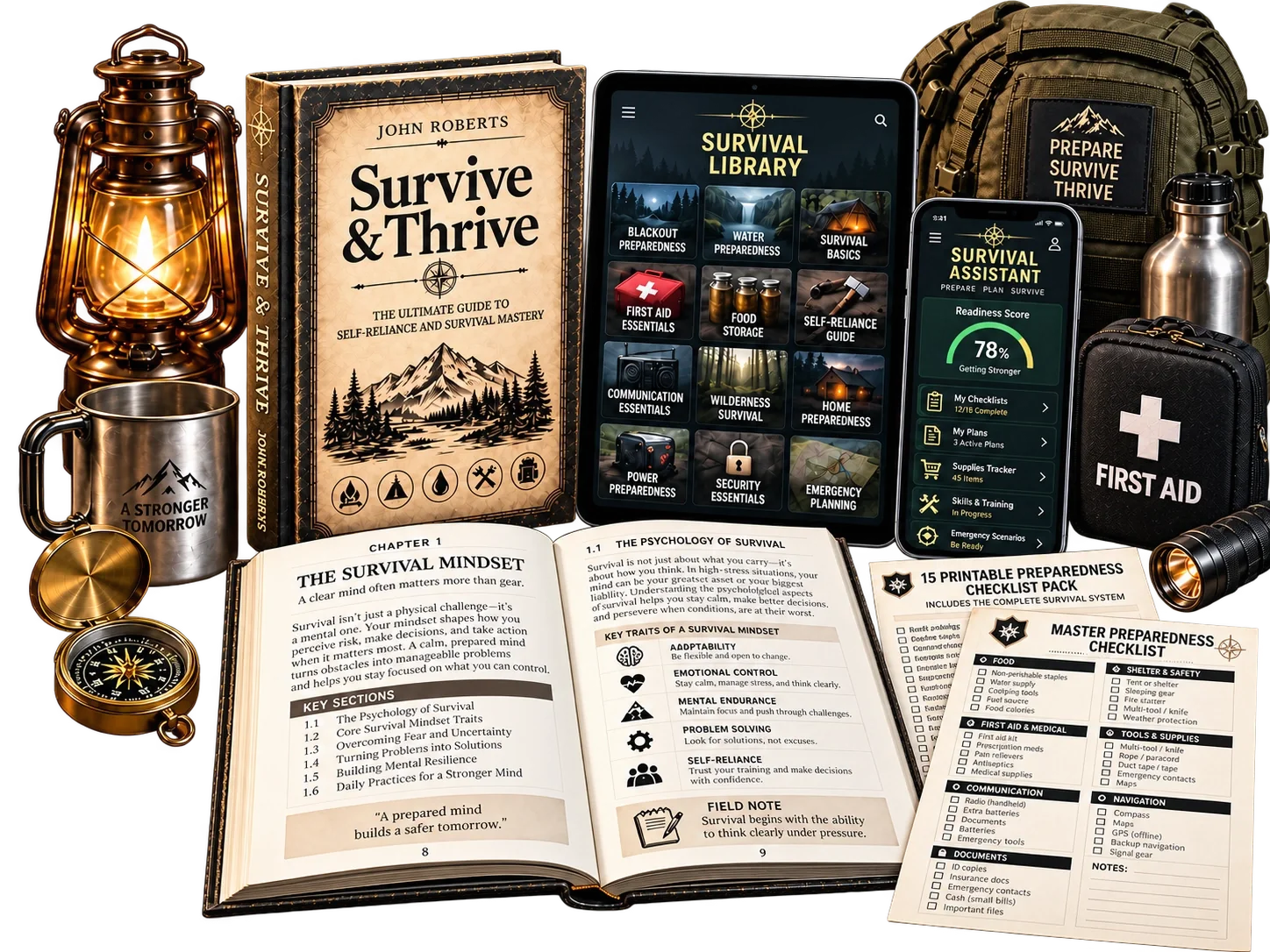
A clear household starting path. Practical checklists. A core survival guide. Deep reference material. An offline-capable app. One organized system for the work that distant headlines cannot do for your family.
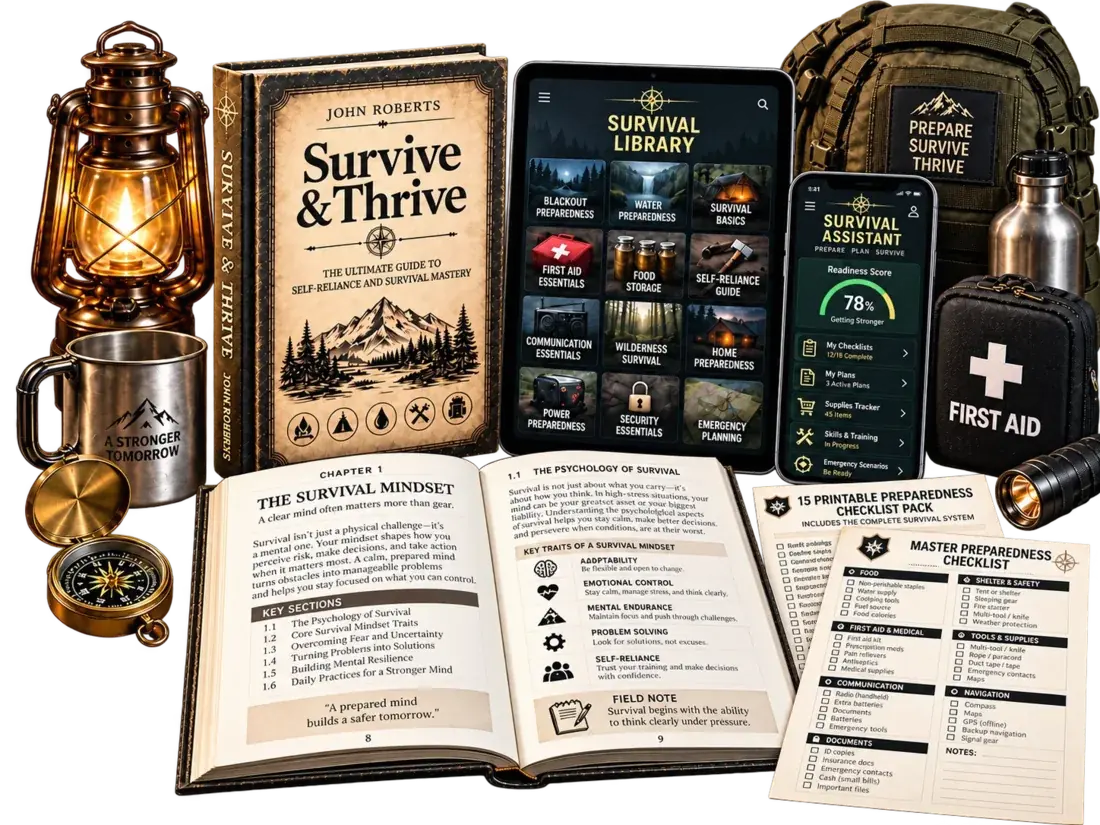
Digital system. Physical gear and printed books shown in the artwork are not shipped.
One purchase · All nine layers
Give your household a next move.
$49.99 USD
One-time payment. Instant digital access. No recurring subscription. Keep the core resource files.
GET THE COMPLETE SURVIVAL SYSTEM
30-day money-back guarantee · Purchase through Gumroad
When global conflict interrupts the services around you, your family still needs meals, safe water, shelter, coordination, and practical judgment. The system gives you a path for building those capabilities before they become urgent.
Start with household readiness. Learn the fundamentals. Find deeper reference when the problem demands it. Keep useful knowledge within reach.
Nine layers. Practical civilian readiness.
Build capability for the needs
that continue through the crisis.
01 + 02 · Start with your household
READ THIS FIRST + Family Ready Quickstart
Turn attention away from the endless feed and toward useful preparation. The orientation and Quickstart give your household a starting path before uncertainty makes everything feel equally urgent.
03 · Put family readiness into action
15 Survival Action Checklists
Review water, blackout, vehicle, evacuation, and family needs. Expose unfinished work while you can still buy supplies, coordinate plans, and correct a gap without fighting the clock.

04 · Learn before pressure takes over
214-page Survive & Thrive
The 17-chapter core guide develops preparedness, self-reliance, practical judgment, and action. Build the foundation behind your decisions before interrupted services turn ordinary household needs into unfamiliar problems.

05 + 06 · Reach beyond the first answer
Guided Library Index + 950+ manuals
Use a problem-first index to reach deeper reference on food, water, first aid, shelter, construction, and self-reliance. Keep breadth behind the household plan as one disruption exposes another.
07 · Keep specialist depth available
Advanced Reference Archive
Historical, military, technical, and specialty material adds deeper study behind the family starting path. Begin with civilian needs and reach further as your practical knowledge develops.
08 · Keep the reference close
Offline-ready resource files
Save guides, checklists, indexes, and manuals on your own devices. Print key plans and references. Keep a layer of knowledge that does not disappear with your next failed connection.
09 · Survival Assistant app included
Your family needs a plan it can find.
The Survival Assistant puts saved household information, supplies, family plans, checklist progress, emergency guidance, and searchable built-in preparedness knowledge on your device.
Review readiness. Work through 15 interactive checklists. Record supplies and calculate household water needs. Save communication and evacuation plans before a failed call turns coordination into guesswork.
The connection can fail.
The preparation does not have to start over.
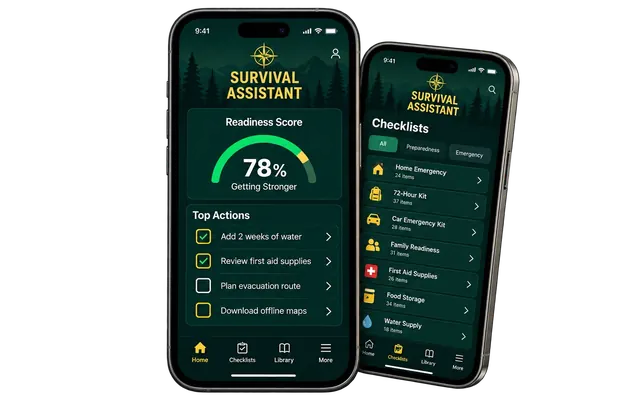
Set up and run the Offline Readiness test before disruption. Save deeper manuals separately, export your household backup, and print essential plans for access without battery power.
Complete system: $49.99 once · offline-capable app included · 30-day guarantee
Watching is not preparation
Knowing the latest development is not the same as knowing what your family will do.
You can recognize every border on the news map and still have no plan for a missed family call, interrupted water service, or three days without your normal kitchen.
You can buy a radio without choosing how your household will use it. You can own a generator without connecting fuel, power priorities, and the rest of the plan.
Gear solves individual problems. Knowledge connects the problems.
“I already follow the news closely.”
Use that awareness to finish household work. The next update cannot store your water, organize your supplies, or make sure everyone knows the family plan. The system puts practical action behind your attention.
“We already have emergency supplies.”
Connect them. Review quantities, locate references, and account for the people who must use them. Food, water, power, mobility, and communication belong in the same household plan.
“There is too much to prepare for.”
Start with needs that remain the same across disruptions. Use the Quickstart and checklists for the next useful step, the core guide for fundamentals, and the index and library for depth.
“I can look up answers when something happens.”
Do the research while the connection works. Keep organized material locally and print what matters. A reference you already have is a different resource from a search you still need to make.
PREPARE BEFORE THE DISTANCE DISAPPEARS
$49.99 one-time purchase · instant digital access · no subscription
Before you get the system
Practical answers for your household.
Is this a separate World War III product?
This page applies the Complete Survival System to the civilian consequences of global war. Your purchase includes the existing nine-layer system described above: the starting tools, core guide, library, app, and offline resource files.
What kind of wartime preparedness is the focus?
Household continuity: food, water, shelter, interrupted services, communication, evacuation readiness, first-aid preparedness, and practical self-reliance. Start with what your family needs to keep functioning when its usual support systems become unreliable.
Does the Survival Assistant work offline?
Yes. Its offline-capable core includes saved household information and plans, checklists, emergency guidance, and searchable built-in preparedness knowledge. Set it up and test offline readiness first. Save deeper manuals separately and print essential plans.
What does it cost, and is there a subscription?
The complete system is $49.99 USD as a one-time purchase, with no recurring subscription and a 30-day money-back guarantee. The downloadable core resource files are yours to keep.
Is a physical kit or printed book shipped?
This is a digital preparedness system with instant access. Save the resource files locally and print the pages you want. Physical equipment and printed books shown in product artwork are not shipped.
Where can I inspect the product before buying?
Review the complete current offer, explore the Survival Assistant’s offline capabilities, and see the Survival Library.
Act while the ordinary world still helps you
You cannot choose how far the conflict spreads. You can choose how much your household leaves undone.
You can keep watching the maps and waiting for a clearer signal to prepare.
Or you can use the time when food still arrives, files still download, fuel is still available, and your family can make decisions around a quiet table.
Count the supplies. Save the references. Build the plans. Learn how the pieces fit together before the next interruption makes you find out the hard way.
The wrong time to discover your family’s weak points is when the world starts pressing on them.
Prepare while the war is still something you can turn off on a screen.
Before the delayed shipment becomes your empty shelf.
Before the failed network becomes your unanswered call.
Before the energy disruption becomes your cold room.
Put your family’s next move in place now.
GET THE COMPLETE SURVIVAL SYSTEM — $49.99
One-time purchase · instant digital access · no subscription
Offline-capable Survival Assistant included · 30-day money-back guarantee
The connections behind the consequences
Why distance does not remove dependency
- International Energy Agency: Energy Security identifies geopolitical risk, cyberattacks, and supply-chain disruption among threats to energy systems.
- UN Trade and Development: Review of Maritime Transport 2024 examines maritime chokepoints and the effects of disrupted routes on shipping costs, food security, and energy supplies.
- CISA: Connected Communities Guidance addresses cyber risks across interconnected essential services.
- NYC Health: Nuclear Incident provides public information on sheltering, communications, and household emergency preparation.